Opus 5.0 Creepy Glitch Remains Unresolved: Reddit Users Demand Answers

A specific prompt triggered creepy Opus 5.0 output, and community inquiries remain unanswered—highlighting model uncertainty and transparency gaps.
The article revisits an AI community anomaly: entering the prompt "see the below---" caused Opus 5.0 to produce unsettling, multilingual-mixed output. A Reddit user asked whether this was ever explained, but no official technical explanation or fix was issued, and discussion stayed sparse. The piece notes such prompt-triggered anomalies aren't isolated—community speculation includes activated training-data patterns, multilingual output drift, and instruction over-interpretation—none confirmed by the developer. The author stresses these cases reveal model behavior boundary uncertainty and product transparency gaps: users want to know not just what happened, but whether anyone is addressing it.
An Unexplained "Creepy" Output
A few months ago, a strange phenomenon involving Opus 5.0 circulated in the AI community: when users entered a specific prompt—reportedly "see the below---"—the model would generate unsettling content, often mixed with other languages. A Reddit user posted asking: "Was there ever an explanation for that creepy Opus 5.0 glitch a few months ago?"
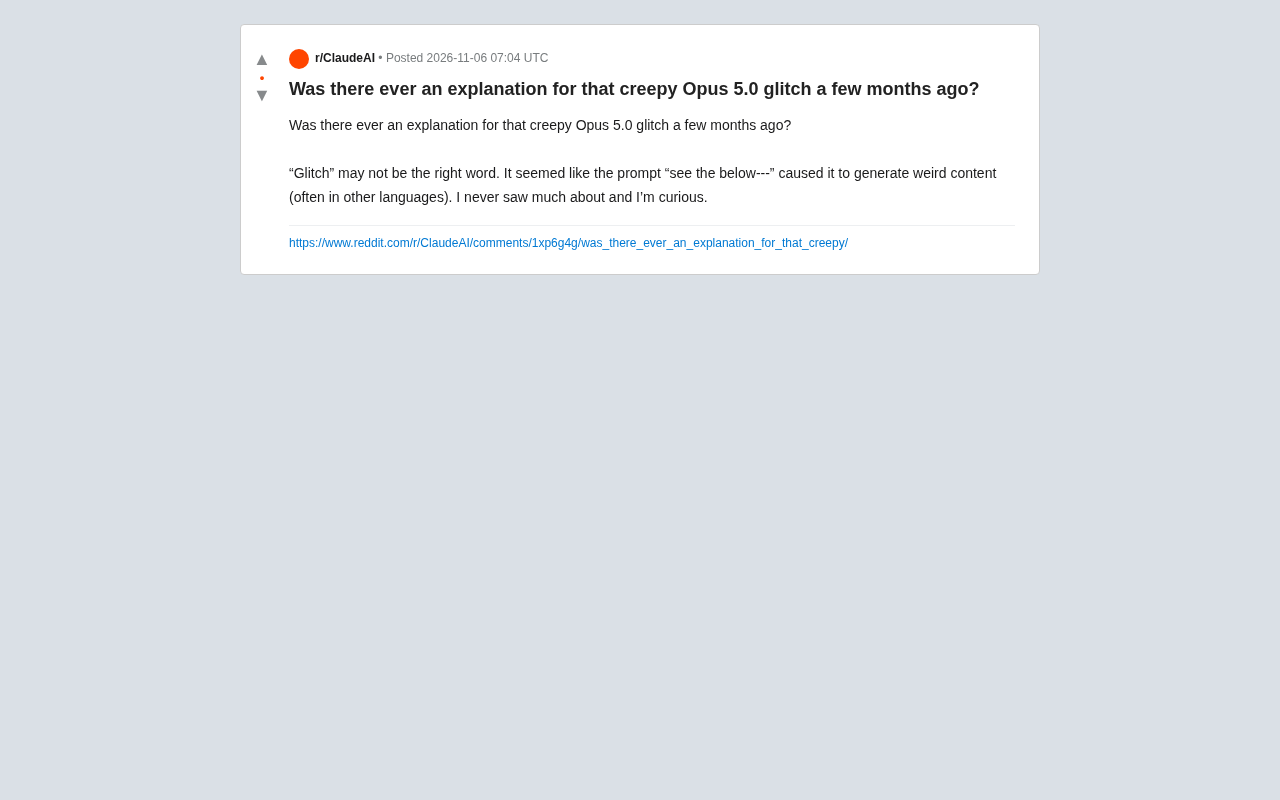
The poster themselves acknowledged that the word "glitch" might not be accurate. It was more like an anomalous behavior pattern that could be triggered by a specific prompt, rather than a random error. After the post went up, no official technical explanation or fix announcement followed, and the discussion remained relatively scattered.
Opus 5.0 is a version designation for a model in Anthropic's Claude family of large language models. In the LLM community, "Opus" typically corresponds to the most capable, largest-parameter tier in the Claude family, alongside the lighter Sonnet and Haiku tiers. In community discussions, users habitually refer to specific model snapshots using a version number plus codename, making it easier to compare behavioral differences across time periods. It's worth noting that model version naming and actual release cadence are controlled by the developer, and the "Opus 5.0" that circulates by word of mouth in the community may not correspond to an official formal name—some discussions may mix different snapshots or rumors. Understanding this helps assess the credibility and spread of such "glitch" rumors.
Prompt-triggered behavior refers to a class of model anomalies that don't occur randomly but are reliably induced by specific inputs. It differs from "glitches" in the traditional sense caused by hardware or software defects: the model itself is running normally, but under specific contexts it enters an unexpected behavior pattern. In research, this phenomenon is often called a close relative of "adversarial prompts" or "jailbreak prompts," with the difference being that the former may not carry malicious intent—it may simply have inadvertently hit a sensitive area in the training data or alignment process.
Gaps and Speculation in Community Discussion
Based on currently available information, public explanations for this phenomenon are virtually nonexistent. The original poster stated "I never saw much about it," which points to a reality: even on Reddit, where the AI community is highly active, such anomalies don't necessarily receive sustained attention or official responses.
This kind of "prompt-triggered anomalous output" is not an isolated case in large language model usage. Several types of speculation typically emerge in the community: special patterns in training data being inadvertently activated, output drift caused by multilingual mixed training, or the model over-interpreting instructions in specific contexts. But to date, no public statement from the developer has confirmed any of these hypotheses.
Output drift caused by multilingual mixed training is one of the more common mechanisms speculated about in the community. Modern large language models are typically trained jointly on multilingual corpora, with tokens from different languages sharing the same vocabulary and parameter space. When input triggers a pattern that appears repeatedly across multilingual data, the model may "slip into" another language's distribution, manifesting as foreign words or phrases mixed into the output. This phenomenon is more likely to occur in low-resource languages or in contexts mixing code and symbols, and is also known as language confusion or code-switching behavior.
Alignment and jailbreaking provide another background for understanding such anomalies. Alignment refers to using techniques like reinforcement learning from human feedback to make model behavior conform to developer-defined safety and helpfulness goals; jailbreaking refers to users bypassing these constraints through carefully crafted prompts. Seemingly harmless strings like "see the below---" may happen to fall in areas where alignment coverage is thin, causing the model's interpretation of instructions to deviate from expectations. It should be emphasized that these are all mechanism-level speculations, lacking logs or reproduction details disclosed by the developer, and cannot be treated as conclusions.
Why Such "Glitches" Deserve Attention
For ordinary users, an anomalous output may just be conversation fodder; but for AI developers and researchers, it reveals the uncertainty of model behavior boundaries. The fact that a seemingly harmless prompt can steer output in an unexpected direction shows that the model's internal mechanisms for understanding and responding to instructions still contain paths that are difficult to fully predict.
More critically, there's the issue of information transparency. When users encounter anomalous behavior and raise questions in the community, the lack of official response allows speculation to spread. The Reddit original post's follow-up question is itself a direct reflection of this transparency gap—users not only want to know "what happened" but also "whether anyone is handling it."
What Can Be Confirmed So Far
Based on available information, only a few things can be confirmed: the specific prompt "see the below---" did trigger Opus 5.0 to produce anomalous content; the anomalous output often involved other languages; community discussion was limited, with no public technical explanation or fix statement. As for the specific cause, scope of impact, and whether it has been fixed, there is no reliable information.
For users concerned about model behavior stability, the value of such cases lies in the reminder: when using any large model, remaining vigilant about anomalous outputs, recording trigger conditions, and reporting to the developer remain necessary usage habits. And community-level questioning continues to push forward transparency in AI products.
One-line Summary
A specific prompt triggered creepy Opus 5.0 output, and community inquiries have gone unanswered—reflecting both model behavior uncertainty and transparency gaps.
Paragraph Summary
The article revisits an anomaly in the AI community involving Opus 5.0: after users entered the specific prompt "see the below---," the model would generate unsettling content mixed with other languages. A Reddit user posted asking whether there had been any explanation for this phenomenon months later, but received no official technical explanation or fix announcement, and discussion remained scattered. The article notes that such prompt-triggered anomalous outputs are not isolated, with common community speculations including activation of special patterns in training data, output drift from multilingual mixed training, and model over-interpretation of instructions—none confirmed by the developer. The author emphasizes that such cases reveal the uncertainty of model behavior boundaries and expose product transparency gaps—users not only want to know what happened but whether anyone is handling it. Currently, only the trigger phrase, anomalous characteristics, and limited discussion can be confirmed.
Related articles
 Tech Frontiers
Gemini Omni 1.2 Flash: AI Video Moves Toward Draft-Style Editing
Google's Gemini Omni 1.2 Flash update enables conversational, draft-style editing of the same video—swap scenes while keeping products, adjust lighting while keeping characters. Clips up to 15s, 720p costs 30% less than the previous Flash—ideal for e-commerce ads, previs, and short-asset production.

Codex Tutorial: One-Command Install and Run Your First Task
Codex tutorial: one-command install and run your first task. Covers the four Codex forms, sandbox and approval guardrails, AGENTS.md and MCP configs, cloud network policy, and the iron rule of human review—everything you need to get started with this autonomous coding agent.
 Tech Frontiers
Localix: An Open-Source Agentic Development Environment with Multi-Model and Local AI Integration
Localix is an MIT open-source Agentic Development Environment (ADE) supporting seamless Claude Code plugin loading, multi-model cloud and local execution, Mini Apps extensions, and agent context management—an open AI collaboration workbench for developers.