Opus 5.5 Leaks Show Lower Pricing! Qwen4, Kimi K3.1, and Other Chinese LLMs Arrive in a Wave

A wave of flagship LLMs arrives at once, with cost reduction and open-source MoE as the defining trends.
This article covers a concentrated wave of LLM launches. Anthropic's Opus 5.5 is nearing release with leaked pricing well below comparable models. StepFun's Step5 Preview brings a 600B-parameter MoE architecture with 27B active parameters and planned open weights. MiniMax pursues a dual-track strategy with the reliability-focused M3.1 and the near-3T-parameter M3 Pro. Alibaba will showcase Qwen4 and the compact Qwen Image 2.1 at Apsara Conference. Moonshot AI teased Kimi K3.1 via a pi-digits puzzle. The overarching trend: competition has shifted from raw scale to who delivers the best capability per dollar, most reliably, and most openly.
The pace of AI large model updates has entered a new period of concentrated releases. According to a recent roundup by a Bilibili tech creator, Anthropic's Opus 5.5 is in intensive testing and could debut as early as this Tuesday. At the same time, Chinese labs including StepFun, MiniMax, Alibaba, and Moonshot AI are all preparing their own flagship models within the same window. This wave of simultaneous launches signals not just an escalating performance race, but a clear industry shift — cost reduction and efficiency are becoming the central narrative for the next generation of models.
Opus 5.5: Performance on Par with GPT-6 Astra, but Priced Lower
According to leaked information, Anthropic has abandoned its earlier Opus 5.5.2 EAP version and is now intensively testing a new Opus 5.5 checkpoint codenamed "Cloud Wafer EAP." This version appeared with a star symbol in internal to-do lists, with a rumored release date set for Tuesday.
The pricing strategy is what's drawing the most attention. Leaked figures put Opus 5.5 at approximately $4 per million input tokens, $20 per million output tokens, and $0.20 for cache reads. If accurate, and if the model truly competes with the rumored GPT-6 Astra tier, Opus 5.5's price-to-performance ratio would be highly compelling. This also reinforces Anthropic's current strategic focus — rather than endlessly expanding context windows, the company is prioritizing efficiency and cost reduction. According to leaked reports, the latest checkpoint's context window has actually been slightly reduced — a subtle but telling directional shift.
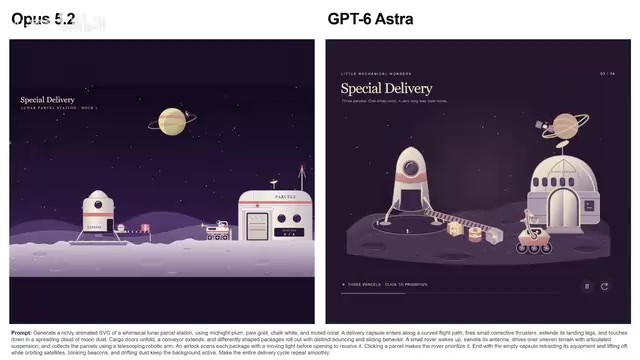
On the capability side, leaks suggest Opus 5.5 can fairly accurately transform and render objects in 3D environments — for example, generating a 3D model of a BMW M5 (though details like wheels still show imperfections) — and produce complete multi-scene simulations using SVG. Overall, this new checkpoint outperforms the 5.5.2 version. That said, all of the above is based on leaks and rumors; nothing has been officially confirmed, and readers should treat it with appropriate skepticism.
Token pricing is the standard billing method for LLM APIs today. A token is the basic unit of text a model processes — roughly every 4 characters in English, or 1–2 characters per Chinese character. "Input tokens" refer to the prompts and context sent to the model; "output tokens" refer to the model's generated response. Output is typically priced higher because it requires autoregressive generation one token at a time, consuming more compute. "Cache reads" are a more recent optimization: for repeated long prompt prefixes (such as system prompts or lengthy documents), providers retain the KV cache for a period, and subsequent requests that hit the cache are billed at a much lower rate — significantly cutting costs for multi-turn conversations or batch processing. Opus 5.5's leaked cache read price of $0.20 per million tokens is roughly 1/20th of the input price, making the savings substantial for enterprise users with high call volumes.
StepFun Step5 Preview: 600B-Parameter MoE, 65% Cost Reduction
On the Chinese side, StepFun was first out of the gate with a preview of its next-generation flagship, Step5, targeting agentic tasks, software development, and professional knowledge domains — with particular emphasis on financial applications.
Architecturally, Step5 Preview is a 600-billion-parameter MoE (Mixture of Experts) model with only 27 billion active parameters, balancing scale with inference efficiency. It supports visual data processing and comes with a million-token context window. StepFun's official benchmarks position it against GLM-5.3 and comparable Qwen (QNK3) models, claiming a roughly 65% reduction in per-task cost.
The open-source plan is what's generating real excitement. StepFun says it will release open weights on October 15. However, the 600B parameter count presents a real barrier — even with quantization, local deployment is virtually impossible for most users, who will still need powerful hardware or cloud infrastructure. How much the community can unlock from the open weights will be worth watching.
MoE (Mixture of Experts) is a sparsely activated neural network architecture. Unlike traditional "dense" models that activate all parameters on every inference pass, MoE splits the model into multiple "expert" sub-networks, with a gating router selecting only a small subset for each computation. This means a 600B-parameter MoE model only engages the equivalent of 27B parameters per forward pass — similar compute cost to a 27B dense model, yet capable of accumulating far greater knowledge capacity during training. The trade-offs are more complex training stability challenges and higher VRAM requirements, since all expert weights must be loaded into memory simultaneously. This is precisely why a 600B Step5 Preview, even with open weights, cannot run on consumer GPUs: the weights alone require roughly 1.2TB of VRAM in FP16, and hundreds of GB even after quantization — far beyond consumer-grade setups, single or multi-card.
MiniMax M3.1 and M3 Pro: Shifting from Scale to Reliability
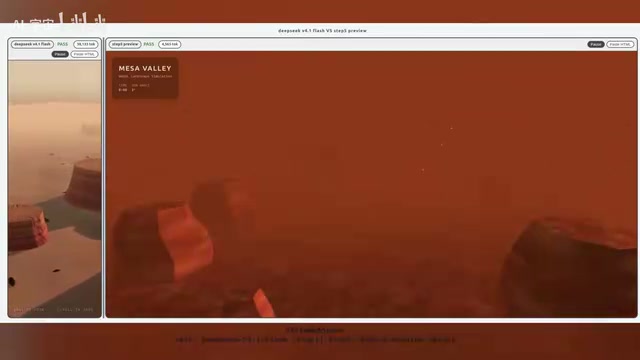
MiniMax M3.1 is also approaching. A Bilibili creator noted that a covert commit in the MiniMax repository included test files referencing M3.1 — while no specific date was confirmed, it clearly signals that the next-generation model is in its final stretch. Industry sources suggest it could launch by the end of this month or early next.
During a recent earnings call, MiniMax's CEO mentioned that M3.1, M3 Pro, and H3.1 are all nearing completion. Notably, M3.1's design philosophy isn't about scaling up — it's focused on making real-world task handling more reliable. The company emphasizes improvements in stability, reasoning quality, efficiency, and agentic generalization. M3 Pro, by contrast, takes the scale route, reportedly approaching 3 trillion parameters, paired with major architectural upgrades for better pretraining scale, training efficiency, and performance on ultra-long-horizon tasks. This dual-track strategy — a "stability edition" alongside a "flagship edition" — reflects the broader industry balancing act between practical reliability and raw performance ceilings.
Alibaba Qwen4 and Image Models: A Showcase at Apsara Conference
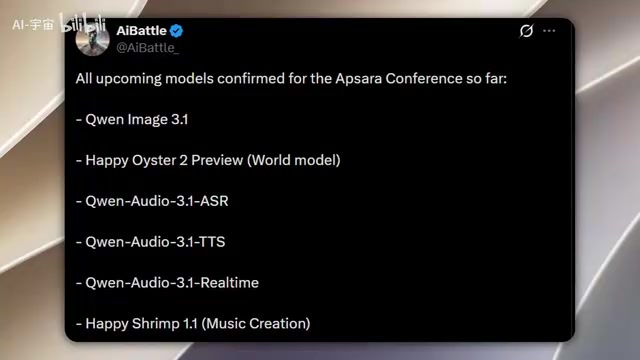
Alibaba is preparing the Qwen4 (QN4) series, which could debut as early as the upcoming Apsara Conference. This follows historical precedent — Tongyi 2.0, Qwen2.5, and Qwen3 all made their first appearances at this event.
This year's conference features a dedicated theme: "Qwen's Evolution Toward the Agentic Era," with Alibaba promising to showcase a flagship LLM with dramatically improved performance on coding and office tasks, along with an all-purpose model and a real-time multilingual translation model. Additional previews include world model Happy Oyster 2, as well as ASR, TTS, and real-time audio models.
The standout announcement is Qwen Image 2.1 — a newly released, open-weight image model with just 7 billion parameters that supports both generation and editing. Despite its compact size, early testers report it largely holds its own against mainstream models, and even Midjourney has acknowledged it can compete with more complex alternatives. The model supports up to 10 reference images, high-precision editing, and native RGBA transparency — meaning it can directly generate images with transparent backgrounds. This level of capability density at this scale makes it a powerful tool that individuals can run locally.
Native RGBA transparency support is a relatively rare capability in image generation models. Traditional generators output RGB three-channel images, and background removal requires a separate segmentation model (such as Rembg or SAM) as a post-processing step, often introducing edge artifacts. Native RGBA output means the model simultaneously predicts the transparency (alpha channel) of each pixel during generation, producing PNG images with transparent backgrounds directly — eliminating post-processing. This is especially valuable for workflows that require layer compositing, such as e-commerce assets, UI design, and game art. The fact that Qwen Image 2.1 achieves this at only 7B parameters, with support for up to 10 reference images, illustrates how rapidly small models are catching up in specialized capabilities — demonstrating that parameter count is no longer the sole determinant of performance in targeted use cases.
Kimi K3.1: A String of Numbers Hiding a Secret
Finally, Moonshot AI's Kimi K3.1 is also on the horizon. The official Kimi account posted a long string of unexplained numbers, and the community quickly noticed: remove "3.1" and the remaining digits match the digits of pi exactly. This has been widely interpreted as a cryptic teaser for Kimi K3.1. No official confirmation has been made, but from a marketing standpoint, the countdown has clearly begun.
Conclusion: Cost Reduction and Open Source Become the New Race Track
This wave of concentrated launches sketches out a clear industry trajectory. On one side, Anthropic's Opus 5.5 demonstrates the closed-source cost-cutting playbook with "better performance at lower prices." On the other, Chinese labs including StepFun, MiniMax, Alibaba, and Moonshot are aggressively pushing open weights and MoE architectures, continuously driving improvements in parameter efficiency, task reliability, and cost control.
From Step5's 600 billion parameters to Qwen Image 2.1's 7 billion that punch well above their weight, model competition is no longer simply about stacking parameters. The new battleground is: at equivalent capability, who is cheaper, more practical, and more open? A reminder: most of the information in this article comes from leaks and community speculation — specific release timelines and specs should be verified against each company's official announcements.
Related articles

Understanding DeepSeek in 3 Minutes: The Rise from a Quant Hedge Fund to an Open-Source AI Leader
DeepSeek's history in 3 minutes: from High-Flyer Quant's compute build-up to V2's MLA inference cost cuts, V3's $5.576M training bill, R1's open-source global shock, and V4 with a $7B Series A.

Local Creative Writing Model Showdown: Fine-tuned Qwen3.8 27B Wins, DeepSeek v4.1 Underwhelms
Bilibili creator tests seven local creative writing models: Hemingway and HumanLike Chat based on Qwen3.8 27B perform best, DeepSeek v4.1 is plain, Dongfang Shuo ranks last with confused characters. Includes three test prompts, scores, and usage advice.

Liang Wenfeng's Three Big Bets: Why Did DeepSeek Open-Source Its 82% Gross Margin?
Why did DeepSeek open-source DeepInfer, its 82% gross margin inference framework, and then launch a hundred-billion funding round? An analysis of Liang Wenfeng's three big bets and the open-source strategy.