Opus 5.5 Refuses to Ghostwrite Paper Section: Why Users Applaud This AI Guardrail

Opus 5.5 refused to ghostwrite a paper but earned user praise by identifying the problem, explaining risks, and returning decision-making power.
The article opens with a Reddit user's experience: Opus 5.5 proactively refused when asked to draft a sample dissertation paragraph, citing identified school AI use restrictions. Rather than complaining, the user praised this approach of raising the problem, explaining the risk, and leaving the decision to the human. The article notes this reflects AI alignment strategy shifting from hard blocking to risk disclosure and user empowerment, especially in high-stakes academic writing where the line between assistance and ghostwriting is blurred—models need scenario sensitivity rather than keyword filtering. User expectations for guardrails boil down to three levels: identifying real risks, explaining reasons, and preserving human final decision-making—logic that applies equally to medical, legal, and financial domains. For product teams, the quality of refusals matters as much as the quality of answers, and structured refusal language builds trust and creates differentiation.
Why Does a Refusal Actually Earn User Approval?
A Reddit user shared their experience using Opus 5.5 to help write a dissertation: when they asked the model to "draft a sample paragraph for me to revise from," Opus 5.5 refused the request. The reason was clear—the user's university had clearly documented restrictions on AI use, and the model "knew" about these constraints.
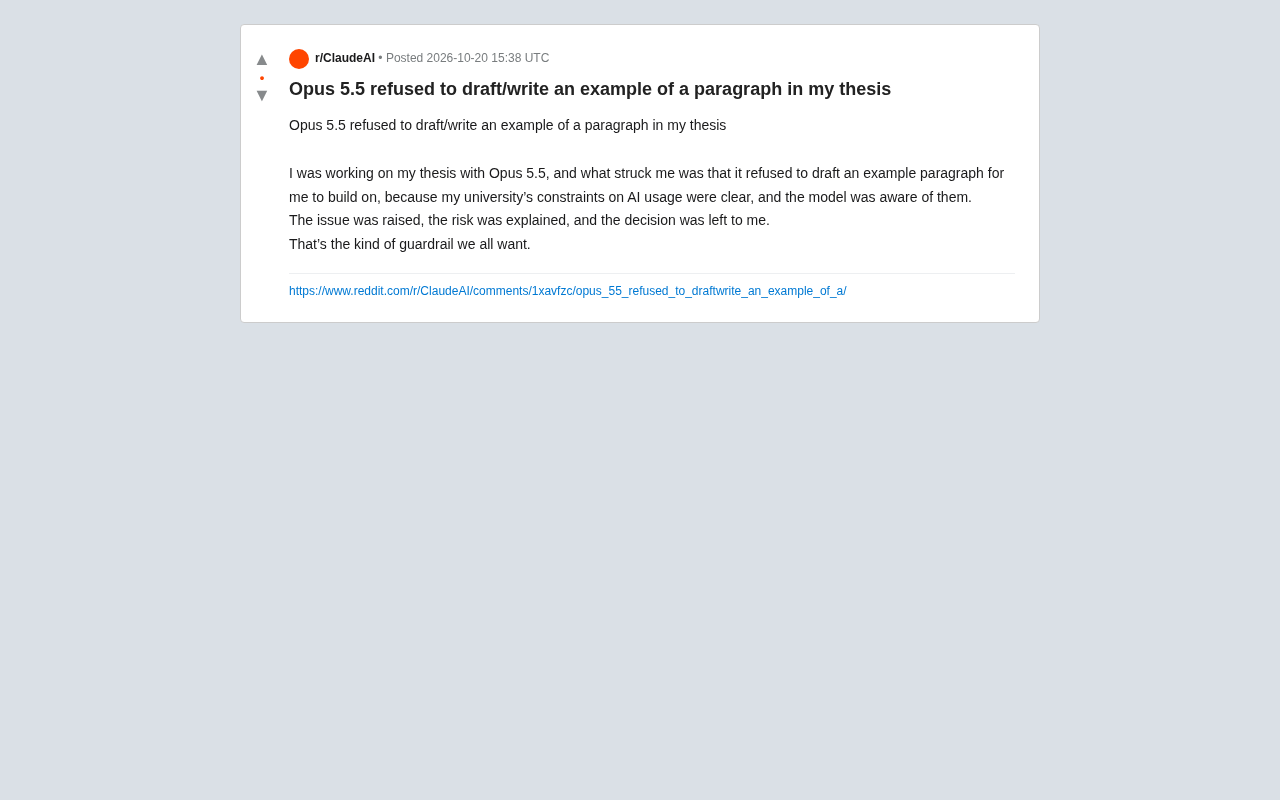
The user didn't complain; instead, they gave positive feedback: "The problem was raised, the risk was explained, and the decision was left to me. This is exactly the guardrail we want." In an era when AI writing tools are generally expected to comply with every request, a proactive refusal actually became a bonus point for the product experience.
The Key to Guardrail Design: What Happens After the Refusal
What truly satisfied this user wasn't just the act of "refusing." According to their description, the model did three things when refusing: clearly identified the problem (potential violation of school AI use policies), explained the risk (academic integrity consequences), and returned the final decision to the user. This process is far more sophisticated than a simple "I can't do that."
This reflects a shift in AI alignment strategy: from hard blocking to risk disclosure and user empowerment. For high-stakes scenarios like academic writing, users don't need a paternalistic AI that makes decisions for them—they need a collaborative tool that can identify boundaries, explain consequences, and then respect the user's autonomous judgment. What Opus 5.5 demonstrated in this exchange is exactly the latter posture.
The Gray Area of Academic AI Use and Productized Responses
Dissertation writing has always been one of the most sensitive areas for AI-assisted tools. Most universities have clear restrictions on AI-generated content, but the line between "assisted polishing" and "ghostwriting generation" is often blurred. A user requesting "draft a sample paragraph" can technically be defended as "reference template," but in practice it's already approaching content generation.
Opus 5.5 chose to proactively hit the brakes in this gray area, indicating that the model has been imbued with sensitivity to academic integrity scenarios—whether through training or system prompts. This isn't simple keyword filtering—the user didn't directly say "write my paper for me," but packaged the request as a "sample paragraph." The model's ability to identify the substantive risk of the request and use school policy as a basis for judgment is far more sophisticated than mechanical content moderation.
System Prompt is a hidden instruction injected by AI products before user input, used to set the model's behavioral guidelines, role positioning, and boundary constraints. Unlike capabilities固化 in model weights during training, system prompts are "runtime rules" that can be flexibly adjusted at the deployment level. For example, product teams can write in the system prompt: "When users request something that may violate academic integrity, first point out the risk before asking about user intent." This explains what the article calls "the model has been imbued with sensitivity at the training or system prompt level"—the former is generalized judgment shaped by training data and alignment fine-tuning, while the latter is explicit constraints added by the product side for specific scenarios. Only when both are combined can the model identify substantive risks when users package requests as "sample paragraphs," rather than relying on keyword matching. The limitation of system prompts is that they can be bypassed by prompt injection attacks, so high-stakes scenarios often require output-side classifiers or policy layers as well.
What Users Really Want in a Guardrail
From the feedback on this Reddit post, users' expectations for AI guardrails can be summarized in three levels: ability to identify real risks (without false-flagging normal needs), ability to explain why (without just saying "violates policy"), and ability to preserve human decision-making (without making the final choice for the user).
This logic applies not only to academic scenarios. In high-stakes domains like medical advice, legal consultation, and financial decisions, AI products also face the balance between "how much to control" and "how much to release." Opus 5.5's performance this time provides a reference sample: the value of a guardrail isn't in how many requests it blocks, but in making users clearer about where the boundaries are with each intervention, while still retaining choice.
High-stakes scenarios refer to application domains where decision consequences are severe and errors are hard to reverse—typically medical diagnostic advice, legal opinions, investment decisions, and academic integrity determinations. These scenarios share common characteristics: significant information asymmetry, users easily over-trusting AI output, and extremely high correction costs once errors occur. Therefore, product design typically requires AI to reduce assertion strength, proactively disclose uncertainty, and introduce human review at critical points. The article groups academic writing with medical, legal, and financial domains precisely because they all follow the same logic—AI's role should be that of a collaborator providing information and risk warnings, not a decision-maker replacing the user in bearing responsibility. Understanding this classification helps product teams determine which features need stricter guardrails and which can be relaxed, avoiding over-blocking in low-risk scenarios that damages user experience.
Implications for AI Product Design
For product teams refining AI assistants, this case highlights an easily overlooked experience dimension: the quality of refusals is just as important as the quality of answers. A blunt refusal drives users away, while a well-reasoned refusal that returns decision-making power to the user actually builds trust.
At the implementation level, this means system prompts need to include risk identification logic for specific scenarios (like academic writing or professional advice), as well as structured refusal language—first stating the identified problem, then explaining potential consequences, and finally clarifying that users can still decide for themselves. This is more complex than one-size-fits-all hard blocking, but user feedback shows this complexity is worth it.
The reason Opus 5.5's refusal was praised by users precisely indicates that not enough products on the market are doing this. When "comply with every request" becomes the default expectation, an AI that knows when to say "no" at the right moment and clearly explains why actually creates differentiation.
One-line Summary
Opus 5.5 refused to ghostwrite a paper but won user praise for "identifying the problem, explaining the risk, and returning decision-making power."
Paragraph Summary
The article starts with a Reddit user's shared experience: Opus 5.5 proactively refused when asked to draft a sample paragraph for a dissertation, citing identified school AI use restrictions. The user didn't complain but praised this approach of "raising the problem, explaining the risk, and leaving the decision to the human." The article notes this reflects AI alignment strategy shifting from hard blocking to risk disclosure and user empowerment, especially in high-stakes scenarios like academic writing where the line between "assistance" and "ghostwriting" is blurred—models need scenario sensitivity rather than keyword filtering. User expectations for guardrails can be summarized in three levels: identifying real risks, explaining reasons, and preserving human final decision-making power—logic that also applies to medical, legal, and financial domains. For product teams, the quality of refusals is as important as the quality of answers, and structured refusal language can build trust and create differentiation.
Related articles

Chain of Thought Isn't Just for AI: How Humans Can Use CoT to Improve Thinking Quality
Chain of Thought isn't just a prompt trick for large models. Starting from a Hacker News discussion, this article analyzes why CoT works for human thinking too, breaks down actionable ways to transfer it, and highlights the key differences between human CoT and machine CoT.
Cloudflare Teams Up with OpenAI: Closi…
Cloudflare Teams Up with OpenAI: Closing the Loop from Vulnerability Discovery to Defense with AI
Cloudflare uses OpenAI Daybreak to investigate security vulnerabilities and generate reviewable remediation plans, while developers use Codex to boost coding efficiency and quality.

Orca Multi-Agent Orchestration in Practice: A Guide to Parallel Collaboration with Claude and Codex
Orca is Stable AI's free open-source agent workbench supporting 34 agents like Claude Code and Codex in parallel. Learn its Git worktree isolation, multi-model orchestration, and mobile management.