Opus 5 Hands-On Review: How Powerful Is This "Hill-Climbing Monster" for Optimization Tasks?

Opus 5 earns "optimization monster" praise for its iterative hill-climbing ability toward optimal solutions.
A developer's tweet calling Anthropic's Opus 5 an "absolute monster" for optimization tasks has sparked discussion. The model reportedly excels at continuous hill-climbing toward optimal solutions when given clear goals. This article examines its iterative optimization capabilities, explains the technical foundations behind feedback-loop-driven improvement, and provides practical guidance for developers to leverage and objectively evaluate this emerging model capability.
A Tweet That Sparked Attention
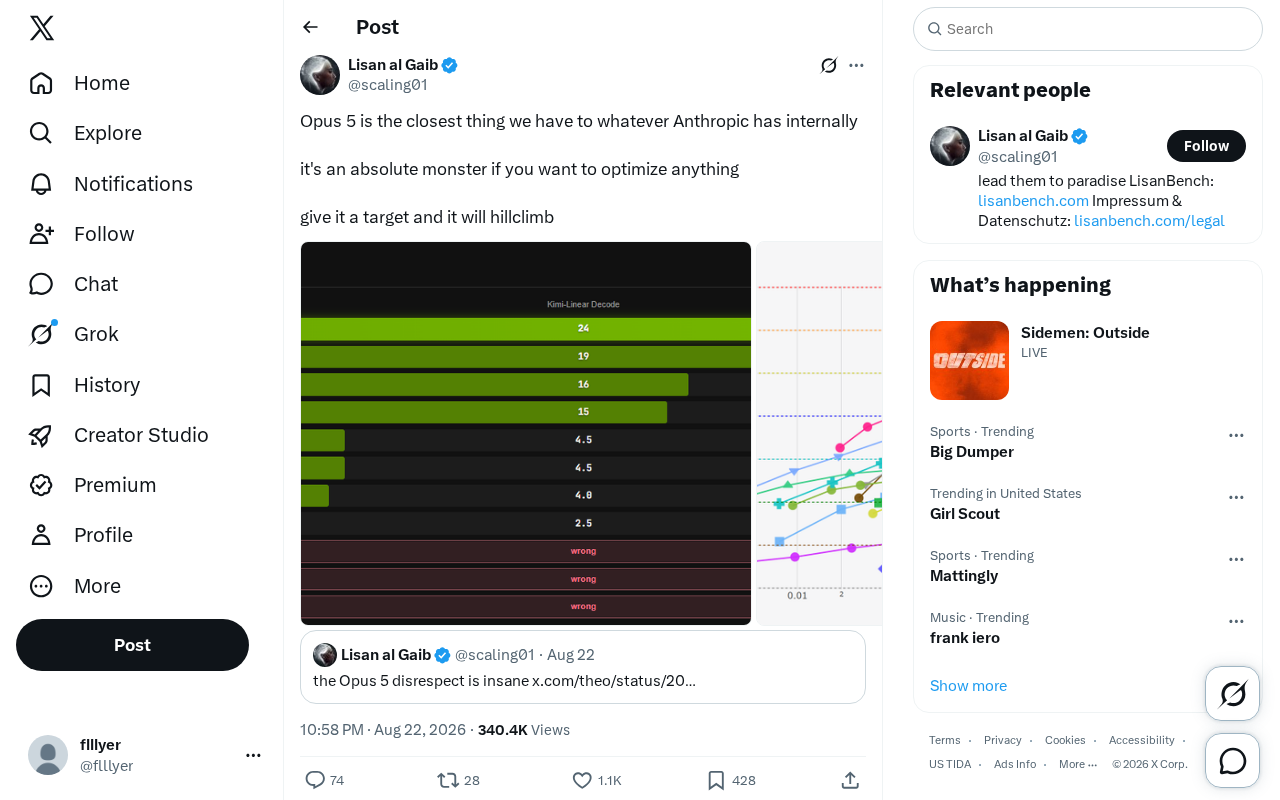
Recently, a tweet about Anthropic's flagship model Opus 5 stirred up discussion in the tech community. The original poster offered a striking assessment: "Opus 5 is the closest model we have access to that reflects Anthropic's true internal capabilities," calling it an "absolute monster" for optimization tasks — "just give it a goal, and it will continuously hillclimb toward the optimal solution."
Anthropric was founded in 2021 by former OpenAI research VP Dario Amodei and his sister Daniela Amodei, with AI safety as its core mission. Its flagship Claude model series employs unique alignment techniques like Constitutional AI, which allows the AI to self-supervise and self-correct based on a set of explicit principles, reducing the risk of harmful outputs. The Claude model lineup is divided into multiple tiers: Haiku (lightweight and fast), Sonnet (balanced), and Opus (most capable flagship). The Opus series has always represented Anthropic's cutting-edge capability level, typically leading in complex reasoning, long-context understanding, and code generation. As of 2025, Anthropic has secured billions of dollars in investment from tech giants including Google and Amazon, with a valuation exceeding $60 billion.
Although brief, this assessment touches on a dimension of LLM capability evaluation worth exploring in depth: a model's performance in goal-oriented iterative optimization, rather than merely the accuracy of single-turn Q&A.
Opus 5's Core Capability: From Single-Shot Generation to Continuous Hill-Climbing Optimization
What Does "Give It a Goal and It Hill-Climbs" Mean?
Traditionally, we evaluate language models by focusing on the quality of "one-shot outputs": give it a question and see how well it answers. But the capability highlighted in the tweet points to a paradigm much closer to engineering practice — you set a quantifiable goal, and the model continuously tries, evaluates, corrects, and gradually approaches the optimal direction.
The term "hillclimb" originates from the optimization algorithm domain, referring to starting from a current state and continuously moving in a direction that improves the objective function. Hill climbing is a classic family of local search optimization algorithms in computer science. The core idea is: start from an initial solution, repeatedly examine candidate solutions in the neighborhood, and move to any solution that's better than the current one, until no further improvement can be found. These algorithms are simple and efficient but carry the risk of getting trapped in local optima — potentially stopping at the top of a "small hill" rather than the global peak. To address this, researchers have developed variants like simulated annealing, random-restart hill climbing, and genetic algorithms to escape local optima. Mapping this concept to the behavior of large language models means the model can self-evaluate the quality of its output after each generation, identify directions for improvement, and produce a better solution in the next iteration — essentially internalizing search and optimization thinking as reasoning capability.
Applying this concept to LLMs means Opus 5 is no longer a passive answering tool, but more like an "optimization engine" capable of autonomous planning, self-evaluation, and continuous improvement.
Why Iterative Optimization Capability Is Critical for Developers
For real-world engineering and research scenarios, the value of "give it a goal and it optimizes" far exceeds single-turn Q&A. Whether it's code performance tuning, prompt engineering, parameter search, or complex multi-step tasks, the truly scarce resource is an agent that can continuously improve within a feedback loop.
The "feedback loop" in model iterative optimization involves multiple technical layers. First is self-evaluation: the model needs accurate judgment of its own output quality, relying on quality discrimination abilities learned through RLHF (Reinforcement Learning from Human Feedback) or RLAIF (Reinforcement Learning from AI Feedback) during training. Second is search and planning: through reasoning frameworks like Chain-of-Thought and Tree-of-Thought, the model can explore multiple possible improvement paths and select the optimal direction. Finally, there's context memory: maintaining complete memory of previous attempts and results across multi-turn conversations to avoid repeating ineffective attempts. The effective combination of these three elements enables high-capability models to exhibit behavior similar to automated optimizers.
If Opus 5 truly excels in this area, it would have real practical significance for building automated optimization workflows.
How to Rationally Evaluate the "Monster" Claim About Opus 5
Single-Source Opinions Warrant Caution
It's worth noting that the assessment above comes from a single social media source and carries obvious personal subjective experience. Statements like "closest to Anthropic's internal capabilities" lack verifiable objective evidence and are more of a speculation based on usage impressions. Without systematic benchmark testing to back it up, readers should treat this as one person's opinion rather than a definitive conclusion.
An Industry Signal Worth Watching
That said, the trend reflected in this tweet is still worth paying attention to. An increasing amount of recent developer feedback suggests that Anthropic's Claude model series continues to strengthen in code generation, long-chain reasoning, and task execution. If Opus 5 truly shows significant improvements in optimization tasks, this aligns with the industry's growing emphasis on "Agent capabilities."
From 2024 to 2025, the AI industry's focus has been shifting from pure conversational AI to AI Agents with autonomous action capabilities. Unlike traditional Q&A-style LLMs, Agents can decompose complex tasks, use external tools (such as code executors, browsers, API calls), plan multi-step execution paths, and dynamically adjust strategies based on intermediate results during execution. OpenAI's Operator, Google's Project Mariner, and Anthropic's Claude Computer Use feature are all representative products in this direction. The key challenge for Agent capabilities is that models need goal decomposition, progress tracking, error recovery, and self-reflection abilities — which closely align with the "give it a goal and it keeps hill-climbing" characteristic described in the tweet.
Developer Practice Guide: How to Leverage Opus 5's Optimization Capabilities
Try a "Goal + Iteration" Interaction Approach
If you're using Opus 5 or similar high-capability models, consider adjusting your interaction approach: instead of asking for a perfect answer in one shot, explicitly provide measurable optimization goals and let the model gradually converge over multiple conversation turns. For example, in code optimization scenarios, you can provide performance metrics and have the model repeatedly propose improvement plans while explaining expected outcomes.
Specifically, this interaction pattern can follow these steps: First, clearly define success metrics (e.g., 50% latency reduction, 30% memory usage decrease). Second, provide the current baseline solution for the model to analyze. Third, have the model propose improvement hypotheses and estimate expected gains. Fourth, feed actual execution results back to the model so it can further adjust its strategy in the next iteration. This approach essentially embeds the model into an "act-observe-adjust" cycle similar to reinforcement learning.
Establish Objective Model Evaluation Benchmarks
Faced with an endless stream of "god-tier model" reviews on social media, developers should establish their own evaluation benchmarks. Design test cases for your actual business scenarios and verify model performance with quantifiable metrics, rather than being swayed by singular subjective praise.
Common evaluation dimensions include: task completion rate (whether the given goal is ultimately achieved), iteration efficiency (number of conversation turns needed to reach the goal), improvement stability (whether each turn shows progress rather than oscillating back and forth), and edge case handling capability (whether the model can creatively find alternative solutions when facing difficult constraints). Developers are advised to maintain a fixed test suite and rerun it when models are updated to track capability trends over time.
Conclusion
The "optimization monster" label given to Opus 5 reflects a deeper shift in LLM evaluation — from "can it answer correctly" to "can it continuously get better." While this tweet represents a personal opinion, it reminds us that the competitive edge of next-generation models may increasingly be defined by their goal-oriented iterative optimization capabilities. As for whether Opus 5 is truly as powerful as described, broader and more objective testing is still needed for verification.
Key Takeaways
Related articles

Roc 0.1.0 Preview: A Fast, Friendly, and Functional New Programming Language
Roc language nears its first numbered release 0.1.0, transitioning from experimental to usable. Explore its platform architecture, core features, and toolchain.
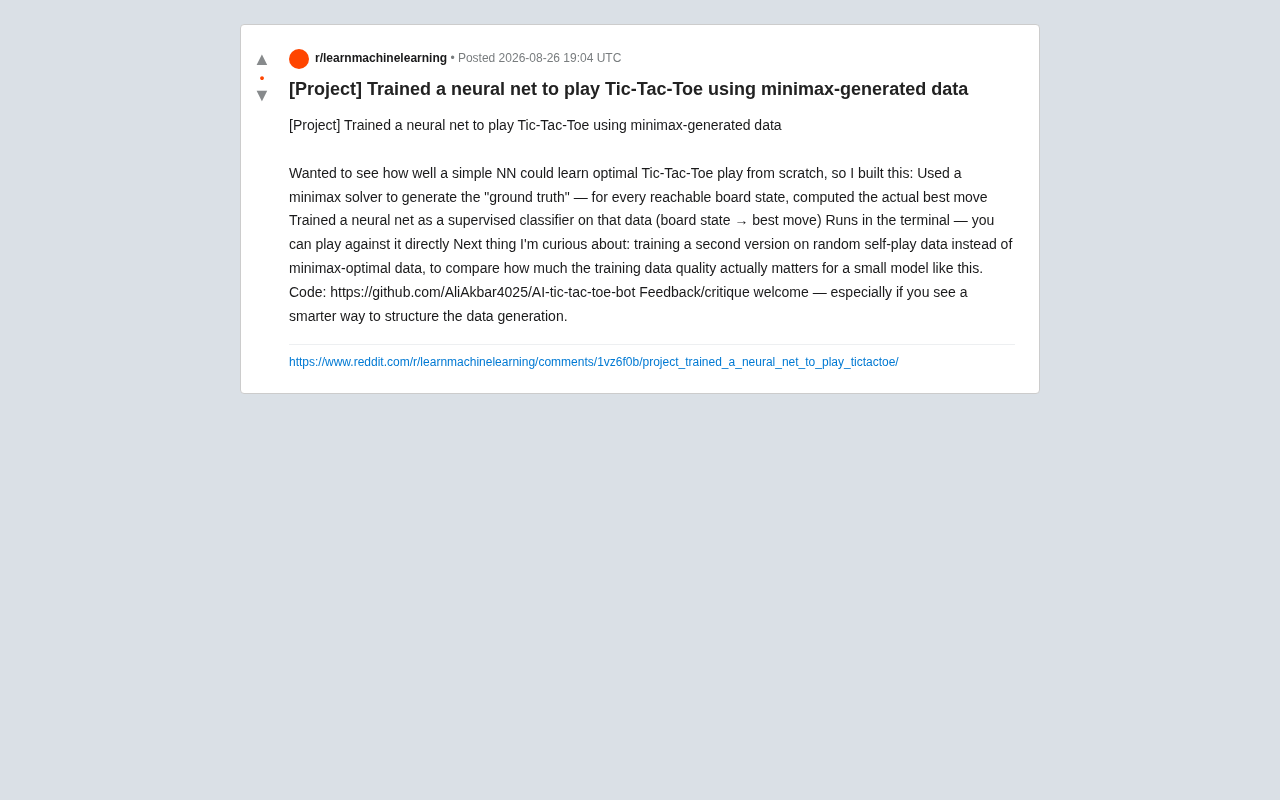
Training a Neural Network to Play Tic-Tac-Toe with Minimax Data: A Data Quality Experiment
Explore how Minimax-generated optimal data trains a neural network to play Tic-Tac-Toe. This article covers knowledge distillation, supervised learning modeling, and how data quality critically impacts small model performance.

Gemini Conversation History vs. Google Activity Logs: A Hidden AI Data Transparency Concern
A user discovered persistent inconsistencies between Google Gemini's conversation history and account activity logs, raising AI data transparency and privacy compliance concerns.