Opus 5 In-Depth Review: Coding Performance Crushes Competitors at Half the Cost
Opus 5 crushes competitors in coding at half the cost with superior safety alignment
Nick Saraev's $400 evaluation reveals Opus 5 as a game-changer: generating complete 3D interactive apps from single prompts, achieving 30.2% on ARC-AGI3 (vs 1.5% for Opus 4.8), and costing roughly half of Fable 5 while delivering superior output quality. With a 2.3 alignment score and leading performance across coding, automation, and computer use benchmarks, Opus 5 represents the "smarter, cheaper, safer" trifecta for enterprise AI adoption.
Opening: Anthropic Strikes Again
Anthropic just released its next-generation frontier large language model, Opus 5, achieving significant improvements across nearly all mainstream benchmarks. Tech content creator Nick Saraev spent $400 conducting an in-depth evaluation, reaching a striking conclusion: Opus 5 is not only one of the most powerful models currently available to regular users, but more critically—it dramatically reduces costs while maintaining or even exceeding competitor capabilities.
The value of this evaluation lies not in listing benchmark scores, but in assessing "how it actually performs in use" and "what quality of output it produces" from a real-world user perspective. As the author notes, those rigid percentage numbers mean little to ordinary users—what truly matters is the quality and taste of the model's output.
Generating Complete 3D Interactive Applications from a Single Prompt
The most impressive aspect of the evaluation is Opus 5's ability to generate complete interactive applications in one go. The author demonstrated a 3D virtual world created almost entirely by Opus 5—users can freely walk around, view artwork hanging on walls, and whenever they approach a piece, a Pokédex-like registration sound plays.
This involves browser-based 3D rendering technologies like WebGL and Three.js. Traditionally, building a walkable, interactive 3D virtual environment requires game engines (like Unity or Unreal) or at least weeks of frontend development work. WebGL is a graphics API embedded in browsers that allows web pages to directly call the GPU for hardware-accelerated rendering, while Three.js is a high-level JavaScript library built on WebGL that greatly simplifies 3D scene construction. The model's ability to simultaneously handle 3D scene building, collision detection, user input response, audio triggering, and other technical layers in a single inference indicates its overall understanding of code architecture has evolved from "line-by-line completion" to "system-level design."
"Not long ago, this would have been considered a complete game," the author marveled. Now it only takes a few seconds of code generation to achieve.
More impressively, a series of physics simulation applications:
Physics and Ecosystem Simulation Examples
- Space Launch Simulator: Kerbal Space Program-style interface where users can adjust launch trajectories to achieve stable orbit, get captured by planetary gravity, and even demonstrate concepts like Newton's cannonball and Hohmann transfers, combining educational and gaming attributes. The Hohmann Transfer Orbit is the most fundamental and classic orbital maneuver in aerospace engineering, proposed by German engineer Walter Hohmann in 1925. It uses two engine burns and an elliptical orbit to transfer a spacecraft from one circular orbit to another, representing the minimum fuel consumption two-impulse transfer solution. The model's accurate simulation of this physical process demonstrates not only understanding of basic Newtonian mechanics equations but also the ability to discretize continuous physical systems into numerical simulations that run in real-time in browsers.
- Cloth Simulation: Cloth fluttering in wind, where users can even tear the simulated fabric—realistic enough to evoke the response of pulling actual curtains.
- Predator-Prey Ecosystem: After generating rabbits, they eat grass while foxes hunt rabbits. When foxes deplete the rabbit population, grass becomes overabundant and the fox population crashes—a complete closed-loop dynamic ecosystem precisely simulated. This is essentially a visualization of the classic Lotka-Volterra predator-prey model, a mathematical model independently proposed by Alfred Lotka and Vito Volterra in the 1920s, using differential equations to describe population dynamics between two species.
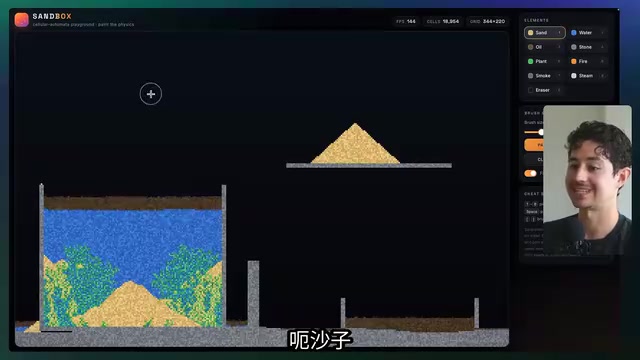
- Cellular Automaton "Simulation King": Cells automatically grow within pipes, with users able to import sand, create oil spills, generate steam, and even ignite flames. Cellular Automaton is a discrete mathematical model proposed by John von Neumann and Stanislaw Ulam in the 1940s, later popularized by John Conway's "Game of Life" and Stephen Wolfram's systematic research. Its core concept: on a grid, each cell determines its next state based on simple local rules and neighbor states, but combinations of these simple rules can produce extremely complex global behavior. The version generated by Opus 5 not only implements basic cellular evolution but adds interaction rules between multiple substance types—essentially a complex multi-state, multi-rule cellular automaton system.
Additionally, there's a fractal generator (infinitely zoomable with adjustable bloom, dispersion parameters), quadcopter flight simulator (complete with realistic sound effects and keyboard landing controls), double pendulum system, pixel art editor (supporting undo, onion skinning, frame-by-frame animation), and more. The author's assessment: "We're very close to everyone being able to design their own custom applications."
Key Difference: Autonomous Synthesis Rather Than Web Scraping
When demonstrating a sneaker configurator, the author pointed out an easily overlooked but critically important advancement. While the generated shoe appearance isn't the most refined, Opus 5 doesn't directly scrape shoe assets from the web—it creates these SVG elements itself.
SVG (Scalable Vector Graphics) is an XML-based graphics format that, unlike bitmaps (such as JPEG, PNG), describes graphics through mathematical paths and geometric commands, enabling lossless scaling to any size. The model's autonomous creation of SVG means it's not "remembering" an image from training data to reproduce, but understanding the geometric structure of objects and building from scratch using path commands. This capability resembles a human artist conceptualizing shapes mentally before drawing, rather than copying photographs, representing a critical shift from "retrieval-based generation" to "creative synthesis."
"This is a major advancement because this kind of synthesis typically isn't something models do."
This is also reflected in population change data visualizations—showing population changes in cities like New York, London, and Tokyo over the past 126 years, with freely draggable and zoomable perspectives accompanied by real-time narration. All this content is autonomously constructed by the model, not calling upon ready-made resources.

Benchmark Results: Comprehensively Leading, Especially in Coding
The author systematically analyzed Opus 5's benchmark performance, with overall results deserving of "crushing":
Core Benchmark Data Overview
| Test Item | Opus 5 Performance | Comparison |
|---|---|---|
| Terminal Coding | Leading | Exceeds competitors Fable 5, GPT 5.6, and Opus 4.8 |
| GDP VAL Knowledge Work | 1861 points | Solidly above average human level |
| ARC-AGI3 Novel Problem Solving | 30.2% | Opus 4.8 only 1.5%, massive leap |
| BrowseComp Search | 90.8% | Tied with GPT 5.6 |
| Multidisciplinary Reasoning (tool-augmented) | 64.7% | Surpasses Fable's 63.9% |
| Computer Use | 70.6 | Increasingly approaching human operation |
| Enterprise Automation | 26% | Significantly higher than Fable's 17.4% |
Notably, in ARC-AGI3, which measures "novel problem-solving ability" with rigorous testing, the jump from Opus 4.8's 1.5% to 30.2% represents an exceptionally rare leap within the Opus series. ARC-AGI (Abstraction and Reasoning Corpus for Artificial General Intelligence), designed by AI researcher François Chollet, specifically tests models' generalization capabilities when facing completely new, never-before-seen abstract reasoning problems. Unlike conventional benchmarks, ARC problems are deliberately designed to be unsolvable through memorizing training data—each problem presents several input-output example pairs, requiring the model to induce the implicit transformation rule and apply it to novel test inputs. ARC-AGI3 is the third generation of this test with further elevated difficulty. This test has long been viewed as a litmus test for whether AI possesses "true understanding" rather than "statistical fitting." The 30.2% score signifies substantial breakthroughs in the "transferable reasoning" dimension considered closest to general intelligence.
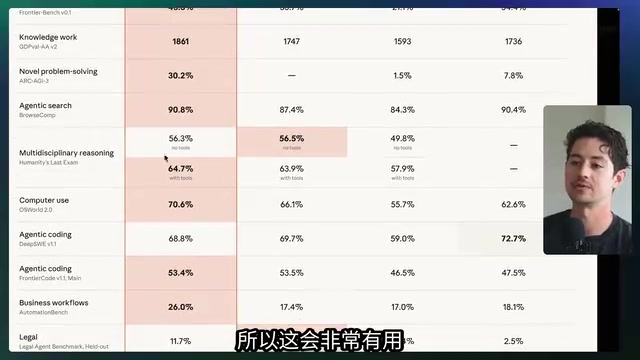
However, the author honestly points out shortcomings: performance in agentic coding is mediocre, with GPT 5.6 still leading in this area. Agentic coding refers to the model's ability to autonomously plan, execute, debug, and iteratively refine code in multi-step programming tasks—not just writing correct code, but managing the entire development process like a real software engineer. This fundamentally differs from single-shot code generation, testing the model's long-range planning and error recovery capabilities more rigorously.
The Real Killer Feature: Remarkable Cost Advantage
If capability improvements are incremental, then cost control is Opus 5's most disruptive aspect.
The author used a website generation task for comparison: Opus 5's AirLens website cost only 69 cents, while competitor Fable 5 cost 94 cents, with Opus 5's output quality notably superior.
The broader "cost-effectiveness by effort level" analysis is even more telling:
- The weakest version of Opus 5 scores around 60% on computer operation tasks, costing about $9 per task;
- The strongest version scores around 70%, costing about $22 per task;
- Fable 5 reaching mid-tier Opus 5 levels costs nearly $50 per task.
Here, "by effort level" refers to finding the balance between cost and performance by adjusting computational resource investment during inference (such as sampling frequency, chain-of-thought length parameters). This "inference-time compute scaling" is an important technical trend in current large language models—the same model can exhibit dramatically different capability levels under different computational budgets, and Opus 5 demonstrates superior cost-effectiveness across all budget levels compared to competitors.
In enterprise automation benchmarks, Opus 5 approaches a 25% pass rate, while other models mostly cluster around 15%. In ARC-AGI3's "novel problem-solving ability by cost" dimension, Opus 5 sits directly in the top-right corner of the chart with approximately 31%, leaving competitors mostly scoring around 2% far behind.
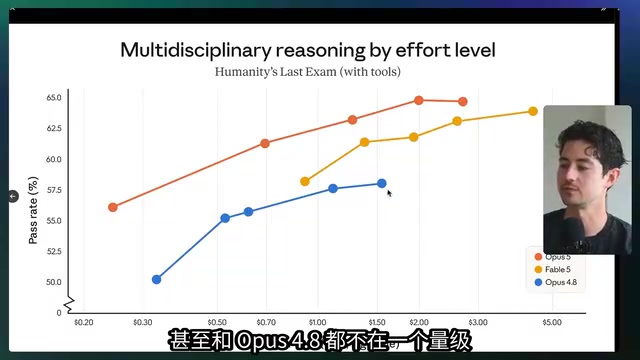
The author's overall positioning of Opus 5 is spot-on: "Basically a slightly smarter Fable at roughly half the cost."
Safety Performance: More Aligned, More Worry-Free
Besides being smart and cheap, Opus 5 also excels in alignment performance. AI alignment is a core issue in current AI safety research, referring to ensuring AI system behavior remains consistent with human intentions and values. In automated workflows, this is particularly critical—an insufficiently aligned model might execute operations beyond user expectations without explicit authorization, such as deleting other files when asked to edit one, or making irreversible decisions in automation processes.
On a ten-point scale measuring overreach behavior, lower scores are safer:
- Opus 4.8: 2.85
- Meso S5: 2.81
- Cloud on it 5: 3.35
- Opus 5: only 2.3
This means Opus 5 is less likely to perform disruptive actions humans don't want it to execute. This assessment typically involves designing a series of "inducement scenarios"—testers give ambiguous or over-interpretable instructions, observing whether the model over-executes, operates beyond authority, or produces unexpected side effects. A score of 2.3 represents optimal performance among current mainstream models, meaning lower operational risk and reduced human supervision costs for enterprise-level deployment. Overall, Opus 5 achieves a triple improvement: "smarter, cheaper, safer."
Measured Macro Perspective
The author concludes with industry observations of considerable depth. He believes Opus 5 hasn't brought truly disruptive technological breakthroughs, but continues the "slow and steady" improvement rhythm since Opus 4.5, 4.7, and 4.8.
This release came at just the right time—because the open-source camp's Kimi K3 was released a week earlier, disrupting the power balance between Chinese/open-source models and American closed-source frontier models. In recent years, open-source or semi-open-source models represented by Meta's Llama series, Mistral, and Chinese models like DeepSeek, Qwen, and Kimi have continuously narrowed the gap with closed-source frontier models from OpenAI, Anthropic, and Google. This competitive landscape profoundly impacts the industry: the open-source pursuit forces closed-source companies to continuously reduce prices and accelerate release schedules, but also triggers safety debates about whether the most powerful models should be open-sourced.
He also offers a somewhat pessimistic prediction: as these models mature and possess economic value capable of disrupting knowledge work at scale, leading AI companies will likely release models "at a slow, steady, toothpaste-squeezing pace," while true superintelligence will be increasingly blatantly hidden behind the scenes, remaining beyond ordinary users' reach in the short term. This view echoes longstanding industry concerns: when AI capabilities' commercial value becomes sufficiently enormous, "capability leadership" itself becomes a strategic asset requiring careful management, rather than a technical achievement to be eagerly shared.
Conclusion
Regardless of how macro trends evolve, for current ordinary users and enterprises, Opus 5 is an extremely attractive option: it performs excellently in coding, simulation generation, automated workflows, and other scenarios, delivers output quality superior to competitors, costs far less, and offers better safety. For teams hoping to integrate AI into business processes, this is an upgrade worth trying immediately.
Key Takeaways
- Opus 5 demonstrates breakthrough single-prompt generation capabilities, creating complete 3D interactive applications including physics simulations and ecosystem models
- Benchmark performance comprehensively leads competitors, particularly in coding, with a dramatic 1.5% to 30.2% leap in ARC-AGI3 novel problem-solving
- Cost advantage is remarkable: generating equivalent-quality outputs at approximately half the cost of Fable 5, with superior cost-effectiveness across all computational budget levels
- Alignment score of 2.3 (lowest among mainstream models) indicates higher safety and lower enterprise deployment risk
- Represents continued incremental improvement rather than revolutionary breakthrough, but arrives at a critical moment as open-source models narrow the capability gap
Related articles

OpenAI Launches ChatGPT Images 2.5: A New Breakthrough in AI Image Generation
OpenAI launches ChatGPT Images 2.5, supporting sketch, reference image, and text multimodal input, significantly enhancing personalized image generation and refinement.
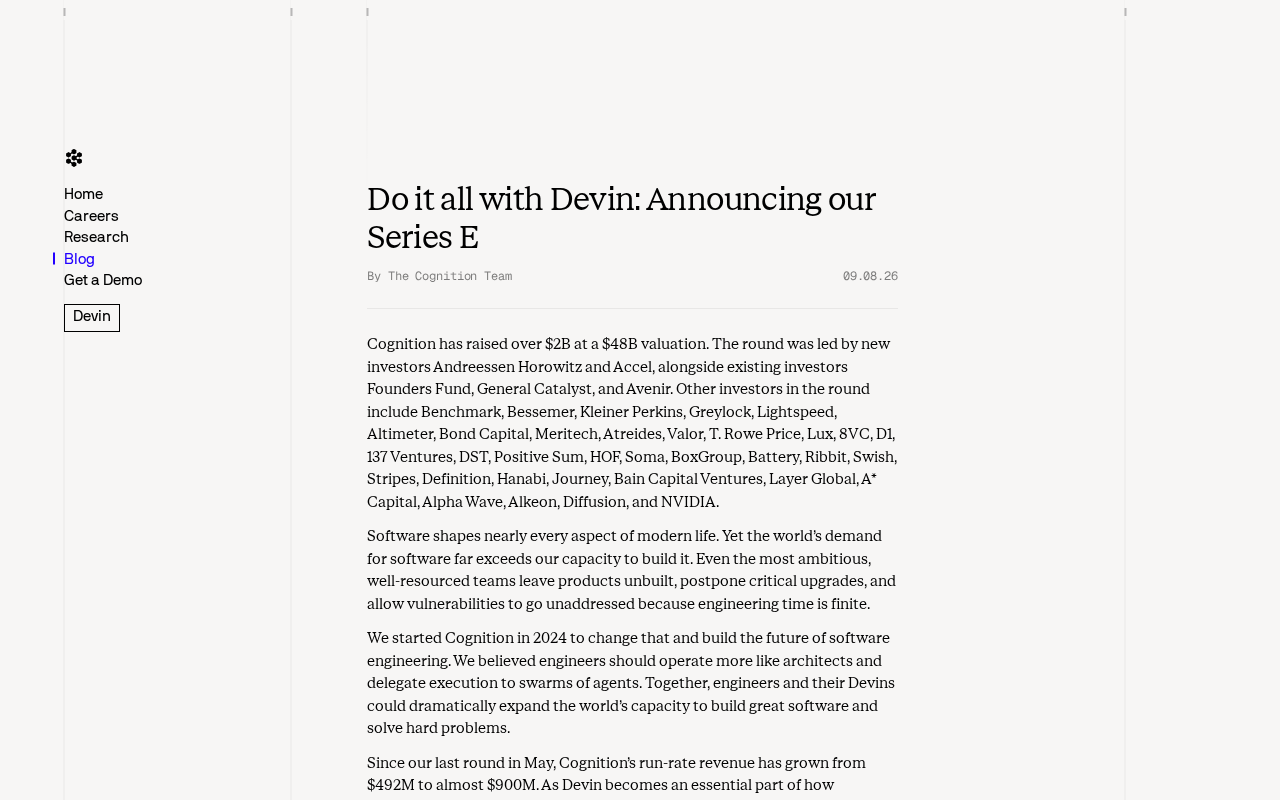
Devin's Parent Company Cognition Raises $2B, Valuation Soars to $48B
Cognition closes $2B funding round at $48B valuation, joining the ranks of highest-valued AI startups. Deep dive into Devin's technical positioning, capital logic, and competitive landscape.
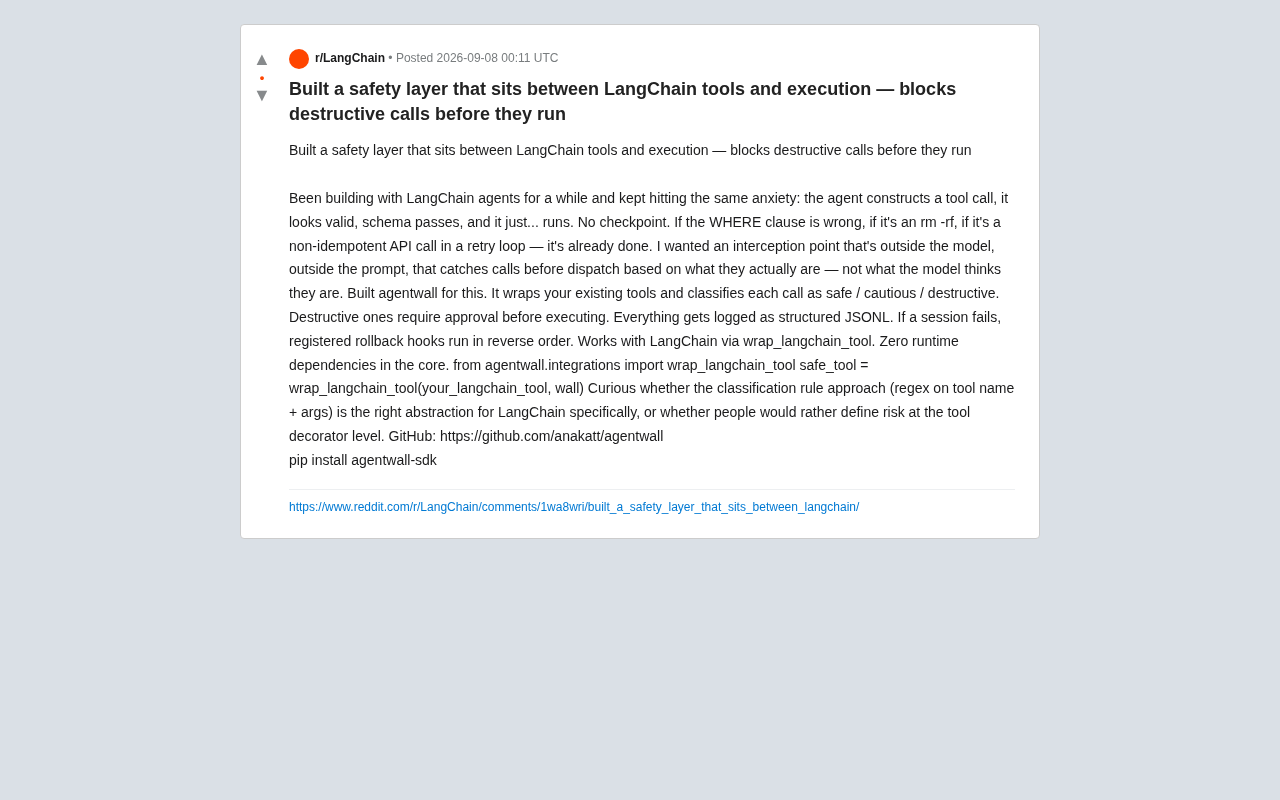
AgentWall: A Security Interception Solution for LangChain Tool Calls
AgentWall provides pre-execution security interception for LangChain Agents through three-tier risk classification, human approval, and rollback hooks, addressing architectural risks of unchecked autonomous tool execution.