Opus 5 Rumors Heat Up: Anthropic's User Trust Crisis and Product Iteration Controversy

Opus 5 rumors split Anthropic's community over model upgrades, usage limits, and user trust.
An anonymous Twitter leak claiming Anthropic's Opus 5 will replace the Fable model has sparked fierce debate on Reddit. The community is divided between cautious optimism and frustration over perceived downgrades and poor communication. Central to the anxiety is a real technical paradox: more capable reasoning models consume far more tokens, meaning subscription users may hit usage caps faster — even as the models get smarter.
Anonymous Leak Sparks Community Debate
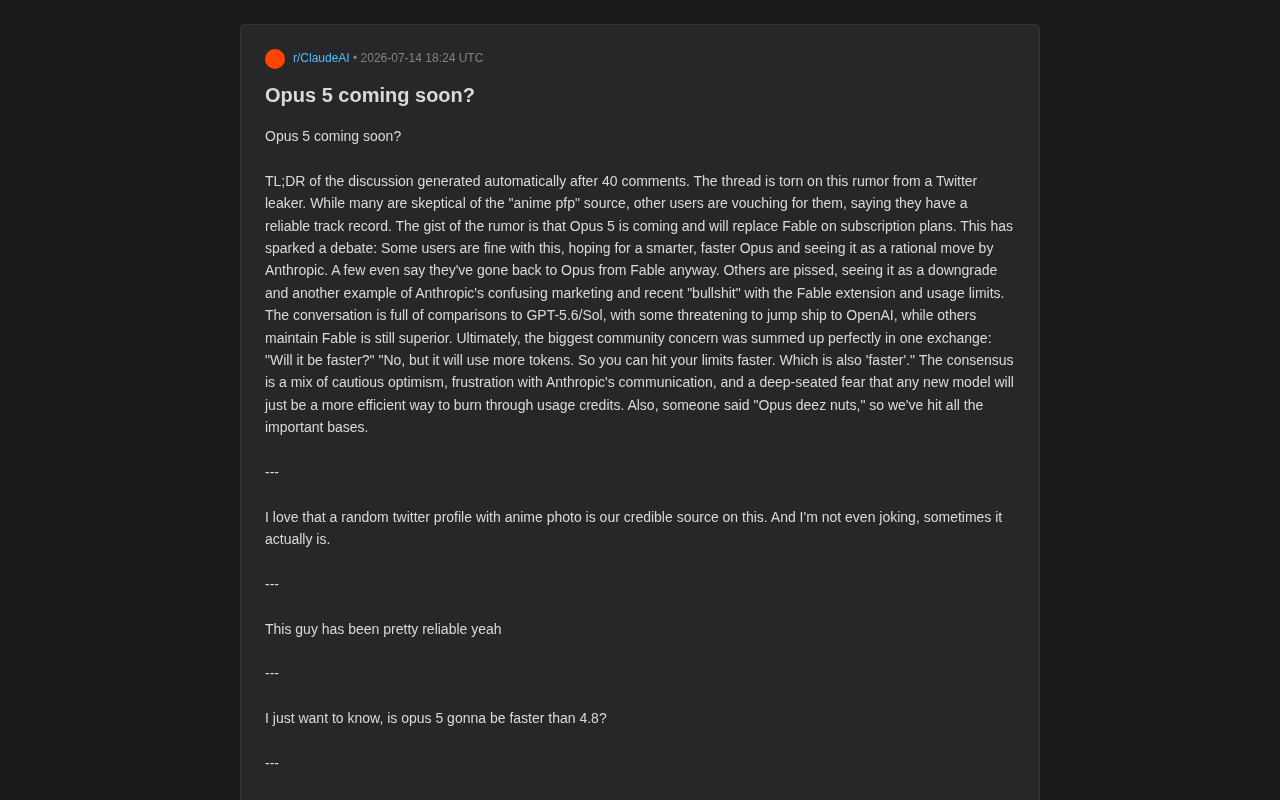
Recently, Reddit's AI community has been buzzing over rumors of a new Anthropic model called "Opus 5." The source? An anonymous Twitter account with an anime avatar — hardly the picture of credibility, yet enough to send ripples through AI enthusiast circles. As one community member quipped: "We're treating a random Twitter account with an anime avatar as a reliable source, and I'm not even joking — sometimes that's just how it goes."
Anonymous leakers have long been a fixture of AI industry news cycles. The structural reasons are clear: the pace of AI development is so rapid that companies rarely have the luxury of building anticipation through lengthy traditional product launches. In the resulting information vacuum, insiders, API testers, and security researchers fill the gaps with fragments of intel. Subreddits like r/ClaudeAI and r/ChatGPT have developed informal "leaker credibility" systems, where a source's historical accuracy becomes their core asset — a stark contrast to the institutional credibility that traditional media relies on. This particular leaker reportedly had a "solid track record" according to some users, which is why, despite plenty of skepticism, a significant portion of the community chose to take the rumor seriously. The core claim: Opus 5 is coming soon and will replace the existing Fable model in subscription plans.
For context, Anthropic's Claude model family uses a dual-axis naming system combining capability tier and generation: Opus sits at the flagship tier, Sonnet in the middle, and Haiku at the lightweight end. Fable, introduced more recently as a distinct name, is positioned as a specialized model for creative writing and narrative generation — an experiment in "verticalizing" a general-purpose LLM, not unlike how OpenAI launched the o1/o3 series as reasoning-specialized models. Replacing Fable with Opus 5, then, would suggest Anthropic is reconsidering the commercial viability of its vertical-specialist model strategy.
Community Reaction: Enthusiasm vs. Outrage
The rumor quickly ignited a heated debate across 40+ comments, with the community splitting sharply in two directions.
The Optimists: A Rational Product Refresh
One camp welcomed the news, looking forward to a "smarter, faster" Opus and viewing the replacement of Fable as a reasonable product line adjustment. Interestingly, many users admitted they had already migrated back from Fable to Opus — a form of "voting with their feet" that may itself be informing Anthropic's strategic rethinking.
The Frustrated: Another Downgrade?
The other camp was noticeably upset, framing the move as a blatant "downgrade" and the latest entry in what they described as Anthropic's "confusing marketing strategy." There's already simmering resentment in the community over recent cutbacks to Fable's extended features and tightened usage limits, with some users bluntly calling these moves "a mess." This frustration points to a deeper issue: Anthropic has a clear weakness in product communication and managing user expectations.
The Core Anxiety: A More Powerful Model That Burns Through Your Quota Faster?
Perhaps the exchange that best captured the community's mood was this exchange:
"Will it be faster than 4.8?" "No, but it'll burn through more tokens. So you'll hit the usage cap faster. That's one way of being 'faster.'"
This darkly humorous remark cuts right to the heart of users' deepest concern — that a new model release might ultimately just mean "burning through your usage allowance more efficiently." For heavy users on subscription plans, if a more capable model comes with significantly higher token consumption, the real-world experience could actually get worse.
This anxiety isn't unfounded. It has solid technical backing. Enhanced "reasoning" in large language models is often implemented through Chain-of-Thought (CoT), where the model outputs extensive intermediate reasoning steps before delivering a final answer. Those intermediate steps count toward token usage just like any other output. OpenAI's o1 model, for instance, sometimes uses "thinking tokens" at several times the volume of the final output, dramatically increasing the cost per call. As reasoning capabilities improve, output verbosity and chain-of-thought length grow accordingly, and the tokens consumed per call climb significantly. Under fixed usage limits, there's a maddening paradox: a "more capable model" and "hitting your cap faster" become two sides of the same coin.
This tension is also rooted in the structural design of subscription pricing itself. Subscription and pay-per-use are the two dominant commercial models in AI products today: the former is friendly to heavy users but imposes a "quota ceiling," while the latter has no usage limit but unpredictable costs. Anthropic's Claude Pro and similar tiers use a "Fair Use" policy rather than a hard token cap — an intentionally vague design that becomes especially problematic as models improve. When a new model doubles the token cost per interaction, a quota that once felt "more than enough" can suddenly feel completely inadequate, and users have no way to anticipate this at the time of purchase. That institutional ambiguity is the systemic root of the community's collective anxiety.
Competitive Pressure: OpenAI's Shadow Looms Large
Comparisons to OpenAI's products (referred to in the community as GPT-5.6 / Sol) came up repeatedly throughout the discussion. Some disgruntled users threatened to "jump ship" to OpenAI, while others maintained that Fable was still the superior option.
Underpinning these comparisons is the intensifying competition between the two AI giants at the high end of the market. As the capability gap narrows and switching costs fall, any misstep in product decisions can trigger user churn. For Anthropic, if Opus 5 does launch as rumored, it won't just be a technical upgrade — it will be a direct test of user loyalty.
Beyond the Rumors: The Questions Anthropic Really Needs to Answer
Taken together, the community's reaction to the Opus 5 rumors is a complex mixture: cautious excitement about new model capabilities, ongoing skepticism about Anthropic's communication style, and a deep-seated fear that "the new model will just burn through your quota faster."
It bears repeating that all of this remains at the rumor stage, sourced from a single anonymous leaker and not yet confirmed by Anthropic. But the discussion itself is revealing — it reflects widespread pain points around user experience, usage transparency, and communication strategy that apply broadly to subscription-based AI products.
For any AI company, truly winning users has never been solely about improving model benchmarks. It requires clear product positioning and honest communication with users. As for whether Opus 5 will actually be "faster" in any meaningful sense — we'll have to wait for Anthropic to provide the answer.
Key Takeaways
Related articles

ChatGPT Space Launches: Team Collaboration and New Pages Features Explained
ChatGPT Space is OpenAI's new team collaboration feature with Pages, real-time collaboration, and Slack/Google Drive sync. We break down its privacy design, multi-platform integration, and the full workflow from conversation to document.

Migrating Apache Spark UDFs to GPU Acceleration with AI Agents
NVIDIA developer blog explains how AI Agents rewrite Apache Spark UDFs for GPU acceleration, covering migration criteria, agent rewriting and verification workflows, plus pitfalls like result consistency and CPU-GPU transfer overhead.

Zed Editor v0.40.4-rc2 Released: Usage Credits Now Available Without Upgrading
Zed editor releases v0.40.4-rc2, allowing users to use usage credits for AI features without upgrading to a paid plan, lowering the trial barrier.