Orca: A Free AI Coding Agent Cockpit — An Alternative to Devin Pro

Orca is an open-source cockpit that runs multiple CLI coding agents in parallel Git worktrees, reusing your existing model subscriptions.
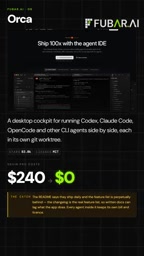
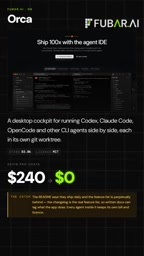
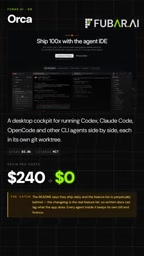
Orca is an open-source desktop tool that orchestrates multiple CLI coding agents — including Codex, Claude Code, and OpenCode — side by side, each in an isolated Git worktree. It supports macOS, Windows, Linux, and mobile, and can drive agents on remote hosts via SSH. Orca is vendor-neutral: users bring their own model subscriptions at no extra cost. Positioned as a free alternative to Devin Pro ($240/yr), it has surpassed 70,000 GitHub stars since launching in March, with daily updates tracked via changelog.
What Is Orca: A Multi-Agent Parallel Desktop Cockpit
Orca is a desktop tool positioned as an "Agent cockpit" that lets multiple command-line coding agents — including Codex, Claude Code, and OpenCode — run side by side, each with its own isolated Git worktree. This means different agents can work on the same codebase simultaneously without interfering with each other, each maintaining its own independent workspace.
This isn't a newcomer to the scene. According to its YouTube channel, it was created back in March, has already accumulated over 70,000 stars, and was still receiving new commits on the day of review — in other words, it's under active, high-frequency development.
Git worktree is a built-in Git feature that allows the same repository to be checked out into multiple different directories on disk simultaneously. Each directory can be on a different branch or commit state, while sharing the same .git object database — no need to clone the entire repo again. In Orca's context, each agent is assigned its own worktree, meaning files modified by Agent A won't affect Agent B's working directory. Both can progress independently on different feature branches or experiments without file lock conflicts. This is fundamentally different from "opening the same project in multiple windows" — the latter shares the same filesystem state and is prone to overwriting each other's changes.
Cross-Platform and Remote Capabilities
Orca supports all three major desktop platforms — macOS, Windows, and Linux — and also offers iOS and Android apps. Even more noteworthy is its remote driving capability: via SSH worktrees, Orca can drive these coding agents on a remote host.
This design frees developers from running everything on their local machine. Actual code execution can be offloaded to a server, while the desktop or mobile client acts purely as a "control panel." For developers who need long-running tasks or want to switch between multiple devices, this is a practical architectural choice.
Bring Your Own Subscription: No Vendor Lock-In
Orca's core philosophy is stated clearly in its repository description: you can run any coding agent using your own subscriptions, so the money you pay to model providers doesn't go to waste. In other words, Orca doesn't sell models or cover your Claude or OpenAI subscriptions — it's simply a shell that hosts and orchestrates those agents.
This is a crucial distinction. It means users can directly reuse their existing model subscriptions within Orca, without any additional model call fees stacking on top.
Positioned Against Devin Pro: Agent vs. Cockpit
Orca's pricing is positioned against Devin's Pro plan ($240/year). However, the comparison is a loose one — Devin itself is an agent, whereas Orca is a cockpit for driving the agents you already have.
This is key to understanding Orca's value: it doesn't compete head-on with Devin on features. Instead, it offers an alternative path. If you were considering a paid Devin Pro subscription, using Orca alongside your existing CLI agent subscriptions can deliver a similar multi-agent collaboration experience without any additional spend — saving you that annual fee.
Devin is an autonomous coding agent launched by Cognition AI, designed to independently complete full software engineering tasks — reading requirements, writing code, running tests, and fixing bugs. Its model, execution environment, and task scheduling are all managed by Cognition. Users who subscribe to Devin don't need to bring their own model or local environment, but in turn, compute resources and model selection are controlled by the service provider. Orca takes the opposite approach: it only provides an orchestration framework, with model capabilities sourced from the user's own Claude, OpenAI, or other subscriptions, and execution running on local machines or self-owned servers. Both serve a similar core need (having AI write code for you), but they differ fundamentally in control, cost structure, and data flow.
A Caveat Worth Noting: Docs Always Lag Behind Features
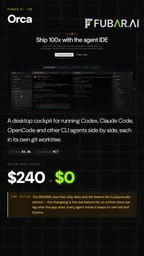
Orca does come with a caveat. According to its README, the development team ships updates every day, and the feature list "is always behind reality." The true record of current capabilities is the changelog — not the written documentation. This means the features described in official docs are often behind what the app can actually do.
For users looking to get started, this is both good news and a heads-up: the good news is that features iterate extremely fast, with something new almost every day; the heads-up is that if you want to know what Orca can actually do right now, checking the changelog is more reliable than reading the docs.
Summary
Orca represents a tool philosophy worth paying attention to: not replacing agents, but orchestrating them uniformly. It integrates different CLI coding assistants like Codex, Claude Code, and OpenCode into a single cockpit that supports cross-platform and remote execution, with each agent running in an isolated worktree to avoid conflicts — all while letting users continue using their own existing subscriptions. For developers already using multiple coding agents who don't want to pay extra for an integrated solution like Devin Pro, this is a cost-effective open-source alternative.
Related articles

ChatGPT Space Launches: Team Collaboration and New Pages Features Explained
ChatGPT Space is OpenAI's new team collaboration feature with Pages, real-time collaboration, and Slack/Google Drive sync. We break down its privacy design, multi-platform integration, and the full workflow from conversation to document.

Migrating Apache Spark UDFs to GPU Acceleration with AI Agents
NVIDIA developer blog explains how AI Agents rewrite Apache Spark UDFs for GPU acceleration, covering migration criteria, agent rewriting and verification workflows, plus pitfalls like result consistency and CPU-GPU transfer overhead.

Zed Editor v0.40.4-rc2 Released: Usage Credits Now Available Without Upgrading
Zed editor releases v0.40.4-rc2, allowing users to use usage credits for AI features without upgrading to a paid plan, lowering the trial barrier.