Organizing Machine Learning Notes with Claude Code: Self-Study Practices and Methodology for CS189
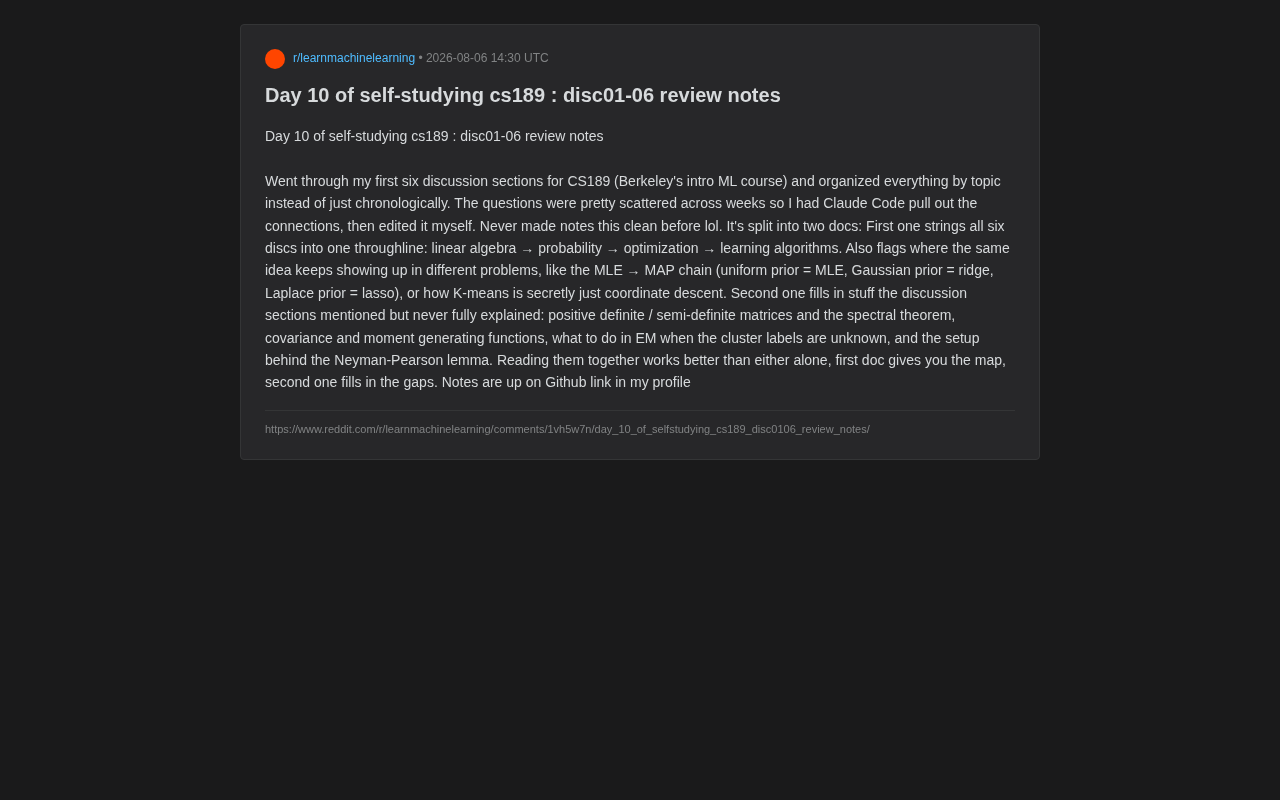
Using Claude Code to restructure CS189 machine learning notes by topic for deeper, systematic understanding.
A self-learner shares how they used Claude Code to reorganize scattered UC Berkeley CS189 machine learning discussion notes into a topic-based dual-document system. The first document builds a knowledge throughline connecting linear algebra, probability, optimization, and learning algorithms, while the second fills conceptual gaps. This AI-assisted workflow — AI draft plus human refinement — demonstrates an effective methodology for deep learning in the AI era.
When AI Becomes Your Study Partner
On the self-study journey, connecting scattered knowledge points into a coherent system has always been a core challenge for learners. Recently, a Reddit user shared their experience self-studying UC Berkeley's introductory machine learning course CS189, demonstrating how to organize and restructure study notes with the help of an AI tool (Claude Code). This case not only showcases the potential of AI-assisted learning but also reveals an entirely new methodology for knowledge organization.
CS189 (Introduction to Machine Learning) is a core upper-division course in UC Berkeley's Computer Science program, known for its mathematical rigor. It requires students to have a solid foundation in linear algebra, probability theory, and multivariable calculus. The course spans from supervised learning to unsupervised learning, from dimensionality reduction to kernel methods, emphasizing the derivation of algorithms from mathematical principles rather than simply calling pre-built machine learning libraries. The discussion sections are led by teaching assistants and typically focus on problem-solving exercises to help students reinforce the theoretical knowledge from lectures — and these are precisely the source material this learner used for their notes.
After completing the first six discussion sections, this learner chose not to organize their notes in traditional chronological order. Instead, they opted for a topic-based restructuring approach. They noted that the problems covered in discussions were quite scattered across different weeks, so they had Claude Code help identify the underlying connections between these knowledge points, then personally edited and refined the results. In their own words: "Never made notes this clean before lol."
The Claude Code mentioned here is a command-line AI coding agent developed by Anthropic. It can directly read local files, search file contents, and execute terminal commands — making it particularly well-suited for tasks that require organizing information across multiple files. In this case, the learner used Claude Code to read through multiple scattered discussion notes, having the AI identify knowledge connections and thematic groupings across different notes, then generate structured documents. This fully leveraged the tool's capabilities for processing long contexts and integrating information.
Dual-Document Structure: A Complementary Design of Global Map and Detail Filling
Document One: Building the Knowledge Throughline
This learner's note design was quite ingenious, adopting a dual-document structure where each document serves a distinct purpose while complementing the other.
The first document weaves the six discussion sections into a complete knowledge throughline, constructing a clear learning path:
Linear Algebra → Probability → Optimization → Learning Algorithms
This throughline isn't simply a list of knowledge points. More importantly, it annotates where the same idea appears repeatedly across different problems. This is precisely the most easily overlooked yet most valuable aspect of learning machine learning — recognizing the unity of underlying mathematical principles.
The document highlights several brilliant "conceptual connection points":
-
The MLE → MAP Chain: There exists an elegant correspondence between Maximum Likelihood Estimation (MLE) and Maximum A Posteriori (MAP) estimation. A uniform prior corresponds to MLE, a Gaussian prior corresponds to Ridge regression, and a Laplacian prior corresponds to Lasso regression. This connection reveals the Bayesian interpretation behind regularization.
Understanding this chain deeply requires grasping its mathematical essence: MLE is the core method of frequentist statistics, aiming to maximize the likelihood function P(D|θ); MAP introduces the Bayesian framework, maximizing the posterior probability P(θ|D) ∝ P(D|θ)·P(θ). When the prior is a uniform distribution, the prior term becomes a constant, and MAP degenerates to MLE; when the prior is a Gaussian distribution N(0, σ²I), taking the logarithm transforms the prior term into an L2 norm penalty λ||w||² on the parameters, which is exactly equivalent to Ridge regression's regularization term; a Laplacian prior corresponds to L1 norm penalty, i.e., Lasso regression. This correspondence profoundly reveals that regularization is not an ad hoc engineering trick but rather the natural result of imposing prior beliefs on parameters.
-
The True Nature of K-means: The K-means clustering algorithm is "secretly" just coordinate descent. This perspective brings a seemingly standalone algorithm back into a unified optimization framework.
K-means' standard procedure contains two alternating steps: the assignment step (assigning each data point to the nearest cluster center) and the update step (recomputing each cluster center as the mean of its members). The core idea of coordinate descent is to hold all other variables fixed while optimizing only one set of variables, then alternate. Placing K-means in this framework: the assignment step is equivalent to fixing cluster centers μ and optimizing data points' cluster labels; the update step fixes cluster labels and optimizes cluster centers — the two alternating steps are a concrete instance of coordinate descent. This unified perspective not only helps understand K-means' convergence (each step monotonically decreases the objective function) but also provides intuitive groundwork for understanding more complex iterative optimization methods like the EM algorithm.
This approach of "revealing hidden connections" is the hallmark of deep learning (in the cognitive sense) — not memorizing isolated facts, but understanding the structural relationships between them.
Document Two: Filling Conceptual Gaps in Understanding
The second document focuses on content that was mentioned but not fully explained in the discussion sections, filling the gaps in the knowledge system. These are often concepts that courses gloss over but are crucial for deep understanding:
-
Positive Definite/Semi-Definite Matrices and the Spectral Theorem: The spectral theorem states that any real symmetric matrix can be orthogonally diagonalized as A = QΛQ^T, where Q is an orthogonal matrix and Λ is a diagonal matrix of eigenvalues. A positive definite matrix is a symmetric matrix with all strictly positive eigenvalues, satisfying x^TAx > 0 for any non-zero vector x. In machine learning optimization, the positive definiteness of the Hessian matrix guarantees strict convexity of the objective function, ensuring that any local minimum is also the global minimum. Covariance matrices are inherently positive semi-definite — a property that guarantees non-negative variance and forms the theoretical foundation for methods like Principal Component Analysis (PCA) and Linear Discriminant Analysis (LDA).
-
Covariance and Moment Generating Functions: Core tools in probability theory for characterizing distribution properties of random variables. The moment generating function M(t) = E[e^{tX}] allows one to obtain successive moments (mean, variance, etc.) of a random variable by differentiating with respect to t and setting t=0. It is a powerful tool for deriving distribution properties and proving the distribution of sums of independent random variables.
-
Handling Unknown Cluster Labels in the EM Algorithm: The Expectation-Maximization (EM) algorithm is the classical method for parameter estimation in probabilistic models with latent variables. In scenarios like Gaussian Mixture Models, the E-step computes the posterior probability of each data point belonging to each cluster under the current parameter estimates (i.e., "soft assignment," as opposed to K-means' "hard assignment"); the M-step uses these posterior probabilities as weights to re-estimate model parameters. The EM algorithm guarantees that the log-likelihood never decreases at each iteration, thus converging to a local optimum. Notably, K-means can be viewed as the "hard" limiting case of the EM algorithm applied to Gaussian Mixture Models.
-
The Setup of the Neyman-Pearson Lemma: A fundamental theorem in statistical hypothesis testing theory, proposed by Neyman and Pearson in 1933. It proves that under a given significance level α constraint, the likelihood ratio test is the most statistically powerful test. In machine learning, this idea directly relates to the design of optimal decision boundaries in classification problems — many classification algorithms are essentially variants of thresholding the likelihood ratio under different assumptions.
The author specifically emphasized that the two documents work best when read together: the first gives you a global map, and the second fills in the map's detail gaps. Reading either one alone is less complete than using them in combination.
Methodological Insights for AI-Assisted Learning
Human-AI Collaboration, Not Complete AI Dependence
The most noteworthy aspect of this case is that the author didn't let AI do everything. Their workflow was: have Claude Code extract connections between knowledge points, then personally edit the results. This "AI draft + human refinement" pattern is precisely the ideal form of AI-assisted learning today.
AI excels at rapidly identifying patterns and connections across large volumes of scattered information — this is exactly where it adds value in organizing "scattered problems across different weeks." The learner's own editing process ensures that knowledge is truly internalized and understood, rather than mechanically copied. After all, the essence of organizing notes is learning, not producing documents.
This workflow also resonates with findings from cognitive science research on learning: active elaboration and retrieval practice are keys to deep learning. Having AI generate a first draft reduces the cognitive load of organizing information, allowing learners to focus their limited attentional resources on higher-level understanding and critical evaluation — judging whether the connections AI extracted are accurate, whether important links were missed, and whether the intuition behind a mathematical derivation is correct.
Topic-Based Organization Beats Chronological Organization
Traditional class notes are typically arranged chronologically, which matches the pace of instruction but not the logical structure of knowledge itself. This learner took the opposite approach, organizing content by topic rather than time — essentially performing a "re-indexing" of knowledge.
This restructuring process is itself an expression of deep learning — you must understand which topic each knowledge point belongs to and which concepts it relates to in order to classify it effectively. AI handles the "heavy lifting" of identifying cross-chapter connections, allowing the learner to focus on higher-level knowledge integration.
From a cognitive psychology perspective, this approach aligns closely with the concept of "interleaving." Research shows that mixing different topics together for study (rather than mastering them one chapter at a time), while feeling more difficult in the short term, produces significantly better long-term retention and transfer ability compared to blocked study. By reorganizing discussion content by topic, the learner essentially created a reference resource that supports interleaved review.
Practical Advice for Machine Learning Self-Learners
For those currently self-studying machine learning or other complex courses, this case offers several lessons worth adopting:
First, leverage AI to extract knowledge connections. When facing knowledge scattered across multiple chapters, use AI tools like Claude Code to quickly discover underlying connections, saving significant manual organizing time.
Second, adopt a topic-based note structure. Organizing knowledge along logical throughlines rather than simple chronological lists helps build a systematic knowledge framework.
Third, pay attention to "unexplained gaps." Concepts that courses gloss over are often the root cause of understanding barriers. Specifically organizing these can significantly deepen your learning. In machine learning, these "gaps" are usually mathematical prerequisites — such as matrix decomposition in linear algebra or distribution property derivations in probability theory — which courses assume as known but are often where self-learners get stuck.
Fourth, commit to sharing your learning outcomes publicly. The author published their notes on GitHub. This open learning attitude not only makes it easy for others to reference but also serves as a validation of one's own learning. Learning in public forces learners to convert vague understanding into clear articulation — a process that is itself an effective learning strategy.
It's worth noting that CS189, as Berkeley's classic introductory machine learning course, covers a complete system from linear algebra foundations to advanced learning algorithms. Being able to organize the first six discussion sections this systematically reflects a solid learning attitude. This "Day 10 of self-study" record showcases not just a set of notes, but a way of thinking about efficient learning in the AI era.
Related articles

DeepCell: One-Click AI Generation of Documents, Spreadsheets, and Slides
DeepCell tops Product Hunt with one-click generation of documents, spreadsheets, and slides, using the .deepcell format for linked updates, designed for System 2 tasks like modeling and sales reviews.

Doneas: 15-Minute Daily Accountability Calls That Keep Indie Developers From Procrastinating
Doneas is a daily accountability tool for indie developers: plan tasks on Monday, join a 15-minute call with five builders each day, and log deliveries on a public progress page. This article analyzes its core mechanics, effectiveness, and potential issues around retention and matching.

Fastlane 2.0: Fully Automated AI Ad Campaigns, From Creative to Optimization
Fastlane 2.0 is an AI ad automation tool: enter your website and it learns your brand, generates video and image ads, and runs and optimizes them on Meta, TikTok, Instagram, and YouTube.