Self-Hosted Inference vs. Pay-Per-Token: Where Is the Break-Even Point?
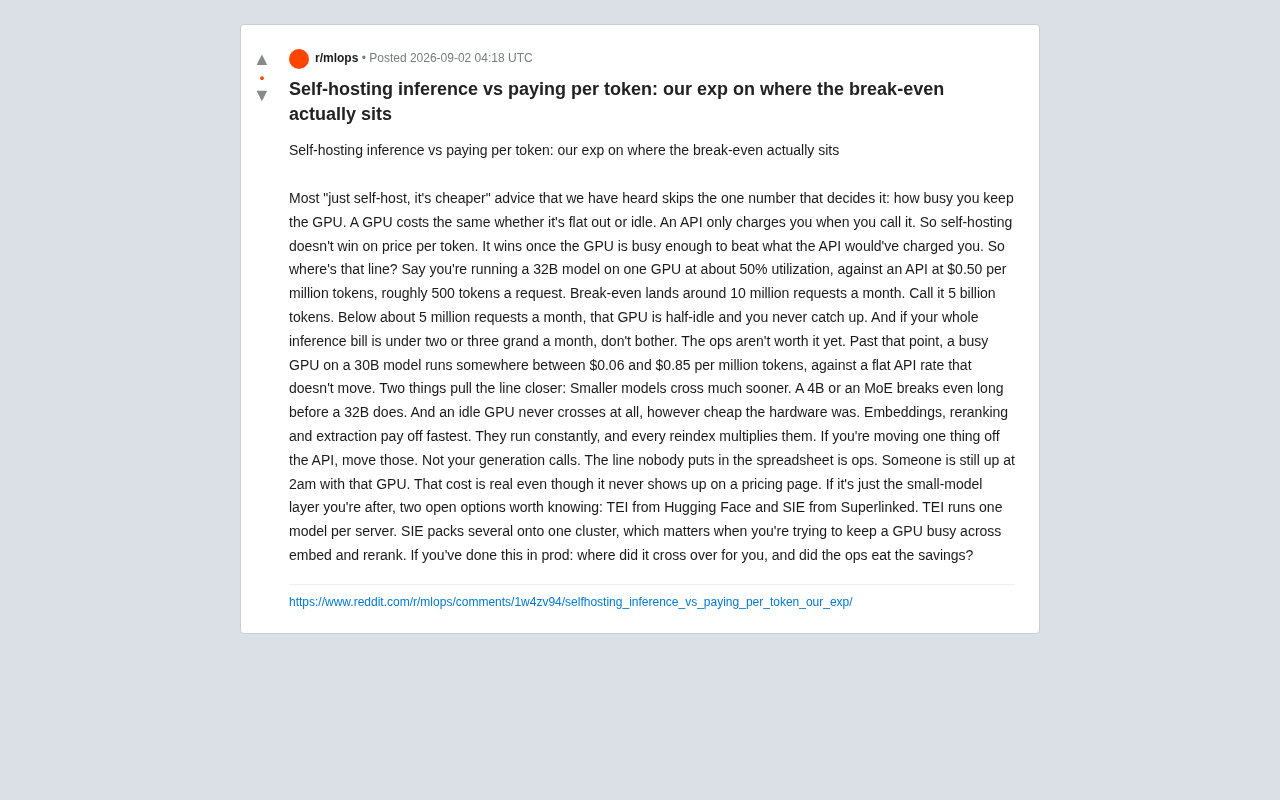
Self-hosted inference only pays off when GPU utilization is high enough—the break-even point is around 5 billion tokens/month.
This article provides a rigorous cost comparison between self-hosted GPU inference and pay-per-token API services. Through quantitative analysis, it reveals a break-even point of approximately 5 billion tokens per month (~$2,000–$3,000 in API spend). It examines how GPU utilization, model size, workload type (embedding/reranking vs. generation), and often-overlooked operational costs shape the decision, and compares open-source frameworks TEI and SIE for self-hosted deployments.
GPU Utilization Is the Real Decision Variable
"Self-hosting is cheaper" has been a widely circulated claim in the AI engineering community, but most advocates skip over a critical number: GPU utilization. The hardware cost of a GPU is fixed—the bill stays the same whether it's running at full capacity or sitting idle. APIs, on the other hand, only charge when called. Therefore, self-hosting doesn't inherently have a lower per-token cost—it only becomes truly cost-effective when the GPU stays busy enough that the cumulative savings exceed API fees.
The GPU utilization problem is fundamentally a classic fixed-cost amortization problem from economics. When a company purchases or leases GPUs (such as NVIDIA A100 or H100), whether buying hardware or reserving cloud instances, a fixed monthly cost is incurred. This follows the exact same logic as capacity utilization in manufacturing—a production line that only runs 4 hours per day allocates 6 times the fixed cost per unit compared to one running at full capacity. In GPU inference scenarios, the actual cost per token = monthly fixed cost ÷ total tokens processed per month. Therefore, every 10-percentage-point increase in utilization significantly reduces the per-token cost, which is why utilization is the core variable that determines whether self-hosting is worthwhile.
Where exactly is this "busy enough" tipping point? That's the question worth serious discussion.
Quantitative Break-Even Analysis
Baseline Scenario Calculation
Using a single GPU running a 32B parameter model as an example, with an assumed average utilization of about 50%, compared against API pricing of $0.50 per million tokens and approximately 500 tokens per request, we can draw the following conclusions:
The 32B parameter model referenced here refers to a large language model with approximately 32 billion trainable parameters, such as Qwen2.5-32B or certain versions in the DeepSeekAd series. Model parameter count directly determines memory usage and compute requirements during inference—at FP16 precision, a 32B model requires approximately 64GB of VRAM just to load the weights, typically needing a single 80GB A100/H100 GPU for full deployment. Understanding this hardware constraint is essential to understanding the baseline assumptions in the cost calculations that follow.
- Monthly request volume below 5 million: The GPU remains half-idle long-term, and the cost can never match the flexibility of APIs
- The break-even point is approximately 10 million requests/month, equivalent to roughly 5 billion tokens
- Beyond this volume: A busy GPU running a 30B-class model achieves an actual cost of approximately $0.06–$0.85 per million tokens, while API rates remain fixed
This data reveals a counterintuitive reality: if your monthly inference bill is less than two to three thousand dollars, self-hosting simply doesn't make economic sense. The value of the operational investment has not been unlocked.
Factors That Can Move the Break-Even Point Earlier
Two types of scenarios can significantly reduce the request volume needed to reach break-even:
Smaller models: 4B parameter models or MoE-architecture models have far lower per-inference costs than 32B models, allowing the break-even threshold to shift dramatically earlier. 4B parameter models (such as Phi-3-mini or Llama 3.2 3B) require only about 8GB of VRAM and can run on consumer-grade GPUs—a single card can even serve multiple model instances simultaneously, which is the hardware basis for why small models can drastically lower the break-even threshold. MoE (Mixture of Experts) is a sparsely activated model design whose core idea is that although the model has a large number of total parameters, only a small subset of "expert" sub-networks are activated during each inference pass. For example, Mixtral 8x7B has approximately 46.7 billion total parameters, but each forward pass only activates about 13 billion parameters, making the inference compute closer to a 13B model than a 47B model. DeepSeek-V3 and certain versions in the Qwen series also use MoE architecture, achieving a better balance between inference efficiency and model capability. If your business only needs small models or MoE models, the economics of self-hosting look much more favorable.
High-frequency, batch-oriented tasks: Embedding generation, reranking, and information extraction are the workloads most worth migrating. To understand why these tasks are the best candidates for self-hosting, consider their technical characteristics: Text embedding is the process of converting text into fixed-dimensional dense vector representations and is a foundational component of semantic search and RAG (Retrieval-Augmented Generation) systems. Every document ingestion and index update requires embedding computation on full or incremental text, which is why its token consumption often far exceeds that of user-side queries. Reranking uses a cross-encoder to perform fine-grained relevance scoring on query-document pairs on top of initial retrieval results, improving final retrieval quality. These two types of tasks share common characteristics: smaller models (typically a few hundred million to a few billion parameters), fast per-inference times, but extremely high call frequencies. Each index rebuild multiplies token consumption. In contrast, generation tasks use LLMs with large parameter counts and long per-inference times (involving autoregressive token-by-token generation), but with relatively lower call frequencies and higher per-call costs. Therefore, from a GPU utilization perspective, embedding and reranking tasks are more likely to keep GPUs fully occupied, making them ideal workloads for priority migration to self-hosting, with generation tasks as secondary candidates.
Operational Costs: The Line That Never Appears in Spreadsheets
Beyond quantitative analysis, there is one cost that almost never appears in any comparison table: operational staffing.
Self-hosting means someone needs to handle GPU failures at 2 AM, maintain version compatibility for model serving, and make scaling decisions during traffic spikes. The engineering time consumed by these tasks is real, even if it doesn't show up on a cloud bill. Specifically, the operational complexity of GPU inference services is far greater than traditional web services—there is a strict compatibility matrix between CUDA driver versions, inference framework versions, and model weight formats, and a careless driver upgrade can render an entire inference cluster unavailable. Additionally, GPU hardware has a higher failure rate than standard CPU servers, and issues like memory errors (ECC errors) and GPU thermal throttling all require dedicated monitoring and incident response mechanisms.
For startup teams or small-to-medium-scale deployments, this hidden cost is often enough to wipe out every penny saved on hardware. When making decisions, operational overhead must be factored in rather than defaulted to zero.
Open-Source Inference Framework Selection Guide
If the case for self-hosting has been confirmed, there are currently two open-source inference frameworks worth considering:
TEI (Text Embeddings Inference)
An inference serving framework from Hugging Face, specifically optimized for text embeddings. TEI is written in Rust and supports dynamic batching, token-level traffic control, and GPU acceleration technologies like Flash Attention, enabling extremely high embedding throughput on a single card. It supports model loading in ONNX and SafeTensors formats, integrates seamlessly with the Hugging Face ecosystem, is easy to deploy, and has an active community. However, architecturally each server runs only one model—this "one server, one model" design philosophy simplifies deployment and debugging complexity, but in scenarios requiring both embedding and reranking services simultaneously, it means maintaining multiple independent servers, which can lead to uneven utilization across multiple GPUs and limited room for improving GPU utilization.
SIE (Superlinked Inference Engine)
An inference engine from Superlinked that supports deploying multiple models simultaneously on a single cluster. The core value of this multi-model co-location strategy lies in smoothing GPU load through task mixing—when embedding requests are in a trough, reranking requests may be at peak, and multiple models sharing the same set of GPU resources can push both hardware time utilization and memory utilization close to their peaks. This scheduling strategy is similar to multi-task time-division multiplexing in operating systems, or the resource overcommit logic in cloud computing. The technical challenges in achieving this include memory isolation and dynamic allocation, request priority scheduling, and inference latency SLA guarantees across different models—NVIDIA's MPS (Multi-Process Service) and MIG (Multi-Instance GPU) technologies provide foundational support for hardware-level resource isolation. When a business needs to keep GPUs continuously busy across embedding and reranking tasks, SIE's multi-model co-location architecture has a clear advantage in resource utilization efficiency. For teams looking to reach the break-even point as quickly as possible through high utilization, this is a solution worth serious evaluation.
Neither framework is absolutely superior—what matters is whether your workload involves single-model high concurrency or multi-model mixed scheduling.
Decision Framework: Three Questions to Set Your Direction
Synthesizing the analysis above, before making a self-hosted inference decision, you can quickly orient yourself with three questions:
-
Does your average monthly token consumption exceed 5 billion (or does your monthly inference bill exceed $2,000–$3,000)? If not, the flexibility and zero-ops advantage of API solutions is hard to beat.
-
Can GPU utilization be consistently maintained at a high level? An idle GPU is never cost-effective, no matter how cheap it is. High-frequency tasks like embedding and reranking are the best candidates, with generation tasks as secondary.
-
Does your team have the capacity and willingness to bear operational costs? If engineering resources are tight, this hidden cost can be more fatal than hardware costs.
The economic logic of self-hosted inference isn't complicated, but it requires decision-makers to maintain a clear understanding of their actual workloads rather than being led astray by the intuition that "self-hosting is inherently cheaper." Put GPU utilization at the center of your analysis, and the rest of the questions will naturally become clear.
Related articles

Chain of Thought Isn't Just for AI: How Humans Can Use CoT to Improve Thinking Quality
Chain of Thought isn't just a prompt trick for large models. Starting from a Hacker News discussion, this article analyzes why CoT works for human thinking too, breaks down actionable ways to transfer it, and highlights the key differences between human CoT and machine CoT.
Cloudflare Teams Up with OpenAI: Closi…
Cloudflare Teams Up with OpenAI: Closing the Loop from Vulnerability Discovery to Defense with AI
Cloudflare uses OpenAI Daybreak to investigate security vulnerabilities and generate reviewable remediation plans, while developers use Codex to boost coding efficiency and quality.

Orca Multi-Agent Orchestration in Practice: A Guide to Parallel Collaboration with Claude and Codex
Orca is Stable AI's free open-source agent workbench supporting 34 agents like Claude Code and Codex in parallel. Learn its Git worktree isolation, multi-model orchestration, and mobile management.