Orkas: The Local-First Open-Source AI Team on Your Desktop, with a Commander Orchestrating 16 Expert Agents
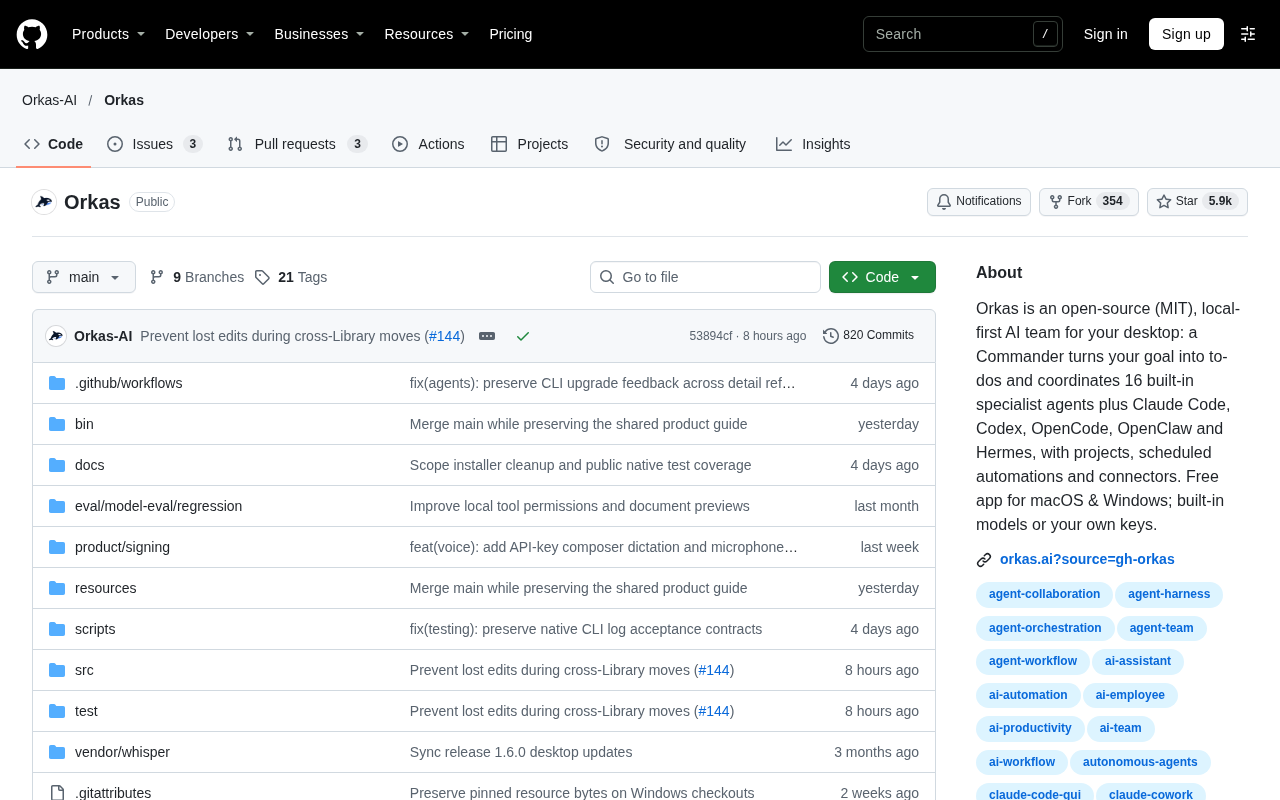
Orkas is an MIT-licensed, open-source, local-first desktop AI team app where a Commander orchestrates multiple agents to execute goals.
Orkas is an open-source project on GitHub that has recently drawn concentrated attention. It is positioned as a local-first desktop AI team application, supports macOS and Windows, and uses the MIT license. After the user provides a goal, the built-in Commander breaks it down into to-dos and dispatches 16 built-in expert agents as well as external coding agents such as Claude Code, Codex, OpenCode, OpenClaw, and Hermes to execute them. It emphasizes local-first operation, allowing users to use built-in models or bring their own API key, and includes project spaces, scheduled automation, and connectors. The project currently has 5,805 stars and 353 forks, with 1,004 stars added in a single day. The article argues that its ecosystem position lies between coding agents and workflow automation platforms, but its stability and the boundaries of agent capabilities at this early stage still need to be verified.
An open-source tool that brings an AI team to your desktop
The Orkas-AI/Orkas project on GitHub has recently drawn significant attention, gaining 1,004 stars in a single day, with 5,805 stars and 353 forks in total. Its positioning is clear: it provides an open-source (MIT license), local-first AI team for the desktop. The user simply provides a goal, and the built-in "Commander" breaks it down into to-dos and coordinates 16 built-in expert agents, as well as external coding agents such as Claude Code, Codex, OpenCode, OpenClawAd, and Hermes, to execute them.
This design approach differs from the single chat-style AI assistants on the market. It is not content with answering questions; instead, it attempts to run the complete "goal—task—execution" chain locally on the desktop, and together with project spaces, scheduled automation, and connectors, it forms a continuously operating personal workbench.
How Commander organizes a team of agents
From goals to to-dos: the task decomposition layer
The core of Orkas is the Commander role. It takes on the responsibility of a "dispatcher" rather than an "executor": it breaks the user's natural-language goal into executable to-dos and then assigns them to the appropriate expert agents. This layered structure is consistent with the common pattern of multi-agent collaboration frameworks, but Orkas turns it into an out-of-the-box desktop application rather than a library that you have to build yourself.
Multi-agent collaboration frameworks typically include three types of roles: the planner (breaking goals into steps), the executor (calling tools to complete specific tasks), and the coordinator (balancing resources and dependencies). There are two common implementation paradigms—one is centralized orchestration, in which a main agent dispatches subtasks in sequence; the other is decentralized negotiation, in which agents dynamically divide work through message passing. The centralized model is easier to debug and reproduce, but it relies heavily on the planning ability of the main agent; the decentralized model is more flexible, yet it is prone to task duplication or deadlocks. Orkas's Commander is a typical centralized orchestration role, concentrating complexity in the scheduling layer so that expert agents only need to focus on their respective functions.
16 built-in experts + external coding agents
The 16 built-in expert agents cover different functions, though the official description does not elaborate on the specific list. More noteworthy is its compatibility with third-party coding agents: Claude Code, Codex, OpenCode, OpenClaw, and Hermes can all be invoked by the Commander. This means that users' existing coding agent subscriptions or workflows do not have to be discarded; instead, they are incorporated into unified scheduling.
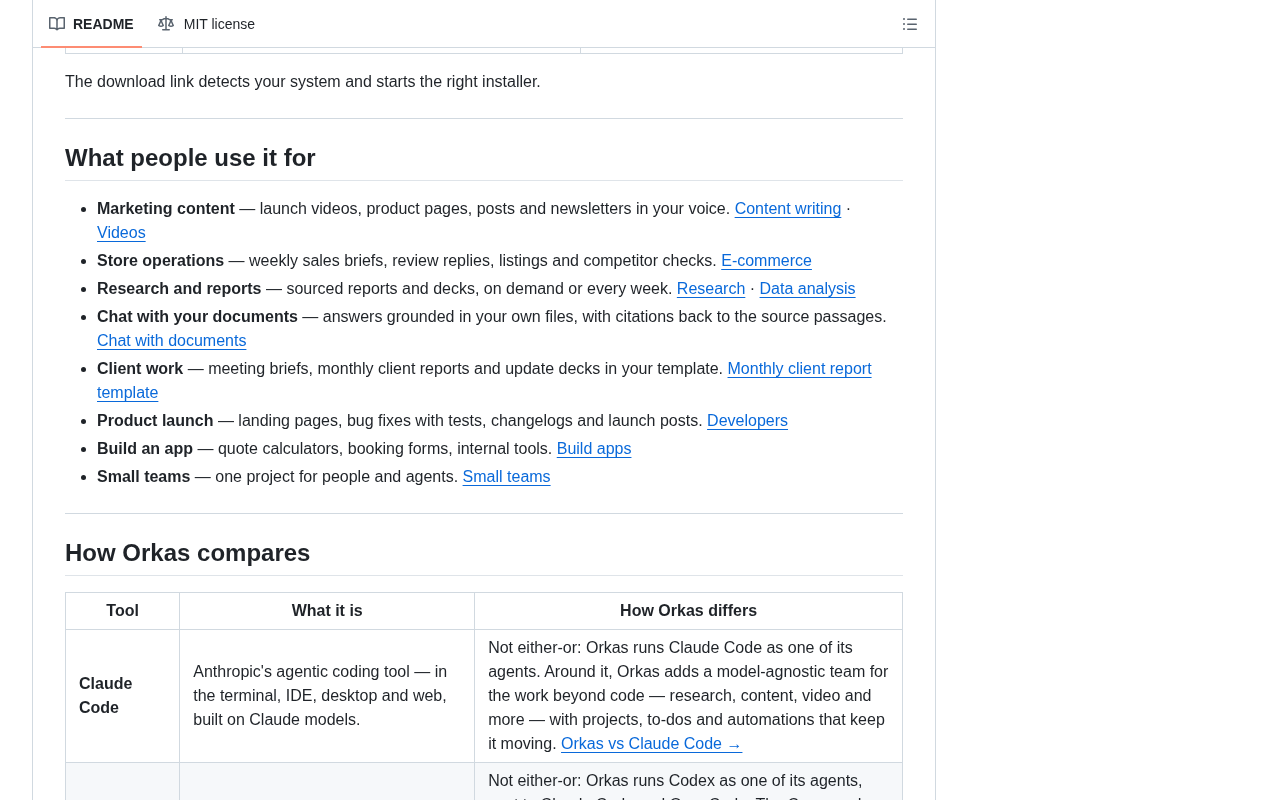
Claude Code is Anthropic's in-terminal coding agent that can directly read and write project files, execute commands, and complete multi-step refactoring; Codex originally referred to OpenAI's series of code generation models and later extended to a coding agent product; OpenCode, OpenClaw, and Hermes are mostly community-driven open-source coding agents or agent runtimes. What these tools have in common is file system access, command execution, and iterative correction capabilities, but each has a different model backend, permission model, and interaction interface. Bringing them all into a single scheduling layer is actually difficult because of protocol and context format adaptation: different agents represent task descriptions, tool call results, and session states inconsistently, requiring an intermediate layer to normalize them.
What local-first means
"local-first" is a keyword that Orkas repeatedly emphasizes. It offers free applications for macOS and Windows, and users can either use built-in models or enter their own API key.
This has practical significance for users who are privacy-sensitive or want to control costs: data and task orchestration remain on the local desktop, while model invocation depends on the path the user chooses. Compared with products that host all context in the cloud, this model goes a step further in controllability. However, it should be noted that the source material does not disclose the specific technical details of local operation, such as which parts are truly offline and which still require a network connection, so it is not appropriate to over-infer its privacy strength.
local-first was proposed by Ink & Switch in 2019, initially for collaborative software. Its core claim is that the primary copy of data is stored on the user's device, with the network serving only as a means of synchronization and enhancement, thereby ensuring offline availability, low latency, and data ownership. In AI applications, this idea has been extended into a hybrid form of "orchestration and data locally, model inference in the cloud." Three layers need to be distinguished: whether the interface and task state are stored locally, whether model inference is performed locally, and whether tool calls access external services. The three can be chosen independently, so "local-first" is not equivalent to "fully offline"; when evaluating privacy strength, each item should be confirmed individually.
Project data and ecosystem position
The current 5,805 stars, 353 forks, and single-day growth of 1,004 stars indicate that it has received concentrated short-term attention in the developer community. The project is written in JavaScript and uses the MIT license, which means the barriers to secondary development and commercial use are low.
From an ecosystem perspective, Orkas sits between two types of products: one is coding agents such as Cursor and Claude Code, and the other is Notion AI and various workflow automation platforms. With the combination of "Commander + expert agents + scheduled automation + connectors," it attempts to build a personal version of an AI team operating system. Whether this direction can be sustained depends on the actual quality of the built-in agents and the richness of the connectors, and these cannot be verified at the level of the introductory description.
Who should try it
- Developers who want to unify the scheduling of multiple coding agents and avoid switching between multiple terminals;
- Users who have requirements for data localization and prefer to bring their own API key;
- Engineers who want to study multi-agent collaboration and task orchestration implementation approaches; the MIT license makes it easy to read and modify the code.
It should be noted that the project is currently in an early stage of high attention, and its actual stability, the boundaries of agent capabilities, and the reliability of automation still need to be verified by more users. It is recommended to try it on a small scale first before deciding whether to incorporate it into daily workflows.
One-line Summary
Orkas is an MIT-licensed, open-source, local-first desktop AI team application in which a Commander orchestrates multiple agents to execute goals.
Related articles

Anthropic Files S-1: $16.3B Revenue, $80.7B Net Loss in Half a Year — Who Controls the Company?
Anthropic files S-1 for a Nasdaq IPO: H1 2026 revenue of $16.3B, an $80.7B net loss from valuation remeasurement rather than cash burn, founders' Class F shares holding 50.1% voting power, and no price or date yet.

Anthropic Files S-1: The Truth Behind $16.3B Revenue and $80.7B Loss
Anthropic's S-1 reveals $16.3B revenue and $80.7B net loss in H1 2026, with $72.4B from accounting effects. The filing also discloses $265.6B compute commitments, cloud deal details, and a 50.1% founder voting control structure, while IPO pricing remains blank.

Anthropic Financials Leaked: Revenue Far Exceeds Compute Costs, Claude Inference Gross Margin Hits 68%
Leaked Anthropic financials show revenue roughly twice total compute costs, Claude inference gross margin at 68%, while frontier training burns $2.8B per quarter. This article breaks down the two accounts and analyzes shifts in AI company valuation logic.