Ornith-1.5 Deep Dive: The Technical Path from Self-Scaffolding to Self-Evolving AI

Ornith-1.5 charts a path from AI self-scaffolding to autonomous self-improvement and evolution.
Ornith-1.5 proposes a clear evolutionary path for AI agents — from self-scaffolding (dynamically building execution workflows) to self-improvement (learning from experience to continuously optimize performance). This article analyzes the technical approach, its alignment with frameworks like Self-Refine and Reflexion, potential applications, and the significant challenges that remain before autonomous AI evolution becomes a reality.
Introduction: A New Milestone in AI Self-Improvement
As large language model capabilities continue to advance, enabling AI systems to break free from human intervention and achieve true "self-evolution" has become one of the industry's most critical challenges. Ornith-1.5, a project that recently appeared on Hacker News, represents a noteworthy exploration of exactly this theme. Its subtitle — "From Self-Scaffolding to Self-Improvement" — precisely captures the core evolutionary logic of the system.
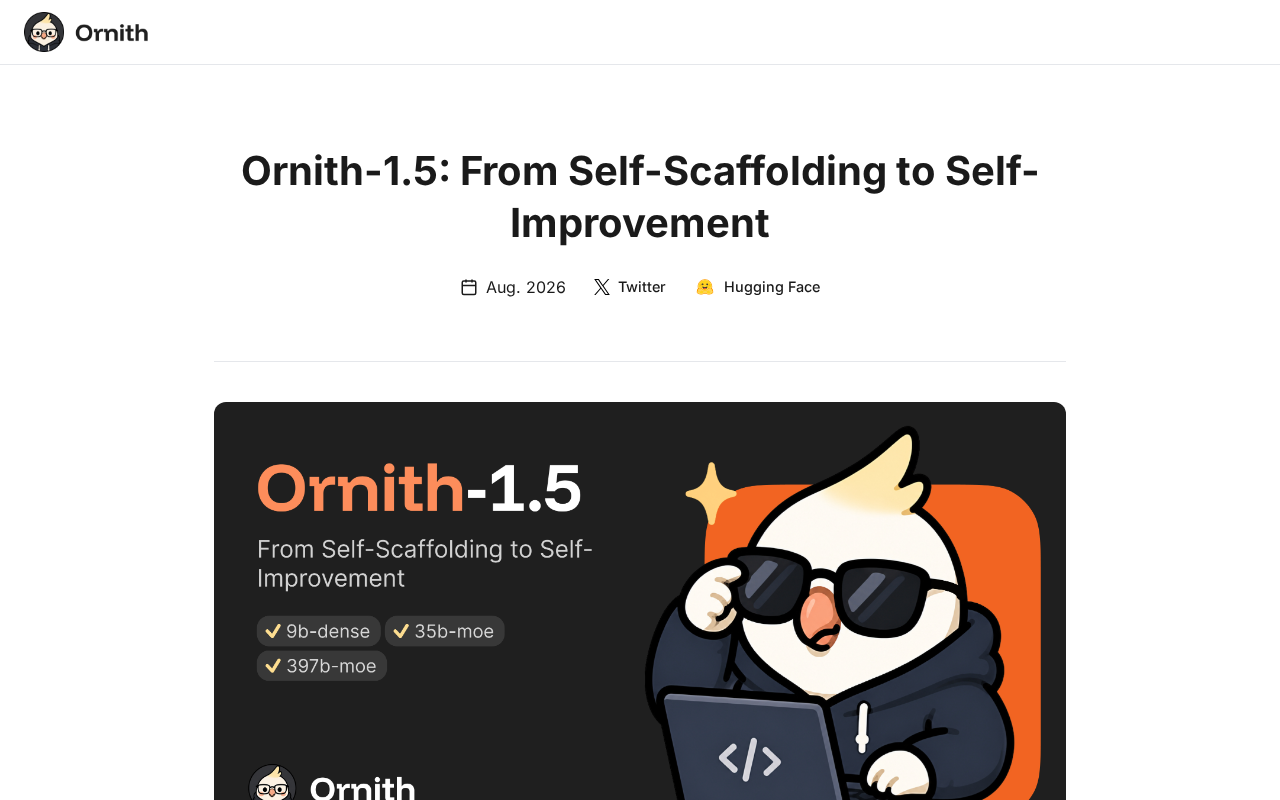
This article examines Ornith-1.5 from three perspectives — technical approach, design philosophy, and industry significance — while exploring the potential impact that "self-improving" AI systems like this could have on the future.
What Is Self-Scaffolding?
From Passive Execution to Active Construction
Traditional AI Agent systems typically follow workflows pre-designed by human engineers — including prompt templates, tool-calling logic, task decomposition strategies, and more. This "scaffolding" is essentially an externally built framework, with the model merely filling in content within its boundaries.
"Self-scaffolding" means the system no longer relies entirely on human-preset frameworks. Instead, it can dynamically construct its own execution workflow based on task requirements. In other words, the model begins participating in meta-level decisions about how to accomplish a task, not just the task completion itself.
The Technical Value of Self-Scaffolding
The significance of this capability lies in reducing the system's dependence on manual tuning. In complex, ever-changing real-world scenarios, human-designed scaffolding often fails to cover every situation. A system with self-scaffolding capabilities can adaptively organize solutions for unfamiliar tasks. This is precisely the capability upgrade emphasized by the "1.5" version iteration in Ornith's naming — moving from fixed scaffolding to flexible self-construction.
From Self-Scaffolding to Self-Improvement: Ornith-1.5's Core Leap
Evolutionary Logic: From Spatial Adaptation to Temporal Evolution
The most ambitious part of Ornith-1.5's subtitle is "Self-Improvement." If self-scaffolding addresses "how to build a workflow for a single task," then self-improvement goes a step further, tackling the deeper question: can a system learn from past experience and continuously optimize its own performance?
This leap represents a fundamental distinction: self-scaffolding is adaptive capability in the spatial dimension, while self-improvement is evolutionary capability in the temporal dimension. A system capable of self-improvement would theoretically accumulate knowledge about its own capability boundaries, failure modes, and optimization directions through repeated task execution, forming a positive feedback loop.
Key Elements of an AI Self-Improvement Loop
To achieve genuine self-improvement, a system typically needs several core capabilities:
- Self-evaluation: Assessing the quality of its own outputs and degree of task completion
- Error attribution: Analyzing the root causes of failures or suboptimal results
- Strategy adjustment: Modifying subsequent execution strategies based on feedback
- Experience consolidation: Crystallizing effective improvements into reusable capabilities
Once this loop is operational, an AI system could potentially improve its performance through runtime iteration — without requiring large-scale retraining.
Industry Context: How Ornith-1.5 Connects to Mainstream AI Research
Alignment with Self-Refine, Reflexion, and Similar Frameworks
The direction Ornith-1.5 explores is highly aligned with several hot trends in the AI field. In recent years, academic frameworks like Self-Refine and Reflexion, along with the industry's relentless pursuit of agent autonomy, all point toward the same goal: giving AI systems greater autonomy and evolutionary capability.
What makes Ornith-1.5's narrative relatively unique is its combination of "self-scaffolding" and "self-improvement" into a single, clear evolutionary path. Rather than stopping at point improvements, it attempts to chart a complete growth curve — from static to dynamic, from human-dependent to autonomously evolving.
Potential Applications
If systems like this can mature and be deployed in production, their value would manifest across multiple domains:
- Software development: Self-improving agents could continuously optimize their solutions across ongoing coding tasks
- Complex Q&A and research scenarios: Systems could automatically adjust retrieval and reasoning strategies based on feedback
- Long-running automation workflows: Reduced manual maintenance costs coupled with improved system robustness
A Sober Perspective: Challenges and Limitations of AI Self-Evolution
Here's a telling detail: based on Hacker News data, the project currently has only 6 upvotes and no comment discussions. This reminds us that Ornith-1.5 is still in a relatively early, niche stage, and its actual effectiveness and technical maturity require further validation.
"Self-improvement" is an incredibly appealing yet equally challenging goal. History is filled with projects built around similar concepts, but systems that achieve stable, reliable, and scalable self-evolution remain exceedingly rare. The core difficulties include:
- How do you ensure self-improvement moves in the right direction?
- How do you prevent the system from getting trapped in erroneous local optima during iteration?
- How do you guard against capability degradation?
None of these questions have mature, universal solutions yet. Therefore, the rational approach to projects like Ornith-1.5 is to stay attentive to their directional value while carefully evaluating their real-world viability.
Conclusion: The Future of Autonomous AI Evolution
Ornith-1.5 outlines a possible path toward autonomous AI Agent evolution, anchored by the theme of "from self-scaffolding to self-improvement." It reflects the industry's ongoing pursuit of greater AI autonomy — building systems that can not only complete tasks but also construct workflows, reflect on outcomes, and optimize themselves.
Although the project currently has limited visibility, the technical direction it represents deserves the attention of every AI practitioner. As large model reasoning capabilities and agent frameworks continue to mature, "self-improvement" may well transition from concept to reality, becoming a defining feature of next-generation AI systems. It's worth keeping a close eye on projects like this to capture the trends and signals shaping the industry's future.
Related articles

Chain of Thought Isn't Just for AI: How Humans Can Use CoT to Improve Thinking Quality
Chain of Thought isn't just a prompt trick for large models. Starting from a Hacker News discussion, this article analyzes why CoT works for human thinking too, breaks down actionable ways to transfer it, and highlights the key differences between human CoT and machine CoT.
Cloudflare Teams Up with OpenAI: Closi…
Cloudflare Teams Up with OpenAI: Closing the Loop from Vulnerability Discovery to Defense with AI
Cloudflare uses OpenAI Daybreak to investigate security vulnerabilities and generate reviewable remediation plans, while developers use Codex to boost coding efficiency and quality.

Orca Multi-Agent Orchestration in Practice: A Guide to Parallel Collaboration with Claude and Codex
Orca is Stable AI's free open-source agent workbench supporting 34 agents like Claude Code and Codex in parallel. Learn its Git worktree isolation, multi-model orchestration, and mobile management.