Orphex MCP: One Gateway to Unify the Marketing Tech Stack

Orphex MCP integrates 65+ marketing platforms via a unified gateway, enabling AI to move from Q&A to direct execution.
Orphex MCP is a unified MCP gateway for digital marketing teams, solving multi-platform tool fragmentation. It handles authentication and integration for 65+ platforms, giving AI cross-channel context without separate connectors. More importantly, Orphex lets AI go beyond Q&A to execute real operations like reallocating budgets and pausing unprofitable creatives, with logging and guardrails ensuring traceability and control. It received 113 upvotes and 26 comments on Product Hunt, ranking No. 4 for the day, with a free start and 30% off the first month. Orphex represents MCP's expansion from developer tools into vertical business scenarios, with the intermediary gateway model poised to reshape marketing AI workflows.
Digital marketing teams' toolboxes are becoming more bloated than ever. Google Ads, Shopify, various analytics platforms... every channel has its own login system, data formats, and operational logic. When AI tries to truly function in such a fragmented environment, it often gets stuck at the very first step: obtaining unified context. Orphex MCP, a new product ranked No. 4 on Product Hunt, attempts to solve this old problem with the MCP protocol.
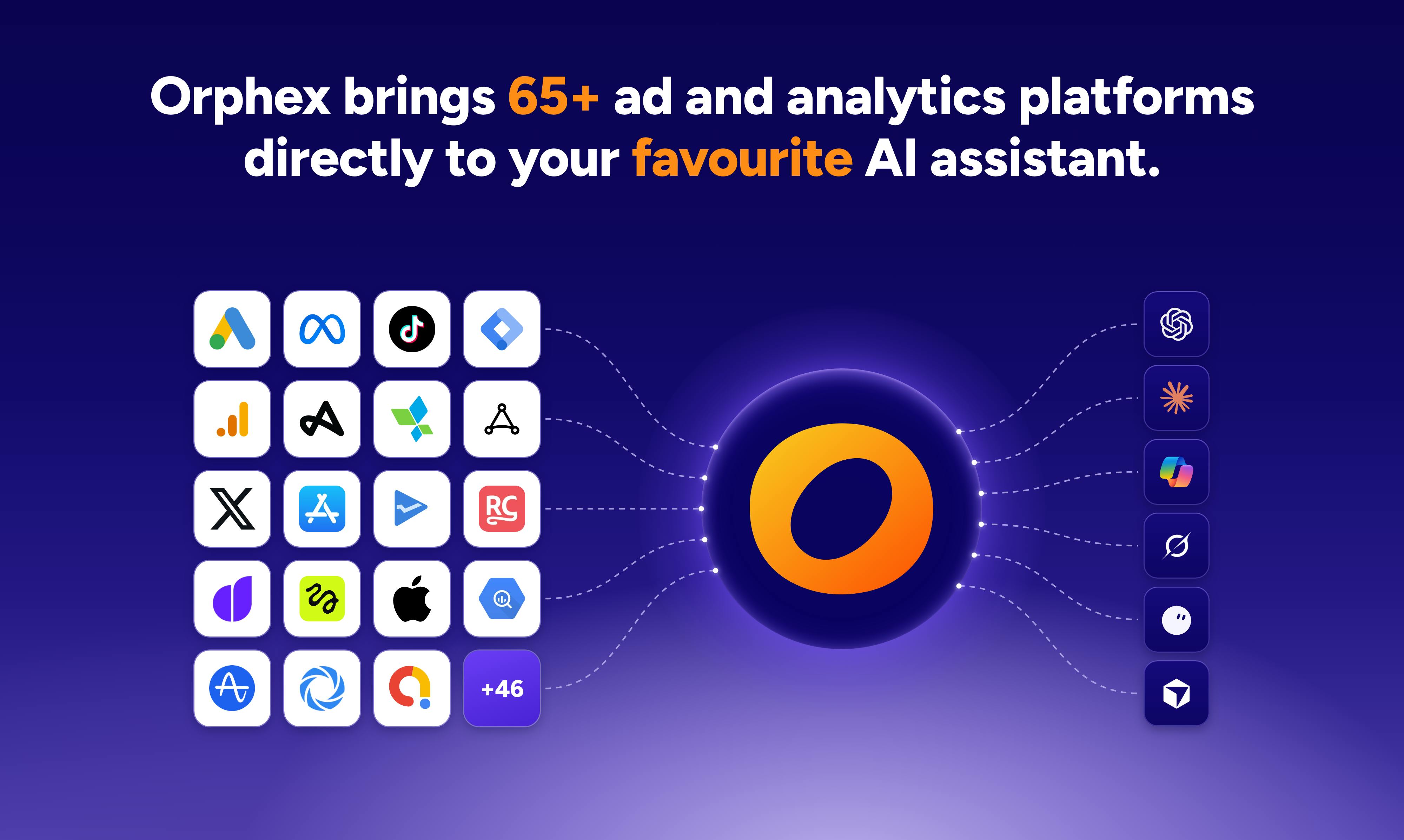
One gateway, authentication and integration for 65+ platforms
Orphex positions itself as a unified MCP gateway for digital marketing teams. According to its official description, it handles authentication and integration for 65+ platforms, ranging from Google Ads to Shopify, enabling AI to obtain true cross-channel context.
This means marketers no longer need to configure API credentials separately for each data source or maintain individual connectors. Orphex consolidates the complexity of authentication and integration into the gateway layer, exposing it externally as a unified MCP interface. For marketing teams increasingly reliant on AI toolchains, this architectural convergence is itself noteworthy—it lowers the upfront cost of "letting AI see the full picture."
MCP (Model Context Protocol) is an open protocol proposed by Anthropic in late 2024, aimed at standardizing the way AI models interact with external tools and data sources. Before MCP, every AI application that needed to connect to external services (such as databases, APIs, and SaaS platforms) had to write its own connector, leading to duplicated development and fragmented integration. MCP defines a unified client-server architecture that allows AI assistants to discover and invoke external capabilities in a consistent way. As an MCP gateway, Orphex essentially builds an aggregation layer on top of the MCP protocol: it connects to various marketing platforms and encapsulates their capabilities as MCP servers, so that any MCP-compatible AI client can access these platforms out of the box. This model lowers the barrier to integrating AI with vertical business systems and avoids the waste of every SaaS vendor building its own AI connector.
From Q&A to execution: AI actually doing marketing
More intriguing is Orphex's redefinition of AI's role. The official wording is to let AI "go beyond QA"—no longer staying at the level of Q&A and analytical suggestions, but capable of executing every operation a human marketer can perform.
Specific actions include: reallocating budgets, pausing unprofitable creative assets, adjusting product settings—all of which can be completed through a single prompt. Operations that previously required marketers to log into three or four backends and click through a dozen steps are now compressed into a single natural language instruction. This is not simply an efficiency gain but a change in the shape of the workflow: AI shifts from "copilot" to "executor."
In the AI field, "QA" usually refers to Question Answering, i.e., a Q&A system, representing AI that can only understand and answer user questions without the ability to execute actions. Orphex's proposal to let AI "go beyond QA" means AI shifts from passive response to active execution, i.e., possessing "agent" capabilities. Agentic AI can autonomously plan and invoke tools to complete tasks based on high-level goals, rather than merely providing information. This requires AI systems to have capabilities such as tool invocation, state tracking, and error handling, while also placing higher demands on permission control and operation auditing. In marketing scenarios, budget allocation and creative management involve real money, and direct AI operation means a transfer of trust and responsibility. Therefore, Orphex's emphasis on logs and guardrails is no accident—it is a prerequisite for agentic AI to be deployed in production environments.
Guardrails: making automated execution trustworthy
Letting AI directly touch budgets and ad creatives carries self-evident risks. Orphex's response is a two-layer mechanism: every change is logged, and protection is provided by guardrails.
Logging solves the problem of traceability—teams can trace back what the AI did and why. Guardrails define the boundaries of automated operations. These two points are precisely the trust threshold marketing teams must cross when moving from "letting AI make suggestions" to "letting AI directly modify accounts." Without these two layers of assurance, any AI tool claiming to autonomously execute marketing operations would struggle to enter real production environments.
Guardrails in AI systems refer to a series of technical and management measures used to constrain model behavior, prevent harmful or erroneous outputs, and ensure operations comply with established rules. When agentic AI executes actual business operations, guardrails typically include: tiered operation permissions (e.g., limiting the size of a single budget adjustment), secondary confirmation for sensitive operations, anomaly detection and blocking, and rollback mechanisms. The combination of guardrails and logging mentioned by Orphex forms an auditable automation loop—logs provide post-hoc tracing, while guardrails provide in-process control. For marketing teams, this means AI's autonomous execution is no longer a black box but can be gradually delegated within controllable bounds, balancing efficiency and risk.
Commercialization and signals
Orphex offers a free start with a 30% discount for the first month. Based on Product Hunt feedback, the product received 113 upvotes and 26 comments, ranking No. 4 for the day. For a B2B tool targeting professional marketing teams, this level of community engagement indicates genuine market interest in "AI directly operating the marketing stack."
As a protocol layer connecting AI with external systems, MCP is penetrating from developer tools into vertical business scenarios. Orphex's attempt represents a direction: instead of having every SaaS vendor write its own AI connector, a single intermediary gateway manages authentication, integration, and security. If this path succeeds, marketing teams' AI workflows will no longer be fragmented by tool boundaries.
One-line Summary
Orphex MCP integrates 65+ marketing platforms through a unified gateway, enabling AI to move from Q&A to direct execution.
Paragraph Summary
Orphex MCP is a unified MCP gateway for digital marketing teams, aimed at solving the fragmentation of multi-platform tools. It handles authentication and integration for 65+ platforms, providing AI with cross-channel context so marketers don't need to configure connectors for each platform separately. More importantly, Orphex enables AI to go beyond Q&A and execute actual operations such as reallocating budgets and pausing unprofitable creatives, while ensuring traceability and controllability of automated execution through logging and guardrails. The product received 113 upvotes and 26 comments on Product Hunt, ranking No. 4 for the day, and offers a free start with a 30% discount for the first month. Orphex represents the trend of the MCP protocol penetrating from developer tools into vertical business scenarios, and the intermediary gateway model is expected to reshape marketing AI workflows.
Related articles

The Kindle Page Turner Can Do What? Remote Camera Shutter and Manual TikTok Scrolling
Amazon's Kindle Click page-turn button was mocked as pointless, but in practice it's surprisingly useful — The Vergecast found it works as a camera remote shutter and a manual TikTok scroller.

GPT-6 Cyber Unearths 948 Linux Kernel Vulnerabilities: A New Era in AI Security Offense and Defense
GPT-6 Cyber and a custom vulnerability research pipeline analyzed the Linux kernel and confirmed 948 exploitable vulnerabilities. This article explains how the AI vulnerability discovery pipeline works, the risks of kernel vulnerabilities, and how the security community can respond collaboratively.

Jensen Huang Returns to Nvidia HQ to Hero's Welcome from Employees
Nvidia CEO Jensen Huang returned to headquarters to a hero's welcome and said he would "do better the second time as CEO." This article analyzes the leadership iteration signal and its impact on the AI industry.