Otis: A Minimal AI Agent Built for Local Models Out of the Box
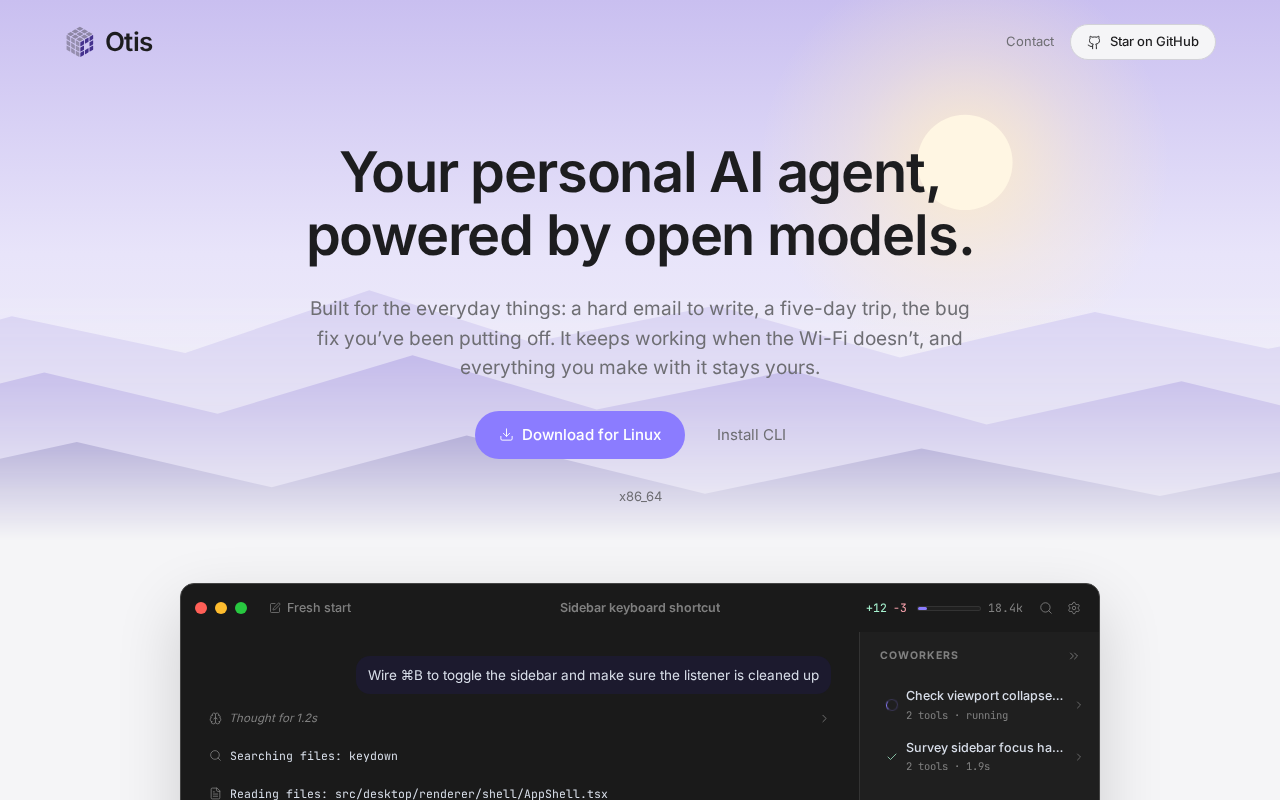
Otis is a minimal open-source AI Agent that runs local LLMs out of the box, prioritizing privacy and low setup friction.
Otis is an open-source AI Agent project posted on Hacker News, built around two principles: minimalism and local models out of the box. Users can run an AI Agent entirely on their own hardware — no cloud APIs required — preserving data privacy, eliminating token costs, and enabling offline use. As quantization advances make 7B–13B models viable on consumer hardware, local Agent frameworks like Otis are becoming increasingly practical. It aims to abstract away the complexity of inference engine setup and model integration, standing apart from heavier frameworks like AutoGPT and LangChain. However, local models still trail cloud flagships in reasoning, context length, and tool-calling reliability, and the project's real-world performance remains to be validated.
A Minimal AI Agent Focused on Local Execution
In a crowded market of AI Agent tools, the vast majority depend on cloud-based LLM APIs — requiring an internet connection, per-token fees, and handing your data over to third-party providers. A Hacker News project called Otis offers a different approach: it's a minimal, open-source AI Agent designed to run local models out of the box.
As the author describes in their Show HN post, Otis is built around two core ideas: "minimal" and "local models out of the box." These two keywords capture the project's design philosophy — rather than piling on features, the goal is to lower the barrier for running local models as much as possible, so users can get an AI Agent up and running on their own hardware with minimal configuration.
The Value and Challenges of Running Models Locally
Running large language models locally has become an increasingly significant trend in recent years. With advances in quantization techniques and the rising performance of consumer-grade hardware, models in the 7B–13B parameter range can now run smoothly on an ordinary laptop or workstation. The benefits are clear: data stays entirely on your device, there are no ongoing API costs, offline use is possible, and privacy is fully under your control.
For developers and privacy-conscious users, an Agent framework that supports local models out of the box is particularly appealing. Traditionally, setting up a local Agent required manually configuring an inference engine (such as llama.cpp or Ollama), managing model downloads and format conversions, and writing tool-calling logic — none of which is trivial. Otis aims to abstract away these steps and reduce the onboarding cost for everyday users.
That said, the local Agent route comes with real challenges: local models typically lag behind cloud flagship models like GPT-4 and Claude in reasoning ability, context length, and tool-calling reliability. Hardware resource demands are also higher, and the success rate of complex task execution requires more real-world validation. The "minimal" design, while improving usability, may also imply meaningful trade-offs in functionality.
The Product Philosophy Behind Minimalism
In terms of naming and positioning, Otis has chosen a path that differentiates itself from mainstream Agent frameworks like AutoGPT and the LangChain ecosystem — which tend to be feature-heavy, built on many layers of abstraction, and steep in learning curve. Otis's emphasis on "minimal" likely means fewer dependencies, a cleaner codebase, and a more straightforward user experience.
This approach has a clear audience in the developer community. Many users don't need a sprawling Agent platform — they want a lightweight, readable, controllable starting point that lets them quickly validate ideas while remaining easy to extend and customize. Another advantage of minimal tooling is transparency: with less code to wade through, users can more readily understand how the Agent actually works, rather than being lost in layers of abstraction.
Worth Watching, but Still Early Days
At the time of writing, the project has modest traction on Hacker News (6 upvotes, no comments yet), and publicly available information remains limited — making it difficult to offer a comprehensive assessment of its actual features, performance, and ecosystem maturity. For developers who are curious, the best move is to go directly to the project repository and look into which local model backends it supports, how well its tool-calling works, and what the real-world hardware requirements look like.
Local AI Agents are a rapidly evolving space, and lightweight projects like Otis reflect a persistent demand in the community for privacy-friendly, low-barrier, self-hostable Agent solutions. Whether it can stand out among the many similar tools will ultimately depend on time and broader user feedback.
Related articles
Ditch the Vector Database: Building a Memory Layer for LangChain Agents with BM25
CogniCore replaces vector databases with BM25 retrieval for LangChain agent memory, outperforming embeddings in small-context benchmarks with zero external dependencies.
Are All-in-One AI Platforms Actually Worth It? A Practical Guide to Escaping Subscription Overload
Tired of paying for ChatGPT, Claude, and Midjourney separately? We break down whether all-in-one AI platforms are actually worth it — and what a smarter subscription stack looks like.

Volkswagen Mission Efficiency: The World's Lowest-Drag EV Breaks Multiple Efficiency Records
Volkswagen's Mission Efficiency prototype claims the world's lowest drag coefficient, built on MEB+ platform with ID. Polo and ID. Cross components. Here's what it means for EV efficiency.