Oura Admits Receiving Government Requests for User Data, Exposing Wearable Device Privacy Crisis

Oura admits receiving government data requests, sparking wearable device privacy concerns
Smart ring maker Oura publicly acknowledged receiving government requests for user data but has not committed to publishing a transparency report. The Oura Ring collects physiological data including heart rate, blood oxygen, and body temperature — far more intrusive than phone location data — yet consumer wearables lack strict legal protections like HIPAA. The tech community is questioning why Oura won't follow the lead of Google, Apple, and others in regularly disclosing government request details.
Oura Admits Receiving Government Data Requests: What Happened
Smart ring manufacturer Oura recently admitted publicly that the company has indeed received requests from government agencies for user data. The news quickly gained traction on Hacker News, garnering 272 upvotes and 149 comments, as the tech community's concerns about wearable device privacy reached a boiling point.
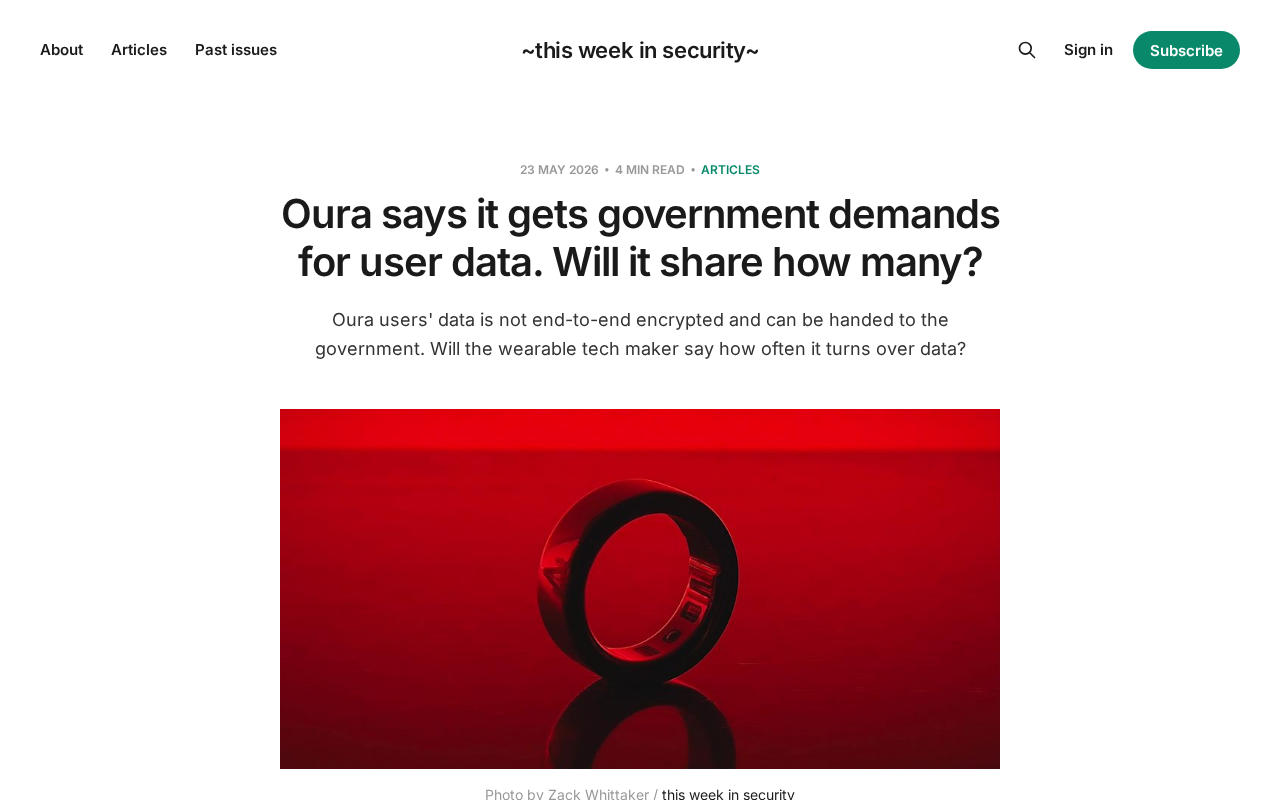
The core controversy centers on whether Oura is willing to transparently disclose the number and specifics of these government data requests. Based on their response so far, the company clearly falls short on transparency.
How Sensitive Is the Data Collected by Wearable Devices?
Oura Ring's Technical Background and Data Collection
The Oura Ring is a premium smart ring developed by Finnish company Oura Health. Since the launch of its first product in 2015, it has become one of the benchmarks in consumer-grade wearable health devices. Its core technology relies on Photoplethysmography (PPG) and Negative Temperature Coefficient (NTC) Thermistors, using sensor arrays on the inner surface of the ring to continuously monitor arterial blood flow changes in the finger. Compared to wrist-worn devices, finger-based measurement benefits from blood vessels closer to the skin surface and higher capillary density, giving Oura leading accuracy among consumer-grade devices.
Notably, the Oura Ring has also been adopted by professional sports organizations including the NBA and Olympic teams, and participated in multiple early-warning research studies during the COVID-19 pandemic. This further demonstrates the medical-grade reference value of its data — and precisely why such data holds considerable appeal for law enforcement and intelligence agencies.
Health Data: More Private Than You Think
As a premium smart ring, the Oura Ring continuously collects extremely private physiological data including heart rate, blood oxygen saturation, body temperature fluctuations, sleep quality, and activity levels. This data not only reflects physical health but can also indirectly reveal users' lifestyle habits, daily routines, emotional states, and even locations.
For law enforcement and intelligence agencies, this type of data is extremely valuable. For example, heart rate and activity data can be used to infer what a person was doing at a specific time — whether they were sleeping, exercising, or in a state of high stress. In criminal investigations, such information could become critical evidence.
Physiological Data vs. Phone Data: A Completely Different Level of Intrusion
Compared to phone location data, the physiological data collected by wearable devices is far more intrusive. Phone data primarily reflects a user's external behavior — where they went, who they contacted. Wearable device data, on the other hand, reaches deep inside the user's body, recording the most intimate vital signs like heartbeat, breathing, and body temperature.
Once this type of data is misused, the consequences are far more severe than traditional digital surveillance.
The Legal Protection Landscape for Physiological Data
At the legal level, the protection framework for physiological health data remains highly fragmented globally. The U.S. Health Insurance Portability and Accountability Act (HIPAA) only applies to "covered entities" such as healthcare institutions and insurance companies. Consumer-grade wearable device companies typically fall outside its jurisdiction, meaning data collected by companies like Oura effectively exists beyond the strictest medical privacy protections.
The EU's General Data Protection Regulation (GDPR) classifies health data as "special category data," requiring explicit user consent for processing and imposing strict restrictions on cross-border data transfers — though enforcement varies by member state. Some U.S. states have begun filling this gap: Washington State's My Health My Data Act, passed in 2023, brings consumer health apps under regulation, but nationwide legislation remains absent. This legal vacuum is precisely the systemic reason why government agencies can obtain wearable device data at relatively low legal cost.
Why Won't Oura Publish a Transparency Report?
The History of Transparency Reports
The practice of publishing Transparency Reports was first pioneered by Google in 2010, initially to disclose the number of government requests to remove search results. In 2013, the Snowden revelations (Edward Snowden's leak of the NSA surveillance program PRISM) fundamentally changed the industry landscape. After the public learned that tech giants including Google, Apple, Microsoft, and Facebook had all been required to provide user data to the NSA, these companies — under immense public pressure — expanded the scope of their transparency reports to include detailed counts of National Security Letters and FISA court order ranges.
Today, transparency reports have become a standard public relations and compliance tool for tech companies. The Electronic Frontier Foundation (EFF)'s annual "Who Has Your Back" report lists them as a core metric for evaluating corporate privacy protection. Oura's absence from this industry norm is particularly glaring in the post-Snowden era.
An Industry Standard Among Tech Giants
In the tech industry, publishing transparency reports is now a widely accepted practice. Google, Apple, Meta, and others regularly disclose the number of government data requests received, the number of user accounts affected, and how the company responded. This practice helps the public understand the scale of government surveillance and provides a degree of check on power.
However, while Oura has acknowledged receiving government data requests, it has not committed to publishing a detailed transparency report. This attitude of "acknowledge but don't disclose" has triggered a series of questions from the community:
- How many users' data has actually been shared with governments?
- Which countries are these requests coming from?
- How many unreasonable requests has Oura rejected?
Smaller Companies Face Greater Difficulty Saying "No" to Government Pressure
Related articles
Meta Muse Hits 900K Downloads in Six D…
Meta Muse Hits 900K Downloads in Six Days: The AI Agent Era Has Officially Arrived
Meta's AI agent Muse hit 902K downloads in 6 days, topping US App Store and Google Play charts above ChatGPT and Claude. A deep dive into Muse's capabilities and the AI Agent race.
 Industry Insights
IRS Fully Embraces Claude AI, Accelerating Federal Government's AI Adoption
The IRS is recruiting staff with 24/7 Claude AI access, marking Anthropic's breakthrough into the federal government. Explore the strategic implications and tax use cases.
 Industry Insights
The IRS Mobile App Debate: A Trust Crisis in Government Digital Transformation
The IRS's proposed mobile app has sparked heated debate. This article analyzes the core arguments, exploring data security, privacy, and the trust crisis in government digital transformation.