OuroWorld: Turning Any 3D World into an Infinitely Looping Dynamic Video

OuroWorld masklessly turns static 3DGS scenes into seamlessly looping dynamic videos from any viewpoint.
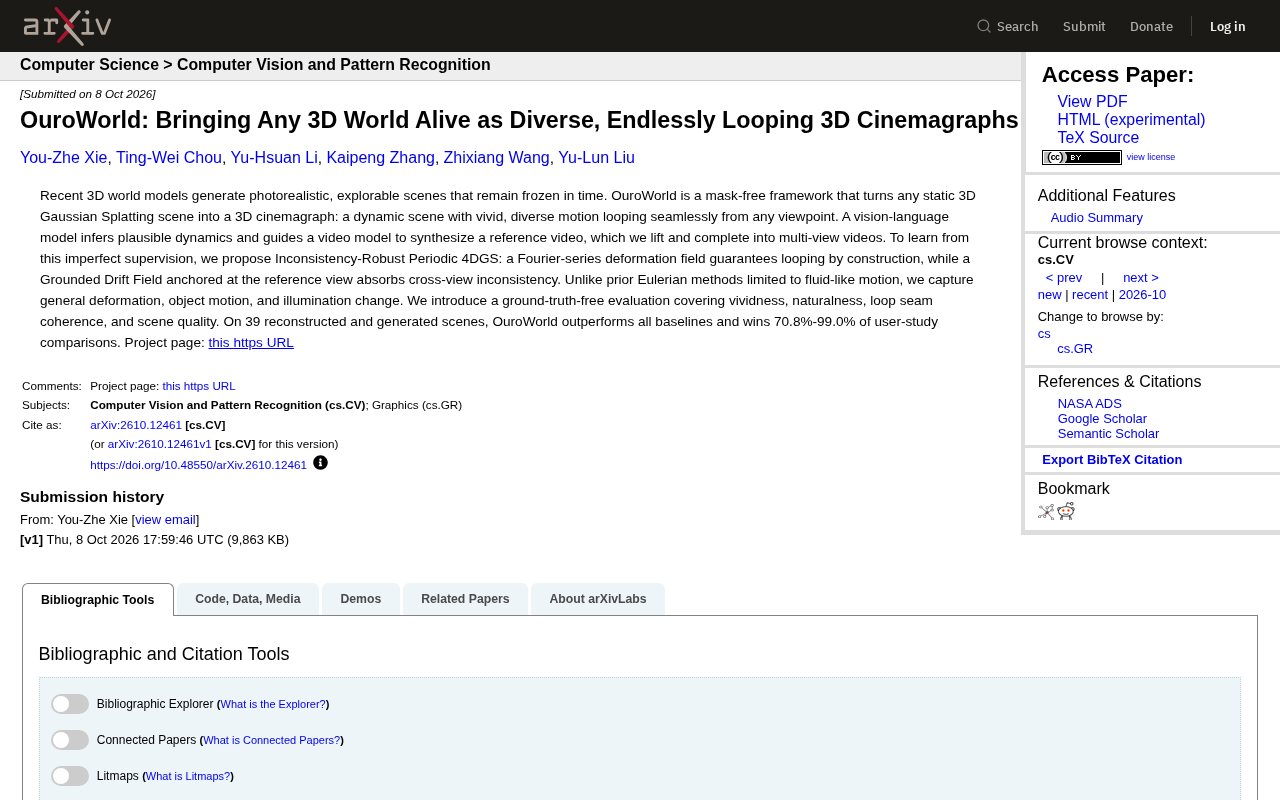
OuroWorld is a mask-free framework that converts any static 3D Gaussian Splatting scene into a 3D cinemagraph that loops seamlessly from any viewpoint. Its pipeline uses a vision-language model to infer plausible dynamics and guide a video model to synthesize a reference video, which is then lifted and completed into a multi-view video sequence. To handle cross-view inconsistencies in the supervision signal, the team proposed Inconsistency-Robust Periodic 4DGS: a Fourier series deformation field guarantees looping by construction, while a Grounded Drift Field absorbs inconsistent information. The method covers general deformation, object motion, and lighting changes, breaking through the limitation of Eulerian methods that excel only at fluid motion. It comprehensively outperforms baselines on 39 scenes, with user study win rates of 70.8%-99.0%.
Static 3D scenes often lack a sense of being "alive." Whether it's an outdoor streetscape reconstructed via 3D Gaussian Splatting or an indoor space produced by a generative model, most results feel like they've been paused—freely explorable, yet frozen in a single moment. The recently released OuroWorld framework attempts to break this limitation: it can transform any static 3D scene into a dynamic video (3D cinemagraph) that loops seamlessly from any viewing angle, without requiring any mask annotations.
From Static GS Scenes to Dynamic Looping Videos
The core idea of OuroWorld is to use a vision-language model (VLM) to infer plausible motion within a scene, then leverage a video model to synthesize a reference video, which is subsequently "lifted" and completed into a multi-view video sequence. The entire process requires no manual specification of motion regions or fluid types, making it a mask-free framework.
Unlike previous Eulerian methods limited to fluid-like motion, this approach can capture general deformations, object motion, and lighting changes. This means the swaying of leaves, the fluttering of curtains, the ripples on water surfaces, and even the shifting of light and shadow can all be modeled as looping dynamics within the same framework.
According to the project page, the research team tested on 39 reconstructed and generated scenes, and OuroWorld outperformed all baseline comparisons, achieving a win rate of 70.8% to 99.0% in user studies. These figures come from the evaluation results published on the project homepage, demonstrating a clear advantage in subjective perception.
3D Gaussian Splatting (3DGS) is an explicit 3D scene representation method proposed in 2023. It characterizes a scene using millions of 3D Gaussian primitives with position, covariance, color, and opacity, and during rendering projects these Gaussians onto the image plane through a differentiable splatting process to synthesize pixels. Compared to implicit neural fields like NeRF, 3DGS offers faster training and rendering and supports real-time high-quality novel view synthesis, making it one of the mainstream representations in current 3D reconstruction and generation. However, 3DGS captures static geometry and appearance at a single moment, without a temporal dimension. To bring a scene to life, one needs to introduce time-varying deformations or an additional 4D representation on top of it. OuroWorld starts from 3DGS reconstruction results as input and overlays a dynamic field to achieve the transformation from static to looping dynamics.
3D cinemagraph borrows from the traditional concept of cinemagraph: the overall image remains static while only a localized region continues to move, creating a sense of vitality within frozen time. In a 3D context, a 3D cinemagraph requires that when the user freely changes viewpoints, the dynamic parts maintain consistent spatiotemporal continuity and seamlessly loop on the time axis. It differs from the previously common single-view micromotion videos, because viewpoint changes reveal whether geometry and motion information are truly consistent, imposing higher demands on representation and synthesis methods.
How to Learn from "Imperfect" Supervision Signals
The truly thorny problem is that between the reference video synthesized by the video model and the multi-view completion results, there often exist cross-view inconsistencies. If one directly trains a 4D representation on such noisy signals, it easily leads to motion blur or jumps at the loop point.
To address this, the team proposed Inconsistency-Robust Periodic 4DGS, which includes two key designs:
Fourier Series Deformation Field
By parameterizing the deformation field with a Fourier series, periodicity is guaranteed by construction—that is, the model's output dynamics naturally satisfy end-to-end continuity without the need for additional looping constraints. This is crucial for achieving "seamless looping."
Fourier Series Deformation Field The idea is to represent the position (or deformation amount) of each Gaussian primitive as a periodic function of time, typically written as a superposition of sine and cosine terms, of the form x(t)=a₀+Σ[a_k cos(2πkt/T)+b_k sin(2πkt/T)]. Since sine and cosine are inherently periodic with period T, the function values at t=0 and t=T are strictly equal, so periodicity is naturally guaranteed by the mathematical form without needing additional penalties for start-end differences in the loss function. Meanwhile, different frequency components correspond to motions of different rhythms and amplitudes—low-frequency terms capture slow overall swaying, while high-frequency terms capture fine jitter. This frequency decomposition allows the model to express diverse and continuous dynamics with a small number of parameters, and also facilitates sampling multiple motion patterns within the same scene.
Grounded Drift Field
This method anchors a drift field at the reference viewpoint to absorb cross-view inconsistencies. In other words, conflicts between multiple views are "borne" by a learnable field rather than contaminating the entire 4D representation.
These two components work together to enable the model to learn coherent and diverse dynamics even under imperfect supervision signals.
Grounded Drift Field addresses the cross-view inconsistency in the supervision signal. The video synthesized by the video model for a reference viewpoint may seem reasonable at first glance, but when it is lifted to multiple views and completed, predictions of the same motion across different views may contradict each other. If such conflicting supervision is directly used to train the 4D representation, the dynamics become blurred or produce jumps. The drift field approach sets up a learnable field at the reference viewpoint to specifically absorb these cross-view differences: conflicting information is locally "sedimented" in this field rather than diffused throughout the entire 4D representation. This way, the main deformation field can still learn clean, coherent dynamics, while residual inconsistencies are explained by the drift field, effectively providing a buffer layer for noisy supervision.
Ground-Truth-Free Evaluation: Measuring Vividness, Naturalness, and Loop Quality
Evaluating dynamic 3D scenes has long lacked a unified standard. OuroWorld introduces a ground-truth-free evaluation system covering four dimensions: vividness, naturalness, loop seam coherence, and scene quality.
The significance of this metric set is that it does not rely on hard-to-obtain real 4D data but measures whether the dynamics are credible based on the generated results themselves. For tasks like 3D cinemagraph where subjective perception dominates, this evaluation approach is closer to actual user experience.
From the demonstrations on the project page, the same static scene can generate multiple different dynamic versions—with differences in motion patterns, rhythms, and amplitudes—rather than outputting a single deterministic result. This diversity is precisely what "diverse motion" emphasizes.
Differences from Existing Methods
Many previous dynamic 3D methods are based on the Eulerian perspective, excelling at simulating fluid-like motion such as smoke and water flow, but with limited capability for rigid body motion, non-fluid deformation, and lighting changes. OuroWorld chooses to work within a Lagrangian-style deformation field framework and leverages VLM's high-level semantic understanding to guide motion synthesis, thereby covering a broader range of dynamic types.
Another difference lies in the looping mechanism. Most methods attempt to align start and end frames in a post-training processing stage, whereas OuroWorld embeds periodicity directly into the mathematical form of the deformation field, guaranteeing looping from the source.
The project homepage (https://ouroworld.userwei.com) is now public, including looping dynamic demonstrations of multiple scenes, baseline comparisons, and user study data. For researchers and developers interested in 3D generation, dynamic scene modeling, and 4D Gaussian Splatting, OuroWorld offers a noteworthy new paradigm: "awakening" static worlds into dynamic videos that can be viewed in an infinite loop.
Eulerian vs. Lagrangian Perspectives are two classical frameworks for describing motion. The Eulerian method focuses on how physical quantities change over time at fixed spatial locations—for example, observing how velocity changes at a given grid point—making it naturally suited for modeling the flow of continuous media such as smoke and water. The Lagrangian method, in contrast, tracks the trajectory of each particle, making it better suited for describing the overall displacement and deformation of discrete objects or deformable entities. The Gaussian primitives in 3DGS can themselves be regarded as tracked particles, so overlaying a deformation field on them falls under the Lagrangian approach, naturally expressing rigid body motion, non-fluid deformation, and lighting transfer without being limited to fluid-like motion. OuroWorld's choice of this framework is precisely to break through the limitations of previous Eulerian methods in dynamic type coverage.
One-line Summary
OuroWorld masklessly transforms static 3DGS scenes into seamlessly looping dynamic videos from any viewpoint.
Paragraph Summary
OuroWorld is a mask-free framework that can convert any static 3D Gaussian Splatting scene into a 3D cinemagraph that loops seamlessly from any viewpoint. Its pipeline uses a vision-language model to infer plausible dynamics and guide a video model to synthesize a reference video, which is then lifted and completed into a multi-view video sequence. To handle cross-view inconsistencies in the supervision signal, the team proposed Inconsistency-Robust Periodic 4DGS: a Fourier series deformation field guarantees looping by construction, while a Grounded Drift Field absorbs inconsistent information. The method covers general deformation, object motion, and lighting changes, breaking through the limitation of Eulerian methods that excel only at fluid motion. It comprehensively outperforms baselines on 39 scenes, with user study win rates of 70.8%-99.0%.
Related articles

Chain of Thought Isn't Just for AI: How Humans Can Use CoT to Improve Thinking Quality
Chain of Thought isn't just a prompt trick for large models. Starting from a Hacker News discussion, this article analyzes why CoT works for human thinking too, breaks down actionable ways to transfer it, and highlights the key differences between human CoT and machine CoT.
Cloudflare Teams Up with OpenAI: Closi…
Cloudflare Teams Up with OpenAI: Closing the Loop from Vulnerability Discovery to Defense with AI
Cloudflare uses OpenAI Daybreak to investigate security vulnerabilities and generate reviewable remediation plans, while developers use Codex to boost coding efficiency and quality.

Orca Multi-Agent Orchestration in Practice: A Guide to Parallel Collaboration with Claude and Codex
Orca is Stable AI's free open-source agent workbench supporting 34 agents like Claude Code and Codex in parallel. Learn its Git worktree isolation, multi-model orchestration, and mobile management.