OutsideQuest: Using Local AI to Turn Screen Time into Outdoor Adventures

OutsideQuest uses a local Qwen2.5 3B model to generate outdoor missions and fight screen addiction.
OutsideQuest is a Hacktoberfest open source AI challenge entry by developer Shrey that uses AI to help people spend less time on their phones and more time outdoors. Users input their free time and interests, and the app generates concrete outdoor missions with steps, duration, and safety tips. Built on Python + Streamlit with Ollama + Qwen2.5 3B for local open-weight inference, it offers a dual-track design — a full local version and a public demo with a built-in mission library — balancing ease of use with privacy. Its key lesson: small open-weight models are already powerful enough to support a complete local AI application loop without relying on closed APIs.
An Open Source Project That Turns Doomscrolling into a Walk Outside
During the first week of the Hacktoberfest open source AI challenge, themed "Touch Grass," developer Shrey submitted a clever entry — OutsideQuest 🌿. Its goal is straightforward: help people spend less time staring at screens and more time exploring the world around them.
Unlike most tools that emphasize "productivity," OutsideQuest flips the script by using AI to encourage people to put down their devices. Users simply enter how much free time they have and what they're interested in, and the app generates a concrete outdoor mission — complete with clear steps, estimated duration, and safety tips. A 30-minute break, for example, might become: "Take a slow walk along a familiar path and notice three details in nature."
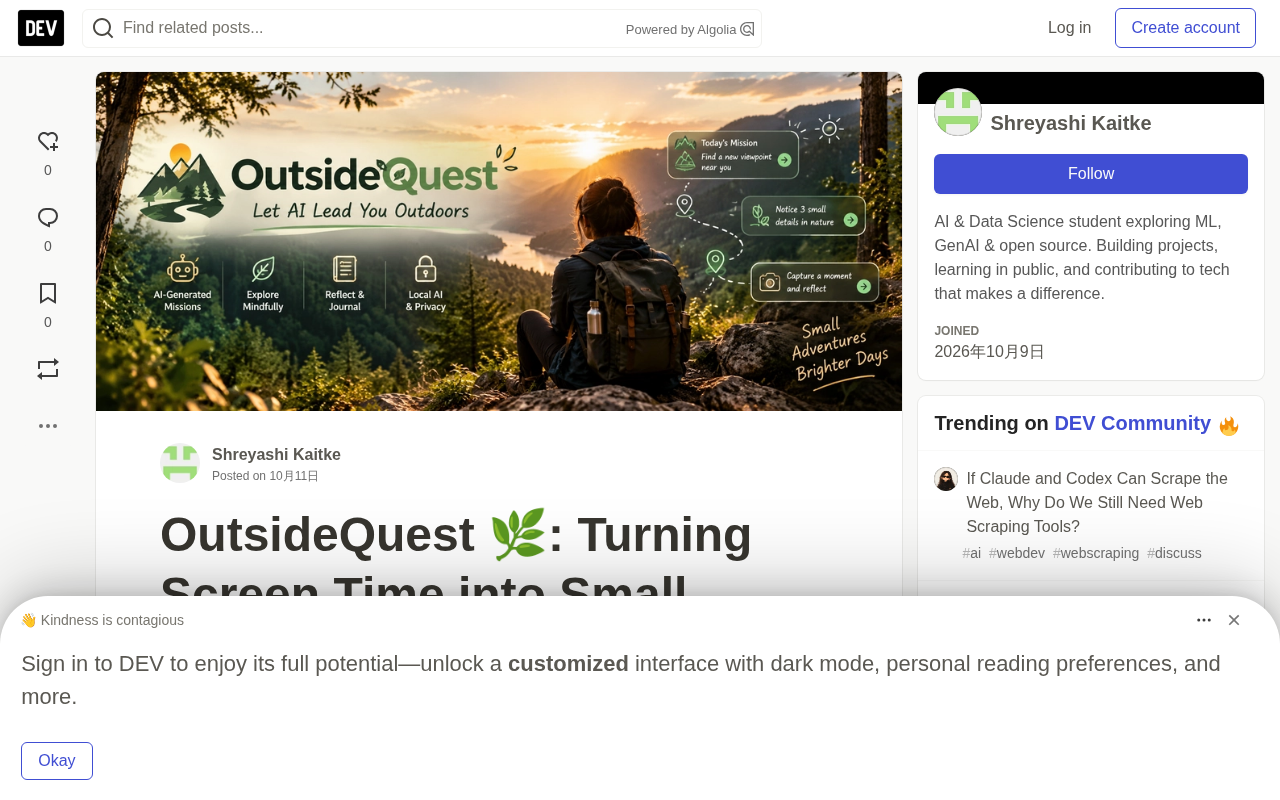
The app targets people who want to go outside but don't want to plan a complex itinerary, buy expensive gear, or clear their entire schedule. The low barrier to entry is exactly what makes it worth paying attention to.
Tech Stack: Local Inference with a Cloud Fallback
OutsideQuest's technology choices reflect a pragmatic engineering philosophy. The project is built on the following components:
- Python for application logic
- Streamlit for an interactive web interface
- Ollama + Qwen2.5 3B for local, open-weight AI mission generation
- Safety validation and fallback missions to ensure a reliable experience
- Render for public deployment
Notably, the developer made a clear distinction between the "local version" and the "public demo." The local version relies on Ollama and the Qwen2.5 3B model to generate missions in real time, giving users the full AI experience on their own machine. The public demo hosted on Render uses a built-in mission library instead — visitors don't need to configure an API key or run a model locally; they can just open a browser and try it.
This dual-track design addresses a common pain point in open source AI projects: how to get users without a technical background up and running quickly, without sacrificing advanced users' control over the model. The public demo also deliberately disables storage of personal progress and reflection logs, reserving those privacy-sensitive features for local use — a thoughtful privacy-conscious decision.
Ollama is a tool that lets everyday users run open-weight large language models on their local machines. It wraps model downloading, runtime configuration, and API serving into simple command-line operations, eliminating the need to set up complex CUDA environments. Qwen2.5 3B is a small-scale model from Alibaba Cloud's Qwen series, with only 3 billion parameters. It can run on consumer-grade GPUs or even on CPU alone, keeping inference speed and resource consumption within the range that personal devices can handle. The "3B" refers to approximately 3 billion (3 Billion) parameters — a scale that's already quite capable for tasks like instruction following and text generation, while demanding far less hardware than larger models like 7B or 13B. This makes it a popular choice for local AI application development. Used together, developers can stand up a complete local AI inference service with just a few commands — no internet connection required, no API keys, no per-call billing.
Why Open Innovation Matters
In a section titled "Why Open Innovation Matters," the developer offers some remarkably clear-eyed thinking. He argues that using open-weight models with local inference delivers the greatest value through flexibility and control — enabling you to build an AI experience around your own needs rather than being entirely dependent on a closed, hosted API.
Concretely, this architecture lets users experiment with mission generation on their own devices, giving them greater control over both the model and the processing environment. For developers, it also makes the project easier to customize, extend, and learn from: you can freely adjust prompts, improve safety checks, and try different models without treating a proprietary API as the foundation of the entire experience.
"For me, open source isn't just about making code public — it's about giving other developers the freedom to understand, adapt, and build on top of an idea."
This captures the core spirit of open source AI. As small open-weight models like Qwen2.5 3B become genuinely capable, individual developers can now run a complete AI application loop entirely on local hardware, free from the cost constraints and limitations of cloud APIs.
What a Small Project Can Teach Us
OutsideQuest isn't a complicated project — it's a Hacktoberfest challenge submission, competing for the "Best Use of Render" award because it's fully deployed on Render and accessible via browser with no software installation required.
But its significance lies precisely in being "small and complete." It demonstrates how to quickly ship a genuinely useful AI application using a lightweight open source stack: Python + Streamlit + Ollama + a 3B model. For anyone looking to get started with local AI development, it's a clear, reproducible reference.
From a product philosophy standpoint, using AI to fight screen addiction and encourage outdoor activity is also an interesting counterpoint to the prevailing "AI everywhere" trend. Technology doesn't have to pull people deeper into their screens — it can also be the nudge that gets them out the door.
Interested readers can visit the live demo or check out the GitHub repository to learn more.
Streamlit is a rapid web application framework for Python developers that lets them build interactive interfaces using pure Python — no HTML, CSS, or JavaScript required. It's especially popular for AI and machine learning projects: with just a few dozen lines of code, you can turn a command-line script into a web app complete with input fields, buttons, and result displays. Render is a cloud platform offering a Heroku-like deployment experience, supporting direct deployment of GitHub repositories as web services with a free tier available — a common choice for independent developers and open source projects hosting live demos. OutsideQuest combines both to achieve a complete "local development → one-click deploy → browser access" pipeline, making this stack a highly practical reference for individual developers who want to quickly validate and share their ideas.
Related articles

Why Does the Tesla Roadster Need to Fly? A Deep Dive into Musk's Wild Demo
Tesla's Roadster launch showed wall-climbing, upside-down driving, and flying stunts—but The Vergecast notes the demo car may lack a battery, the Rocket version is invite-only and not street-legal, and the website terms don't guarantee delivery. After nine years of delays, why does this car still need to exist?

AI Is Not a Replacement: Human-AI Collaboration Through the Lens of Factory Root Cause Analysis
Starting from factory root cause analysis, this article explains how AI accelerates evidence chain construction rather than replacing human experts, exploring the pragmatic implementation logic and business value of 'AI supporting people rather than replacing them.'

AI Agent Decision Auditing: Building an Evidence Chain in Regulated Workflows
Starting from a Reddit discussion, this article analyzes three core issues in AI agent decision auditing within regulated workflows: what fields audit records should contain, how to handle feedback latency for erroneous decisions, and how to continuously calibrate LLM judge consistency with human judgment.