Overseas Creator Breaks Down N8n AI Agent Business Playbook: From Tooling to Monetization

2026's AI agent commercialization inflection point: platform selection, four sellable automations, and agency monetization methodology.
The article notes that in H1 2026, Zapier, Make, N8n, UiPath, and Power Automate all launched production-ready AI agent builders, shifting automation from connecting apps to hiring digital employees, with customers now including dental clinics, real estate agencies, and salons. It compares the three platforms and presents four validated revenue-focused automations—lead capture, WhatsApp follow-up, booking, and content pipelines—then details agency monetization with pricing and a sales playbook.
Title
Overseas Creator Breaks Down N8n AI Agent Business Playbook: From Tooling to Monetization
Meta Description
An overseas creator breaks down the N8n AI agent business playbook: comparing Zapier, Make, and N8n, detailing four monetizable automation categories—lead capture, WhatsApp follow-up, booking, and content pipelines—plus agency pricing and a sales playbook.
Article Content
In the first half of 2026, a quiet but pivotal shift took place in automation: Zapier, Make, N8n, UiPath, and Microsoft Power Automate all launched production-ready AI agent builders within roughly the same quarter. Automation is no longer just about connecting App A to App B—it has become a way to "hire" a tireless digital employee inside business processes. The significance of this shift is that automation is no longer an exclusive toy for geeks; it is a commercial service that can be sold to dental clinics, real estate agencies, and salons. You're no longer selling software—you're selling outcomes.
Bilibili creator "AI Simplifier" systematically breaks down the business playbooks of three major platforms including N8n in a video, laying out a complete path from platform selection to agency monetization. Combining the video's content with publicly available industry information, this article distills a set of actionable methodologies for the AI agent business.
Why Now Is the Inflection Point for AI Agent Commercialization
The video's author makes a noteworthy observation: in the first half of 2026, mainstream automation platforms collectively rolled out AI agents as standard infrastructure. This is no coincidence—it reflects the formation of an industry consensus. When enterprise software giants like SAP made a strategic investment in N8n in May 2026, doubling its valuation to $5.2 billion and planning to embed the N8n canvas into its Joule Studio agent builder, the signal was unmistakable—agents are no longer experiments; they are core components of enterprise software.
The more important change lies in the customer base. In the past, buyers of automation tools were technical teams; now dental clinics, real estate agencies, and salon owners have all become potential customers. Because what they care about isn't how elegant the workflow is—it's "did my phone get answered?" and "did my appointment slots get filled?" This shift on the demand side gives developers with agent-building skills a direct path to monetization.
How to Choose Among the Three Major Platforms: Zapier, Make, and N8n
One of the video's core frameworks is a clear positioning of the three major platforms. The author emphasizes that the key to choosing a platform isn't comparing feature lists—it's looking at where the client's business already runs.
Zapier: Start from the Client's Existing Ecosystem
Zapier has over 8,000 app connections, making it the largest ecosystem and the place where most businesses are already using automation tools. In October 2026, Zapier integrated its standalone agent product into the regular Zap editor as an AI step. This design lets the agent handle open-ended reasoning while the deterministic steps around it handle reliable execution.
The billing model requires special attention: since June 15, 2026, AI by Zapier steps are priced by model tier, with task multipliers of 1x for standard, 3x for advanced, and 5x for top-tier, and new steps default to the top tier. The number of tasks per AI run equals the model rate plus the number of tool calls multiplied by the model rate. In addition, a default runaway-interruption mechanism of 75 tasks can be adjusted up to 500, pausing for human approval when the run exceeds limits. This mechanism is the dividing line between experimentation and unexpected bills.
Make: The Debugging Advantage of a Visual Canvas
Make (formerly Integromat, now part of Solonis) is known for its visual scenario builder. Routers, filters, iterators, and aggregators are all presented as flowcharts on a single canvas, with every module, every data path, and every conditional branch clearly visible. For complex automation, this isn't decoration—it's a debugging powerhouse.
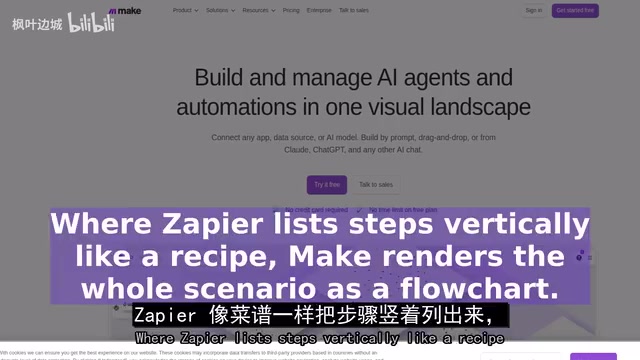
Make's AI layer entered testing in 2026, with agents built on the same visual canvas, equipped with a real-time audit and reasoning panel that shows every decision the agent makes, and supports rules and human approval. Maya, as the natural language layer, can describe requirements to generate scenarios directly. The Make MCP server exposes scenarios as callable tools for external AI agents to use.
The most compelling case comes from Solonis itself: they used Make to build an AI agent expense audit system connecting Workday, Monday.com, and Gemini, achieving a 99.7% reduction in audit costs. That number alone is a strong argument for including Make in any automation proposal.
N8n: The Advanced Choice After Task-Based Billing Pain Points
N8n is an open-source automation canvas that, after pivoting to be AI-friendly in 2022, grew revenue fivefold in less than a year. On September 25, 2026, N8n launched its agent feature, elevating agents from within workflows to be peers of workflows. Each agent has its own model, instructions, triggers and channels (such as Slack, Telegram, or scheduled tasks), tools, memory, sessions, and approvals. Agents can call workflows as tools, and workflows can call agents. N8n reports that users who use agents are about 20% more likely to reach production.
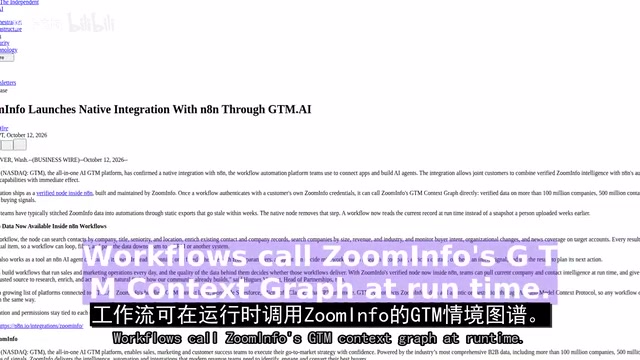
The AI Assistant supports building workflows with natural language, having generated 1.6 million conversations and 800,000 generated workflows, with 80% of users reporting satisfaction, available on both cloud and self-hosted. On October 12, 2026, ZoomInfo launched a native N8n node, allowing workflows to call its GTM context graph at runtime, covering over 100 million companies and 500 million contacts, and the node can be called as a tool by N8n AI agents mid-workflow.
As of October 2026, N8n has over 400 official nodes, more than 700,000 active users, and about 190,000 GitHub stars. The community edition is free and self-hostable, with cloud pricing starting at $24 per month. For agencies, self-hosted N8n is key to maintaining profit margins above 70%.
Task and Task Multiplier: Platforms like Zapier use "tasks" as their billing unit, where one task typically refers to one successful action execution (such as writing a row to a spreadsheet or sending a message). After AI by Zapier steps introduced "task multipliers," a single AI run consumes multiple tasks based on the selected model tier: 1x for standard, 3x for advanced, 5x for top-tier, and if the AI calls tools during the run, each tool call adds another model rate. This means the same agent run could consume more than five times the quota of a regular step under top-tier models. Understanding this mechanism is a prerequisite for quoting clients and designing workflows—routing simple classification to the standard tier and reserving top-tier for complex reasoning only can significantly lower the cost per run.
MCP (Model Context Protocol): MCP is an open protocol proposed by Anthropic that has gradually become an industry de facto standard, enabling AI agents to discover and call external tools, data sources, and services in a unified way. Think of it as the "USB interface of the agent world": as long as a system exposes an MCP server, any MCP-compatible agent can use it directly as a tool without writing separate integration code for each agent. The examples in this article—the Make MCP server exposing scenarios as callable tools and the ZoomInfo node being callable by N8n agents mid-workflow—are both expressions of this idea. For agencies, MCP means wrap once, reuse everywhere—a key to improving delivery efficiency and building reusable assets.
Four Automation Categories That Actually Sell
The video presents four market-validated automation categories, all of which share the trait of directly addressing a business's revenue or cost pain points.
Lead Capture: The Five-Minute Response Window
This is probably the automation most worth pitching first. It's backed by brutal numbers: 62% of small business calls go unanswered, 85% of customers won't call again, and customers expect a response within five minutes. No human team can respond to every inquiry within five minutes at midnight or on a Sunday—but automation can.
The typical flow: a lead comes in from a Facebook ad, website form, or WhatsApp message; automation enriches the information (e.g., supplementing company, title, and background via ZoomInfo-like lookups); AI qualifies it (budget, timeline, needs); hot leads are routed to the owner within one minute; cold leads enter a nurture sequence; all information is recorded in a CRM or spreadsheet. A real case from a real estate agency showed a WhatsApp qualification bot with a setup fee of 50,000 rupees and a monthly fee of 10,000 rupees, qualifying 180 leads in the first month, resulting in 12 on-site viewings and 3 property sales—a client return of roughly 40x the investment.
WhatsApp Follow-Up: Where Customers Actually Are
For local businesses, WhatsApp is the highest-ROI channel. But Meta changed the free rules twice in 2026: starting August 1, Meta Business Agent AI messages are billed by token; starting October 1, service messages and utility templates within the 24-hour window went from free to billed at utility rates. Each business number retains 1,000 free service messages per month, after which they're paid. In the US market it's about 0.0035%, in the UK about 0.022%; marketing messages are more expensive, about 0.025 in the US and about 0.0635 in the UK. When quoting clients, you must base it on real costs, not old free-assumption math.
On tool selection: ManyChat starts free with paid plans from $14 per month, the top budget entry choice; WATI at $69 per month suits small teams wanting a WhatsApp-first solution; Respond.io at $79 per month has the strongest overall capabilities and doesn't mark up Meta fees; Taylor Talk at $112 per month includes AI. One hard rule: chatbots must use the official WhatsApp Business API—the free WhatsApp Business app cannot run bots, so don't try to automate that app on a client's phone.
WhatsApp Business API and the 24-Hour Session Window: The WhatsApp Business Platform (Cloud API) divides messages into three categories—marketing templates, utility templates, and service messages. Meta stipulates that when a user initiates a message, a 24-hour "customer service window" opens, during which businesses can reply freely; outside the window, pre-approved template messages must be used and are billed by template category. The 2026 rule changes specifically eliminated the free allowance for service messages and utility templates within the window (retaining 1,000 free service messages per number per month). Therefore, bot solutions must first determine whether they're currently within the window and which template category to use—otherwise messages either won't be delivered or costs will spiral. This is also the fundamental reason why the official API must be used rather than the WhatsApp Business app.
Booking: AI Front Desk Reception
The 2026 booking tech stack is built on Cal.com: free forever for individual users with unlimited event types, team plans at $12 per user per month, about 25% cheaper than Calendly. Cal.com added agent booking, allowing appointments to be set, rescheduled, or canceled via Telegram or Slack messages.
On top of this, layer a voice AI receptionist: answering calls, identifying intent, checking real-time availability, and completing bookings—all without human intervention. An advanced architecture is N8n + VAPI + Google Calendar + Twilio SMS; the video's author mentions a dental clinic voice agent project using exactly this combination: VAPI handles the voice layer, N8n handles tool-call webhooks, Google Calendar manages availability and bookings, and Twilio SMS sends confirmations.
Voice AI Agent Tech Stack (VAPI and Twilio): VAPI is a developer-facing voice AI orchestration layer that converts phone audio to text (STT), passes it to an LLM for reasoning, then synthesizes speech (TTS) for playback, and supports calling external tools during conversation (function calling). Twilio provides phone numbers, SMS, and call infrastructure. In the dental clinic architecture described, VAPI handles voice interaction and, upon intents like "check availability" or "book an appointment," calls N8n via webhook, which reads and writes Google Calendar, and finally sends a confirmation via Twilio SMS. The benefit of this layered design: the voice layer is replaceable, business logic is centralized in N8n, and the calendar serves as the single source of truth—reducing latency and making each component easier to debug.
Content Pipeline: Attention Is Inventory
This chapter is highly relevant to the video's author himself—his channel publishes one short video and a complete course every day, powered by a content pipeline running behind the scenes. An idea expands into a script, voiceover, visuals, and subtitles, and is scheduled for cross-platform publishing.
The flow starts with a row of ideas in Airtable, Notion, or a spreadsheet; AI drafts the script; text-to-speech generates the voiceover; visuals are assembled; subtitles and tags are generated; and then it's published to Instagram, Facebook, YouTube, and TikTok via APIs and schedulers. The key step is performance data flowing back: views, retention, and click-through rates return to the spreadsheet, and the next day's topic selector learns from them. This pipeline isn't just a publishing machine—it's a learning machine. For local businesses, "we'll run your social media for you" is one of the easiest pitches to sell; every salon, clinic, and restaurant needs to post content, and none of them want to do it themselves.
Agency Monetization: Sell Outcomes, Not Software
The video's closing chapter focuses on how to package these capabilities and sell them to real businesses. There's only one core principle: don't sell N8n workflows, don't sell Make scenarios—sell booked meetings, answered inquiries, and saved time.
On pricing, the video gives specific ranges: an agency starter package is a one-time fee of $2,500 to $7,500; most small businesses spend $300 to $2,000 per month on automation, replacing $5,000 to $15,000 per month in human labor; the typical ROI period is 2 to 4 months. As open-source models mature, automation pricing dropped about 35% between 2024 and 2026—technology is cheaper, and profit margins are actually higher.
The three-tier engagement structure is a common agency model: Tier 1 discovery and strategy, $1,500 to $3,000, mapping processes and finding money leaks; Tier 2 implementation, $5,000 to $25,000, building the automation; Tier 3 monthly maintenance, $1,000 to $5,000, monitoring, maintaining, and improving. A simpler per-client subscription model is $300 to $1,500 per client per month—deploy one agent to 20 clients and that's $6,000 to $30,000 per month in recurring revenue. The same build, sold 20 times.
Local business packages priced in rupees: an FAQ bot with a setup fee of 15,000 to 25,000 rupees and a monthly fee of 3,000 rupees, suitable for salons, clinics, and cafes; a lead qualification bot with a setup fee of 35,000 to 60,000 rupees and a monthly fee of 8,000 rupees, suitable for real estate, coaching, and gyms. Profit margins range from 70% to 85%.
The execution playbook has three steps: first, pick a niche—dental, real estate, or salons—just one; second, build an automation for the first client for free as a case study—this isn't charity, it's marketing; third, reach out with a formula: point out the problem (your website can't take bookings after hours), add proof (my system booked 12 viewings a month for a similar clinic), state the value (they got a 40x return). Problem, proof, value—every message and every call follows this structure.
The video's author also points out an asymmetric advantage: an N8n workflow that takes 12 hours to build requires only 90 minutes of maintenance per month. 12 hours of work, 90 minutes of maintenance, sold to 20 clients—that asymmetry is the entire business. And each platform's build demo videos are themselves a portfolio—potential clients who watch the build process will pay for the results.
Actionable Advice
The homework the video assigns is simple: don't build eight automations—build one. Choose lead capture, build the capture flow, set it up for a real business this week (even a friend's business), and then watch what happens to their response time. That one build will teach you more than ten more courses. For developers hoping to enter AI agent commercialization, platform selection is already clear, pricing models are well-grounded, and the only remaining variable is execution.
One-line Summary
2026's AI agent commercialization inflection point: platform selection, four sellable automation categories, and agency monetization methodology.
Paragraph Summary
The article notes that in the first half of 2026, Zapier, Make, N8n, UiPath, and Power Automate collectively launched production-ready AI agent builders, shifting automation from connecting apps to "hiring digital employees," with the customer base expanding to dental clinics, real estate agencies, salons, and other local businesses. It compares three platforms: Zapier's massive ecosystem suits starting from a client's existing stack, Make's visual canvas aids debugging complex branches, and N8n's open-source, self-hostable model suits high-margin agency models. It then presents four validated automation categories directly tied to revenue pain points: lead capture's five-minute response window, WhatsApp follow-up under Meta's new billing rules, booking reception combining Cal.com and voice AI, and content pipelines. Finally, it lays out agency monetization principles—sell outcomes, not software—with pricing ranges, a three-tier engagement structure, and a "problem-proof-value" outreach formula, emphasizing that the asymmetry of 12 hours to build and 90 minutes to maintain is the essence of the business.
Related articles

Running Real-Time Local Voice AI on a Single 12GB GPU: Full Pipeline with a 35B Model and Voice Conversation
A developer shows how to run a 35B MoE LLM, Whisper ASR, and Breeze TTS2 locally on a single 12GB GPU, cutting end-to-end voice chat latency from 8s to 2–3s via streaming, parallel synthesis, and quantization, plus Agent tool-calling integration.

Qwen4 Architecture Preview Open-Sourced: 125B Parameters, 512 Experts, Designed for VRAM-Constrained Hardware
Qwen4 isn't released yet, but its architecture is previewed via open-source Qwen3.8 Flash Next: 125B params, 6B activated per token, 512 experts, 262K context, built for VRAM-limited hardware. This article covers official confirmations, key config.json metrics, and local deployment tests on 24G memory.

Run 8K Images on 6GB VRAM! Hands-On Test of Fudan's Open-Source MOSS-Image Model
Fudan OpenMouse team and Shanghai MOSS Intelligence open-source MOSS-Image, a 500M-parameter DT architecture text-to-image model that runs locally on 6GB VRAM with precise text rendering, structured layout control, and 4K Token prompt support—ideal for e-commerce posters and local deployment by individual creators.