Overseer: Breaking the HPC Memory Wall with Learned Prefetching

Overseer is the first end-to-end learned page prefetching system deployed on real hardware, significantly cutting HPC workload runtime.
Overseer is the first end-to-end learned page prefetching system deployed on real hardware, addressing the growing cost of page faults in modern HPC. It transparently collects page fault sequences via eBPF, uses a Transformer predictor (OverNet) on network-attached hardware to learn access patterns, and materializes pages early via a kernel executor. OverNet's per-instance ordinal ranking of fault deltas lets one model generalize across processes without per-workload retraining. It cuts runtime by ~35% on Hilbert curve traversal and by an order of magnitude on dense matrix multiplication, proving learned prefetching's feasibility in real environments.
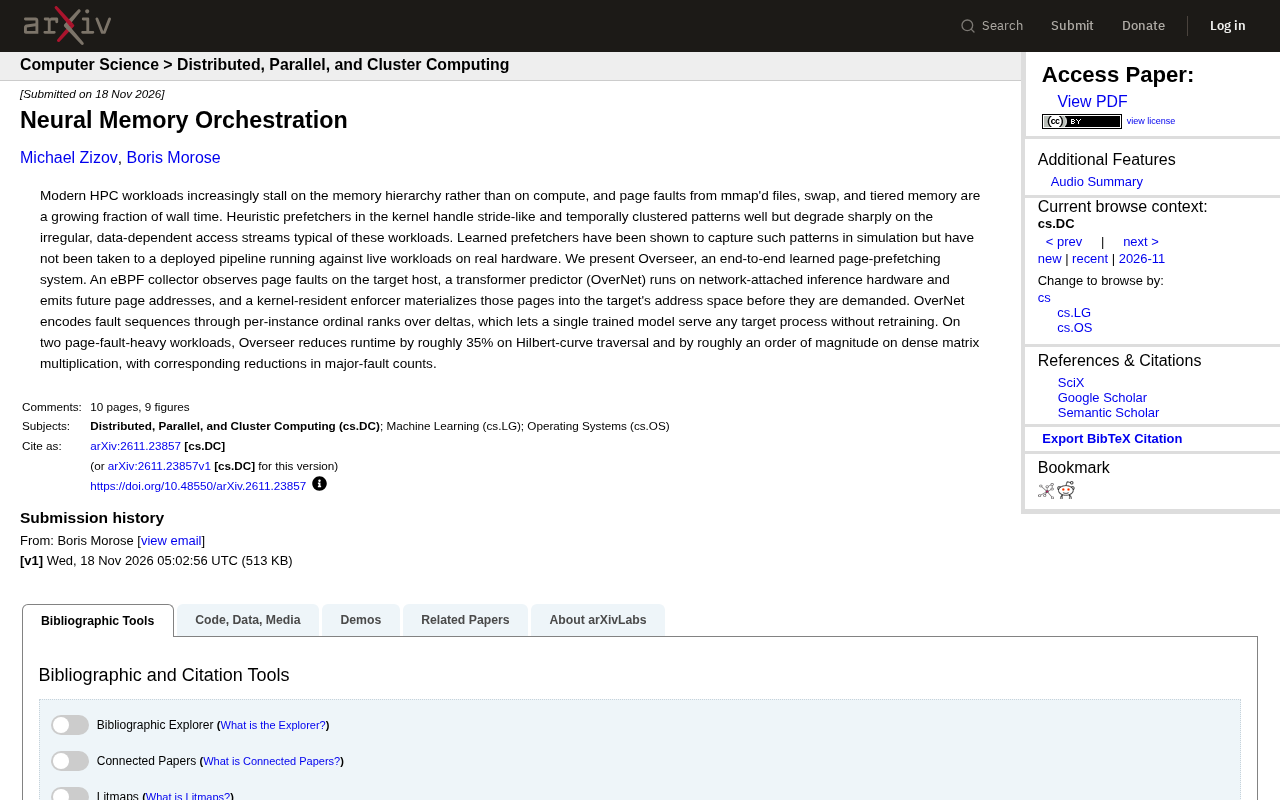
The performance bottleneck of modern high-performance computing (HPC) workloads is shifting from computation to the memory hierarchy. Page faults—arising from mmap files, swap space, and tiered memory—are accounting for an increasingly large share of total wall-clock time. In-kernel heuristic prefetchers excel at stride-pattern and temporally clustered access patterns, but their performance degrades sharply when faced with the irregular, data-dependent access streams typical of these workloads. Learned prefetchers have been shown in simulation to capture such patterns, but have never before been deployed into a pipeline running on real hardware against live workloads. This article introduces Overseer, an end-to-end learned page prefetching system that collects page faults via eBPF, runs a Transformer predictor on network-attached inference hardware, and uses a kernel-resident executor to materialize pages into the target address space ahead of demand.
From Heuristics to Learning: A Paradigm Shift in Prefetching
Traditional kernel prefetchers rely on fixed rules, such as detecting the stride of sequential accesses or clustered patterns within a time window. These rules work well for regular access patterns, but HPC workloads often exhibit irregular, data-dependent access streams—for example, sparse matrix traversals, graph computations, and adaptive mesh refinement. In these scenarios, heuristic prefetchers either fail to capture the patterns or generate large amounts of useless prefetches that pollute the cache.
The core idea of Overseer is to move prefetching decisions from kernel rules to a learned model. Rather than relying on hand-designed heuristics, it learns access patterns from actual page fault sequences and predicts future page addresses that are likely to be accessed. The key challenge of this shift is: how to provide low-latency prefetching services to arbitrary processes without modifying the target application or retraining the model.
Page faults and prefetching: A page fault occurs when a virtual page accessed by a process has not yet been mapped to physical memory. The kernel must intervene, potentially triggering disk I/O or memory allocation, with latencies ranging from microseconds to milliseconds. Prefetching aims to load pages into memory before they are actually accessed, thereby hiding latency. Traditional kernel prefetchers are based on fixed heuristic rules (e.g., detecting the stride of sequential accesses) and work well for regular access patterns, but when faced with irregular, data-dependent access streams such as sparse matrix traversals and graph computations in HPC, they either fail to capture the patterns or over-prefetch and pollute the cache. Learned prefetchers, by contrast, learn patterns from historical access sequences and hold the promise of adapting to complex access streams.
System Architecture: eBPF, Transformer, and Kernel Executor
Overseer employs a three-stage pipeline. First, an eBPF collector observes page faults on the target host, capturing fault sequences in real time and sending them to the inference side. Second, a Transformer predictor called OverNet runs on network-attached inference hardware, receiving page fault sequences and outputting future page addresses. Finally, a kernel-resident executor materializes these pages into the target process's address space before they are actually demanded.
The key to this division of labor is offloading the inference workload from the target host to dedicated hardware, avoiding prediction overhead interfering with the workload being optimized. The use of eBPF ensures that the collection process is transparent to the target process, requiring no application code changes or kernel module recompilation.
eBPF (extended Berkeley Packet Filter) is a safe, efficient virtual machine mechanism in the Linux kernel that allows user-space programs to inject sandboxed code into kernel event points (such as system calls and page faults) for execution, without modifying kernel source or loading modules. eBPF programs run when events are triggered and exchange data with user space through maps. In Overseer, the eBPF collector uses kernel tracepoints to capture page fault events, extracting fault address sequences in real time and sending them to the inference side. This design is completely transparent to the target process, requires no application modification or restart, and has extremely low overhead, making it suitable for production deployment.
OverNet: Cross-Process Generalization via Ordinal Ranking
OverNet's design addresses a core challenge of learned prefetching: how to make a single trained model serve arbitrary target processes without retraining for each one. Its approach is to characterize page fault sequences through per-instance ordinal ranking encoding of deltas. Put simply, the model does not directly learn absolute page addresses; instead, it learns the relative change patterns between page accesses and normalizes these changes into a ranking space. This enables the model to capture access structures common across different workloads while adapting to the address layout specific to each process.
This encoding gives a single trained model cross-process generalization capability, significantly reducing deployment costs. In real environments, retraining a model for each new workload is infeasible; OverNet's generalization design is the key prerequisite for Overseer's practical deployability.
Transformer and ordinal ranking: A Transformer is a neural network architecture based on self-attention that excels at processing sequence data and capturing long-range dependencies. OverNet uses a Transformer to model page fault sequences and predict future page addresses. However, since different processes have different address space layouts, directly learning absolute addresses is difficult to generalize. Ordinal ranking encoding converts page access deltas into relative rankings, normalized into a unified space, so that the model focuses on the structure of access patterns rather than specific addresses. This allows a single model to generalize across processes without retraining for each workload, greatly reducing deployment costs.
Measured Results: Hilbert Curve Traversal and Dense Matrix Multiplication
Overseer was tested on two page-fault-intensive workloads. In Hilbert curve traversal, runtime was reduced by about 35%; in dense matrix multiplication, runtime was reduced by an order of magnitude, with a corresponding decrease in major page fault counts.
These two workloads represent different access patterns: Hilbert curve traversal has spatial locality but irregular address jumps, while dense matrix multiplication involves large-scale contiguous but blocked data streams. Overseer achieved significant gains on both, demonstrating that learned prefetchers can handle diverse patterns that heuristic methods struggle to cover.
Significance and Limitations: Learned Prefetching Moves Toward Deployment
Overseer's contribution lies in advancing learned prefetching from simulation environments to a deployment pipeline on real hardware. It demonstrates that end-to-end learned prefetching systems are feasible on real workloads and can deliver substantial runtime gains. The combination of eBPF collection, network-attached inference, and a kernel executor provides a reusable architectural template for the design of future memory management systems.
However, the current evaluation covers only two workloads, and the impact of network latency between the inference hardware and the target host on prefetch timeliness has not been fully discussed. Validating generalization on a broader set of workloads and optimizing end-to-end inference latency are issues that must be addressed before the system can move to production.
Conclusion
Overseer demonstrates the potential of learned page prefetching in real HPC environments: by transparently collecting page faults via eBPF, generalizing predictions across processes with a Transformer model, and materializing pages ahead of demand with a kernel executor, it achieves significant runtime reductions on two representative workloads. This work opens a new direction for memory hierarchy optimization and suggests that solving the memory wall problem may increasingly depend on cross-layer co-design of systems and machine learning.
One-line Summary
Overseer is the first end-to-end learned page prefetching system deployed on real hardware, significantly reducing runtime for HPC workloads.
Paragraph Summary
Overseer is the first end-to-end learned page prefetching system deployed on real hardware, aimed at solving the increasingly severe page fault overhead in modern high-performance computing. The system transparently collects page fault sequences via eBPF, uses a Transformer predictor (OverNet) on network-attached hardware to learn access patterns, and has a kernel executor materialize pages ahead of demand. OverNet encodes page fault deltas with per-instance ordinal ranking, enabling a single model to generalize across processes without retraining for each workload. On two page-fault-intensive workloads—Hilbert curve traversal and dense matrix multiplication—Overseer reduced runtime by about 35% and by an order of magnitude, respectively, demonstrating the feasibility and potential of learned prefetching in real environments.
Related articles

Prospero: A Lightweight Native AI Coding Tool Built with ImGui
Prospero is a bloat-free native AI coding tool built with ImGui, emphasizing lightweight design, high performance, and low dependencies. This article analyzes its design philosophy, technical choices, and the divergence between platformization and toolization in AI coding tools.

WebRTC Abused: New Variant of Credit Card Skimming Scripts on Shopping Sites
Security researchers found skimming scripts on popular shopping sites using WebRTC data channels to exfiltrate credit card data. This article analyzes the technical原理, differences from traditional Magecart attacks, and defense strategies for e-commerce platforms in third-party script governance and CSP policies.

Single GB10 Card Hits 101 tok/s: Inkling 2 Mini Performance Tested on vLLM
A developer shared on Hacker News running Inkling 2 Mini with vLLM on a single GB10 at 101 tok/s. This article analyzes the technical context, the significance of vLLM with small models on single cards, and caveats for interpreting tok/s metrics.