Ox Alpha Suspected to Be Google Gemini: The Competitive Strategy Behind Anonymous Model Testing

AI community speculates mysterious Ox Alpha model may be Google's Gemini, revealing stealth testing strategies in AI competition.
A mysterious AI model codenamed Ox Alpha has sparked intense speculation that it may be a Google Gemini model tested anonymously on public platforms. This analysis explores the strategic value of anonymous model testing — avoiding brand bias, gathering unbiased feedback, and creating buzz — while examining how this practice has become standard among major AI labs competing in an increasingly crowded landscape.
A Storm of Speculation Around a Mysterious Model
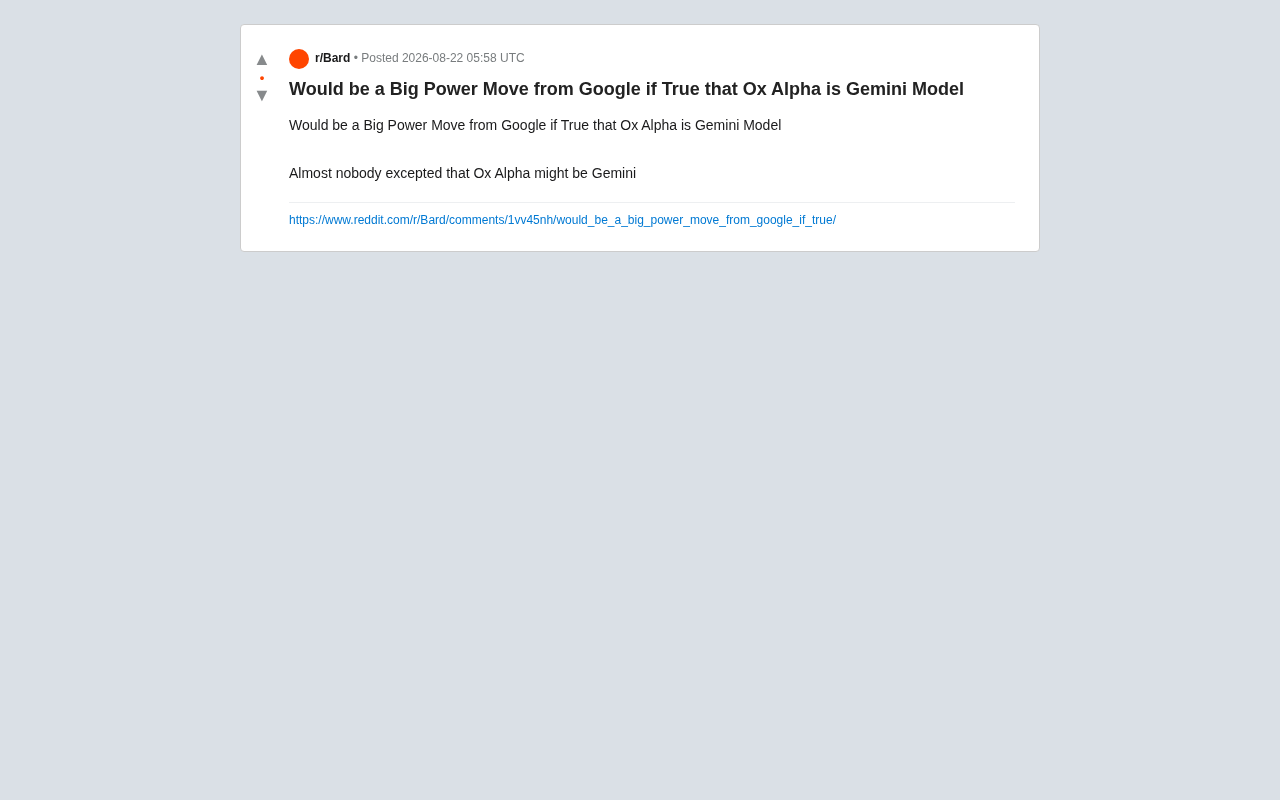
Recently, a mysterious model codenamed "Ox Alpha" has sparked widespread discussion across the AI community. On technical forums like Reddit, some believe this previously unidentified model is very likely the work of Google — specifically, a model from the rumored Gemini series. The moment this speculation emerged, it sent ripples through the industry, as "almost no one anticipated that Ox Alpha could be Gemini."
Anonymous or codename-based model releases have become a common strategy among major AI labs in recent years. Companies often deploy models in "stealth mode" on public testing platforms (such as arena-style model battle leaderboards) before official launches, gathering real user feedback while avoiding the risks of inflated brand expectations. The most representative platform is LMSYS Chatbot Arena (now renamed LMArena), operated by a UC Berkeley team. It uses a "blind battle" mechanism — users submit a prompt, and the system randomly assigns two anonymous models to respond simultaneously. Users then select the winner based on response quality. Using the large volume of user votes, the platform employs an Elo rating system (borrowed from chess) to dynamically rank models. This crowdsourced evaluation approach is considered the closest approximation to real user preferences currently available, reflecting a model's overall performance in open-ended conversations far better than traditional academic benchmarks like MMLU or HumanEval. Because of its anonymity mechanism, major AI labs frequently submit new models under codenames for "stress testing" before official release. The appearance of Ox Alpha fits this pattern perfectly.
If True, This Would Be a "Power Move" from Google
The original post's title states plainly: "If Ox Alpha really is a Gemini model, this would be a Big Power Move from Google." The logic behind this statement deserves deeper exploration.
Gemini's Brand Baggage and the Strategic Value of Anonymous Testing
Gemini is a multimodal large language model series first released by Google DeepMind in December 2023, positioned as Google's core product to compete with OpenAI's GPT-4. Gemini comes in three scale tiers — Ultra, Pro, and Nano — each targeting different use cases. However, Gemini's launch journey has been far from smooth: the original Gemini faced a trust crisis when its promotional video was accused of being fabricated, and Gemini Ultra's image generation feature was urgently taken offline due to excessive political correctness overcorrection. These incidents built up a degree of negative expectations around the "Gemini" brand within the tech community.
It is precisely against this backdrop that deploying a model under an anonymous codename carries multiple layers of strategic value for Google:
- Avoiding the expectation trap: The Gemini brand carries enormous expectations tied to Google's competition with OpenAI and Anthropic, while also bearing the shadow of previous launch setbacks. If released directly under the brand name and underperforming expectations, the PR backlash would be even greater. Debuting under a neutral codename like "Ox Alpha" lets the model "speak through its performance," free from brand bias.
- Obtaining unbiased evaluations: When users don't know which company built a model, their assessments tend to be more objective, unaffected by brand preferences. Especially given Gemini's previous trust crisis, anonymous testing helps Google gather more authentic performance feedback, eliminating the psychological effect of "giving a low score just because it's Google."
- Creating buzz and suspense: Mystery itself is a marketing tool. When the community starts debating "whose model is Ox Alpha," Google has already gained free attention.
Why the Community "Almost Didn't See It Coming"
The post specifically emphasizes that "almost no one anticipated that Ox Alpha could be Gemini." This detail is quite telling. It likely means that Ox Alpha's demonstrated capabilities, response style, or technical characteristics during testing diverged from the community's existing perception of Gemini. If a model that performs impressively yet "doesn't feel like Google" ultimately turns out to be Gemini, that would precisely demonstrate a significant breakthrough or transformation in Google's model capabilities — undoubtedly the most powerful proof for a company that has been trying to shed its "chaser" label.
Anonymous Model Testing: Standard Practice in the AI Industry
You might not have noticed, but releasing models under codenames for testing is far from exclusive to Google. Multiple companies across the industry have employed similar strategies, deploying new models under mysterious identities on public evaluation platforms to observe their rankings and user preferences in real conversational scenarios.
The rise of this practice reflects several realities of the current AI competition:
First, model iteration cycles are extremely fast. Major labs release new versions nearly every few weeks. Anonymous testing allows rapid validation of a new model's market reception without disrupting the brand's release cadence.
Second, user feedback has become a core competitive advantage. As technical capabilities gradually converge, subtle differences in user experience often determine success or failure. Blind-test data collected through anonymous testing is more convincing than any internal evaluation. The dynamic nature of the Elo rating system — gaining more points by defeating stronger opponents and losing more by falling to weaker ones — enables newly entered anonymous models to find their true performance level through intensive battles in a relatively short time.
Third, competitive psychological warfare. Preventing competitors from identifying which company owns a high-performing model is itself a way to disrupt their strategic calculations. In the current three-way game among the first tier of large model developers — OpenAI holding first-mover advantage and the largest market share with ChatGPT and the GPT-4 series, Anthropic differentiating with Claude's "safety alignment" focus, and Google possessing the largest computational resource reserves and search ecosystem integration advantages — every model release has become a strategic chess move. Additionally, Meta's Llama series leads in the open-source domain, while xAI's Grok, Mistral AI, and others are rapidly catching up, making the competitive landscape even more complex. Anonymous testing has become a rational choice for minimizing risk while maximizing information gathering.
A Rational Perspective: Still Unconfirmed Speculation
It's important to recognize clearly that as of now, "Ox Alpha is Gemini" remains community-level speculation with no official confirmation. The original post's title phrase "if true" also indicates that this claim is built on assumptions.
In the AI field, speculation about mysterious model identities is common — some cases are eventually confirmed, while others turn out to be false alarms debunked by subsequent information. Therefore, regarding Ox Alpha's true identity, we should maintain a cautious stance:
- Focus on actual performance: Regardless of who built Ox Alpha, its real capabilities demonstrated in public testing are what matter most. Objective data like Elo ranking changes in blind battles and user preference rates are far more valuable than any identity speculation.
- Wait for official signals: Final confirmation of model attribution typically requires official announcements from the company or cross-verification from reliable sources.
- Beware of over-interpretation: A single community post's viewpoint should not be amplified into an industry-defining conclusion.
The "Stealth Game" in a White-Hot Competition
The mystery of Ox Alpha's identity reflects a microcosm of large model competition entering its most intense phase. As technical gaps continue to narrow, companies are engaging in increasingly refined battles over release strategies, market psychology, and user experience. Testing the waters under anonymous codenames is both a sign of confidence in one's own capabilities and a hedge against market risk.
This phenomenon also reveals deeper changes in the AI industry's evaluation ecosystem: traditional academic benchmarks (chasing scores on fixed datasets like MMLU, GSM8K, etc.) are increasingly unable to differentiate between top-tier models, while crowdsourced evaluations based on real user interactions are becoming the new "litmus test." Anonymously submitting models for such evaluations essentially acknowledges a fundamental truth — what ultimately determines a model's quality is the real choices users make when they don't know the brand.
If Ox Alpha is ultimately confirmed as Google Gemini, it could indeed represent an impressive move by Google in the AI race — proving not only the model's capabilities but also that Google has learned to play its cards more smartly in a complex competitive environment. But before the truth is revealed, this guessing game around a mysterious model has already become a fascinating window into industry dynamics.
Key Takeaways
Related articles

Chain of Thought Isn't Just for AI: How Humans Can Use CoT to Improve Thinking Quality
Chain of Thought isn't just a prompt trick for large models. Starting from a Hacker News discussion, this article analyzes why CoT works for human thinking too, breaks down actionable ways to transfer it, and highlights the key differences between human CoT and machine CoT.
Cloudflare Teams Up with OpenAI: Closi…
Cloudflare Teams Up with OpenAI: Closing the Loop from Vulnerability Discovery to Defense with AI
Cloudflare uses OpenAI Daybreak to investigate security vulnerabilities and generate reviewable remediation plans, while developers use Codex to boost coding efficiency and quality.

Orca Multi-Agent Orchestration in Practice: A Guide to Parallel Collaboration with Claude and Codex
Orca is Stable AI's free open-source agent workbench supporting 34 agents like Claude Code and Codex in parallel. Learn its Git worktree isolation, multi-model orchestration, and mobile management.