Pacer: Predict Whether Your AI Coding Subscription Quota Will Last Until Reset

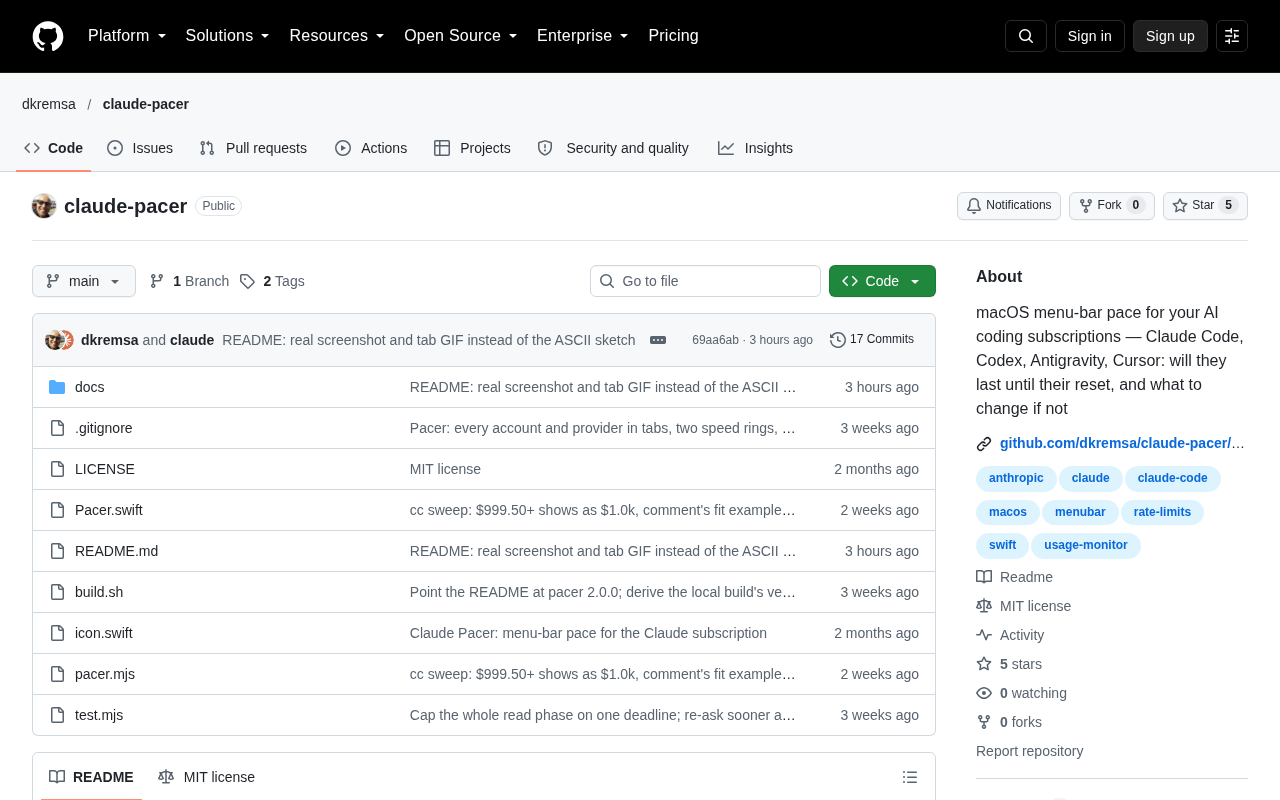
Pacer is an early-stage pacing tool that predicts whether your AI coding subscription quota will last until reset.
Subscription-based AI coding tools like Claude Code and Cursor impose periodic usage limits, but official dashboards only show consumption without predicting sustainability — leaving developers stuck in a "splurge early, starve later" cycle. Pacer is an indie tool that acts as an "AI subscription pacer," estimating whether your current usage rate will carry you through to the next reset and providing early warnings. It represents a growing "meta-tool" trend in the AI ecosystem. Currently early-stage with limited Hacker News traction, its main challenges include data acquisition, multi-platform support, and prediction model accuracy.
A Small Tool That Solves a Real Pain Point
Developers who use AI coding subscription services like Claude Code, Cursor, or GitHub Copilot have probably run into this frustrating scenario: you use freely at the start of the month, only to realize mid-month that your quota is running low — and then you're forced to ration usage for the rest of the billing cycle, or even stop working entirely until the quota resets. AI tools with subscription models almost universally impose periodic usage limits (token quotas, request counts, or credits), yet there's rarely any intuitive way to pace your allocation across the full billing period.
A tool called Pacer appeared in the Show HN section of Hacker News, aimed squarely at this problem. Its core purpose is straightforward: help users determine whether their AI coding subscription quota will last until the next reset date.
What Pacer Is Trying to Solve
The name Pacer says it all — like a pacer in a long-distance race who helps runners maintain a steady rhythm and avoid burning out too early. Applied to AI subscriptions, Pacer's logic is to use your current consumption rate and remaining quota to estimate whether you can sustain your usage through to the end of the billing cycle.
Typical Use Cases
- Quota alerts: Get notified early when your consumption rate is running significantly ahead of the "ideal pace," rather than discovering the problem only after you've run out.
- Usage planning: For heavy monthly subscribers, distribute your daily allowance sensibly to avoid running dry at the end of the month.
- Cost awareness: Help teams or individual developers build an intuitive understanding of their actual AI tool consumption.
The value of tools like this lies precisely in transforming the abstract "how many tokens do I have left" into the more actionable "at this rate, how many more days can I keep going?" For developers who have deeply integrated AI coding assistants into their daily workflow, this kind of predictive capability can effectively reduce the risk of having work interrupted by quota exhaustion.
Why This Need Is Becoming More Common
As AI coding subscriptions evolve from "novelty" to "essential productivity tool," usage management has become a new pain point. Early adopters may have only used models occasionally, but today tools like Claude Code and Cursor often handle a large portion of code generation, refactoring, and debugging — consuming quota far faster than users expect.
Billing models also vary widely across providers: some charge per token, some per request, some use opaque "credits" systems, and most have periodic reset mechanisms. This complexity makes it hard for ordinary users to stay on top of things. Third-party tools like Pacer exist to fill the gap left by official dashboards that "tell you how much you've used, but not how to use it wisely."
Take some mainstream services as examples: Claude Code (Anthropic) uses token-based metering with a fixed monthly cap on Pro subscriptions — exceed it and you wait for a reset or pay extra; Cursor uses a "fast request" quota that throttles you to a slower model once exhausted; GitHub Copilot charges enterprise users per seat, but actual code completion call frequency remains opaque to individual users. This "black-box billing" experience, compounded by inconsistent units across tools (tokens, requests, credits, points), makes it especially difficult for developers who switch between tools or run multiple subscriptions simultaneously to maintain an overall sense of their usage. Pacer aims to address exactly this cross-platform cognitive gap.
A Realistic Look: Limitations of an Early-Stage Project
To be objective, Pacer has attracted limited attention on Hacker News so far (only 6 upvotes and 3 comments at the time of posting), and is clearly an early-stage personal project. Based on publicly available information, it looks more like a developer scratching their own itch than a mature commercial product.
Tools like this typically face several practical challenges:
- Data acquisition: How does it accurately read usage data from each platform? Whether it relies on official APIs, manual input, or local log parsing directly determines the accuracy and scope of its predictions.
- Multi-platform support: Billing units and reset rules vary significantly across subscription services — the broader the coverage, the higher the maintenance cost.
- Prediction model: Simple linear extrapolation (remaining quota ÷ remaining days) is easy to implement, but developers' actual usage tends to fluctuate dramatically; more sophisticated predictions are needed to deliver real value.
The "scratch your own itch" approach is a common starting point in indie developer culture — a developer builds a tool to solve their own real problem, then open-sources or publicly releases it. The advantage of such projects is that the need is genuine and the motivation is pure; the downside is that features tend to be highly personalized, lacking systematic design for broader user scenarios. This type of tool appears frequently in Hacker News's Show HN section, where community feedback (upvotes, comment quality) typically serves as an early signal of how universal the need is and how much potential the project has. Pacer's current metrics are modest, suggesting it hasn't yet reached or convinced enough potential users who share the same pain point. Whether it can iterate into a more general-purpose product depends on whether the author continues to maintain it and whether a contributor community forms.
Conclusion
Pacer represents a class of "meta-tools" emerging in the AI ecosystem — tools that don't provide AI capabilities directly, but instead help users better manage and use AI services. As subscription-based AI coding assistants become more widespread, peripheral tools focused on usage monitoring, cost optimization, and quota planning will continue to multiply.
For developers who rely heavily on AI coding subscriptions, a pacing tool like this could help avoid the frustrating "end-of-month shutdown." That said, as an early open-source/indie project, its actual maturity remains to be seen — interested users would do well to try it themselves before drawing conclusions.
Related articles

Chain of Thought Isn't Just for AI: How Humans Can Use CoT to Improve Thinking Quality
Chain of Thought isn't just a prompt trick for large models. Starting from a Hacker News discussion, this article analyzes why CoT works for human thinking too, breaks down actionable ways to transfer it, and highlights the key differences between human CoT and machine CoT.
Cloudflare Teams Up with OpenAI: Closi…
Cloudflare Teams Up with OpenAI: Closing the Loop from Vulnerability Discovery to Defense with AI
Cloudflare uses OpenAI Daybreak to investigate security vulnerabilities and generate reviewable remediation plans, while developers use Codex to boost coding efficiency and quality.

Orca Multi-Agent Orchestration in Practice: A Guide to Parallel Collaboration with Claude and Codex
Orca is Stable AI's free open-source agent workbench supporting 34 agents like Claude Code and Codex in parallel. Learn its Git worktree isolation, multi-model orchestration, and mobile management.