Pactto: An AI Collaboration Space for Creative Teams Where Every Piece of Feedback Actually Lands

Pactto is an AI-powered collaboration space that ensures creative review feedback is remembered and acted on in real time.
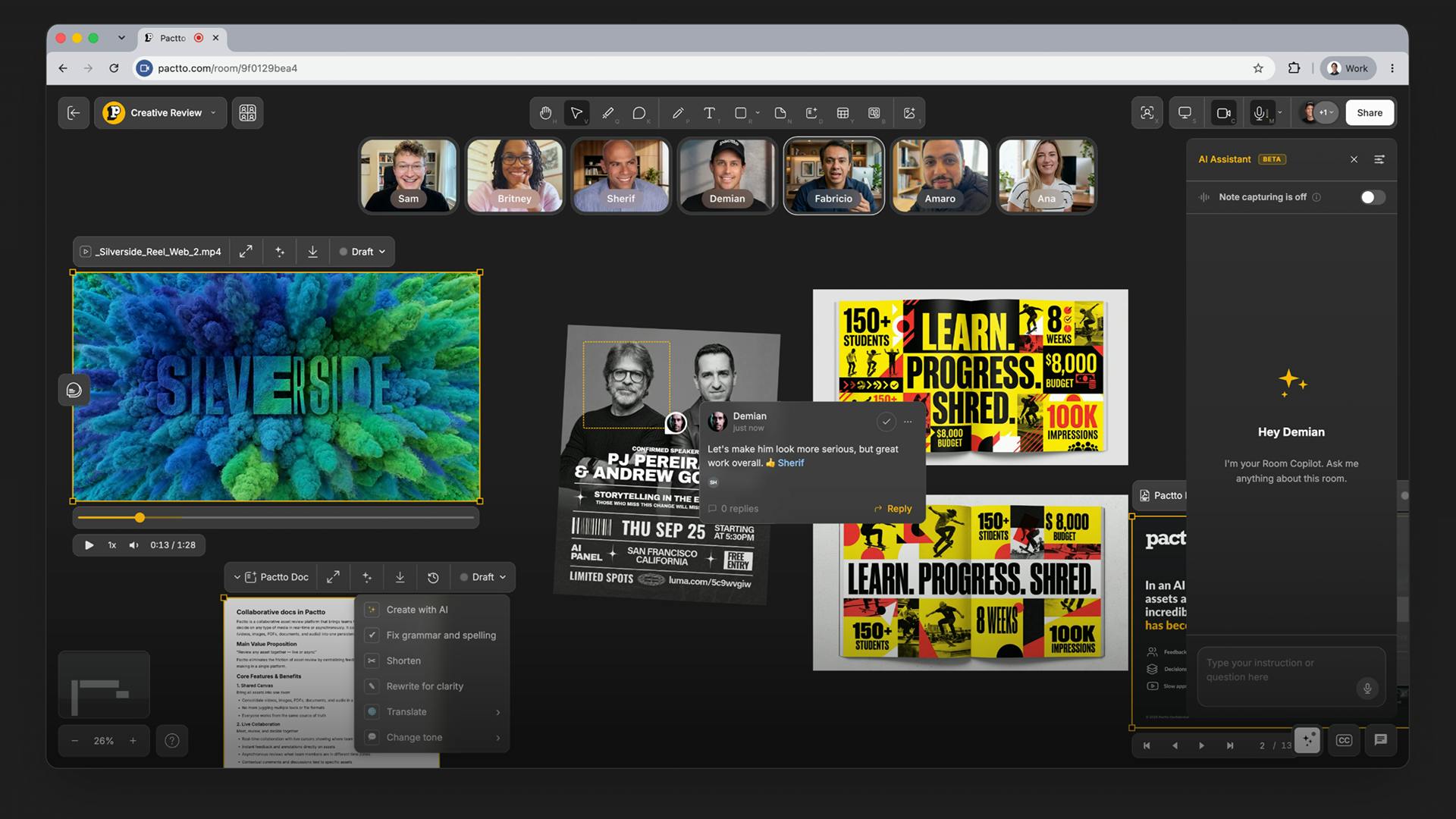
Pactto is an AI collaboration tool built for creative teams, tackling the pain point of information loss after design review meetings. Unlike Zoom or Google Meet, Pactto's persistent rooms record every conversation, decision, and piece of feedback so nothing disappears when the call ends. Its three core capabilities — studio-quality asset presentation, an AI agent that understands creative intent, and a live AI execution layer for real-time edits — form a differentiated package for design studios, ad agencies, and brand teams. Currently sitting at 87 upvotes and ranked 10th on ProductHunt, it shows promise but still needs to prove the accuracy of its creative-intent AI and the true scope of its live editing functionality.
In the daily workflow of creative teams, the biggest pain point is rarely a lack of tools — it's the loss of information. After a design review wraps up, the moment a Zoom or Google Meet call ends, all the context, key decisions, and feedback simply vanish. Pactto, a new arrival on ProductHunt, is targeting exactly this long-overlooked problem.
What Problem Is Pactto Trying to Solve
Pactto positions itself as "The room where creative teams align and AI takes action." Its core logic is straightforward: creative reviews shouldn't be one-off meetings — they should be a continuous, traceable workflow that retains memory and directly produces actionable outcomes.
Compared to general-purpose video conferencing tools like Zoom and Google Meet, Pactto's key differentiator is memory. According to the official description, context disappears the moment a call ends on generic meeting tools, whereas Pactto's rooms remember everything — every conversation, every decision, every piece of feedback. This "nothing gets forgotten" design is especially valuable for creative work that revolves around visual assets and iterative feedback.
Three Key Capabilities
Based on the product introduction, Pactto leads with three capabilities that set it apart from ordinary meeting software.
Studio-Quality Presentation of Work
Pactto allows creative teams to showcase their work at "studio quality." For design, video, and branding teams, the presentation environment directly shapes how clients and internal reviewers perceive the work. Compared to the rough experience of screen-sharing in a meeting, a dedicated environment optimized for creative assets is a genuine upgrade.
An AI Agent That Understands Creative Intent
Pactto introduces an AI agent designed to "understand creative intent" when reviewing assets. This means the AI isn't just passively recording — it actively tries to comprehend the creative direction behind the discussion, capturing feedback more precisely. It promises to capture every note, systematically preserving opinions that would otherwise be scattered across a conversation.
"Understanding creative intent" is a technically ambitious goal. Current mainstream AI meeting tools (such as Otter.ai, Fireflies, and Notion AI) primarily rely on speech-to-text plus summary generation — essentially structured distillation of spoken content, without truly "understanding" the design decision logic behind the discussion. For Pactto's AI agent to genuinely grasp creative intent, it would need to simultaneously process visual assets (images, video frames) and conversational context, linking the two together — for example, when someone says "the typography on the left feels too heavy," the AI would need to locate the corresponding visual element. This touches on the capability boundaries of multimodal large models (such as GPT-4V or Gemini). While the industry is advancing rapidly in multimodal understanding, seamlessly integrating it into real-time review workflows remains frontier territory, and real-world performance depends heavily on engineering execution quality.
Making Changes Live
The most imaginative feature is "make changes live" — the AI can execute modifications in real time during a review session. This is the direct embodiment of "AI takes action" in Pactto's tagline: feedback no longer sits in a "noted for later" queue, but can be immediately translated into adjustments to the actual work. If this capability is mature enough, it could dramatically compress creative iteration cycles.
The "live changes" capability carries significant technical nuance worth examining. Operations that current AI can handle relatively well include structured changes like copy replacement, color parameter adjustments, and layer text edits. However, modifications involving layout restructuring, style transfer, or complex visual elements require more powerful generative AI capabilities, and typically depend on native API integrations with design tools (such as the Figma Plugin API or Adobe CEP). If Pactto's "live changes" are limited to document or text-based assets, the gap between reality and marketing will be substantial. But if it can genuinely integrate with tools like Figma and After Effects, it would represent a truly disruptive workflow integration — making this the feature boundary most worth verifying during any trial.
Market Positioning and Key Observations
Pactto is categorized under Meetings, Artificial Intelligence, and Video — essentially a vertical branch within the AI meeting collaboration space, specifically serving creative teams. On ProductHunt, it received 87 upvotes and 18 comments, ranking 10th for the day: a product with solid traction but not yet viral.
The smart play here is vertical focus. General AI meeting tools (like various meeting notes products) face fierce competition, while Pactto narrows its scope to the creative review workflow — a high-frequency use case with clearly defined pain points. By combining presentation quality, persistent context, and AI execution, it forms a differentiated package. For design studios, advertising agencies, and brand teams, this logic has obvious appeal.
Questions Worth Watching
Of course, the publicly available information only describes the product vision, and several promises still need validation. Can the "AI that understands creative intent" actually capture nuanced design feedback in real-world usage? What asset types does "live editing" support, and at what level of granularity? These are the factors that will determine the product's success — and the questions potential users should prioritize when trying it out.
As a newly launched product, Pactto presents a compelling direction: transforming creative collaboration from "meeting ends, everyone forgets" to "every piece of feedback actually lands." Whether it can deliver on that promise will require much more real-world validation.
Related articles

Hands-On with the Gemini 4 Argon API: Thinking Levels and Background Mode Explained
A Free Code Camp crash course on the Gemini 4 Argon API: from getting a key and sending your first request to controlling reasoning costs with thinking levels, enabling multi-turn chat with previous_interaction_id, and generating a Breakout game in background mode—plus a Google engineer's take on the model's capabilities.

Reinforcement Learning Takes On Getting Over It: Distributed Training Strategies Behind 63% Progress
A developer uses deep reinforcement learning to tackle Getting Over It. The agent climbs from the bottom to 63% progress but gets stuck at the anvil. The project is open-sourced, using divide-and-conquer training and CPU-only training, seeking community collaboration to break the bottleneck.

Sigma FP2 Released: The World's Smallest Full-Frame Camera Gets Sensor and Screen Upgrades
Sigma launches the FP2 full-frame camera, retaining its smallest-and-lightest design with three key upgrades: improved sensor, articulating LCD screen, and longer battery life—built for portable video creators.