PageIndex: A Document Q&A Engine Where Every AI Answer Is Traceable and Verifiable

PageIndex makes every AI-generated answer traceable to its exact source line in your documents.
PageIndex is a document Q&A engine that hit #1 on Product Hunt by solving a critical professional pain point: answer verifiability. Users can import entire document collections, ask complex questions, and click any citation to jump directly to the highlighted source line in the original text. Designed for legal due diligence, financial research, academic work, and enterprise knowledge management, it prioritizes trust and traceability over raw model capability.
In enterprise and professional domains, the biggest pain point with AI Q&A tools has never been "can it answer" — it's "is the answer correct, and can it be verified." When lawyers, analysts, and researchers face hundreds or thousands of pages of contracts, reports, and papers, a seemingly fluent answer that can't be traced back to its source is often more dangerous than no answer at all. PageIndex, which recently hit #1 on Product Hunt's daily rankings, takes direct aim at this very problem.
PageIndex's Core Positioning: Making Every Answer Verifiable
PageIndex's core value proposition is crystal clear — delivering accurate, trustworthy answers from the lengthy professional documents your work depends on. It lets users import entire document collections, ask their toughest questions, and every citation is clickable — jumping straight to the highlighted source line in the original text, enabling verification in just seconds.
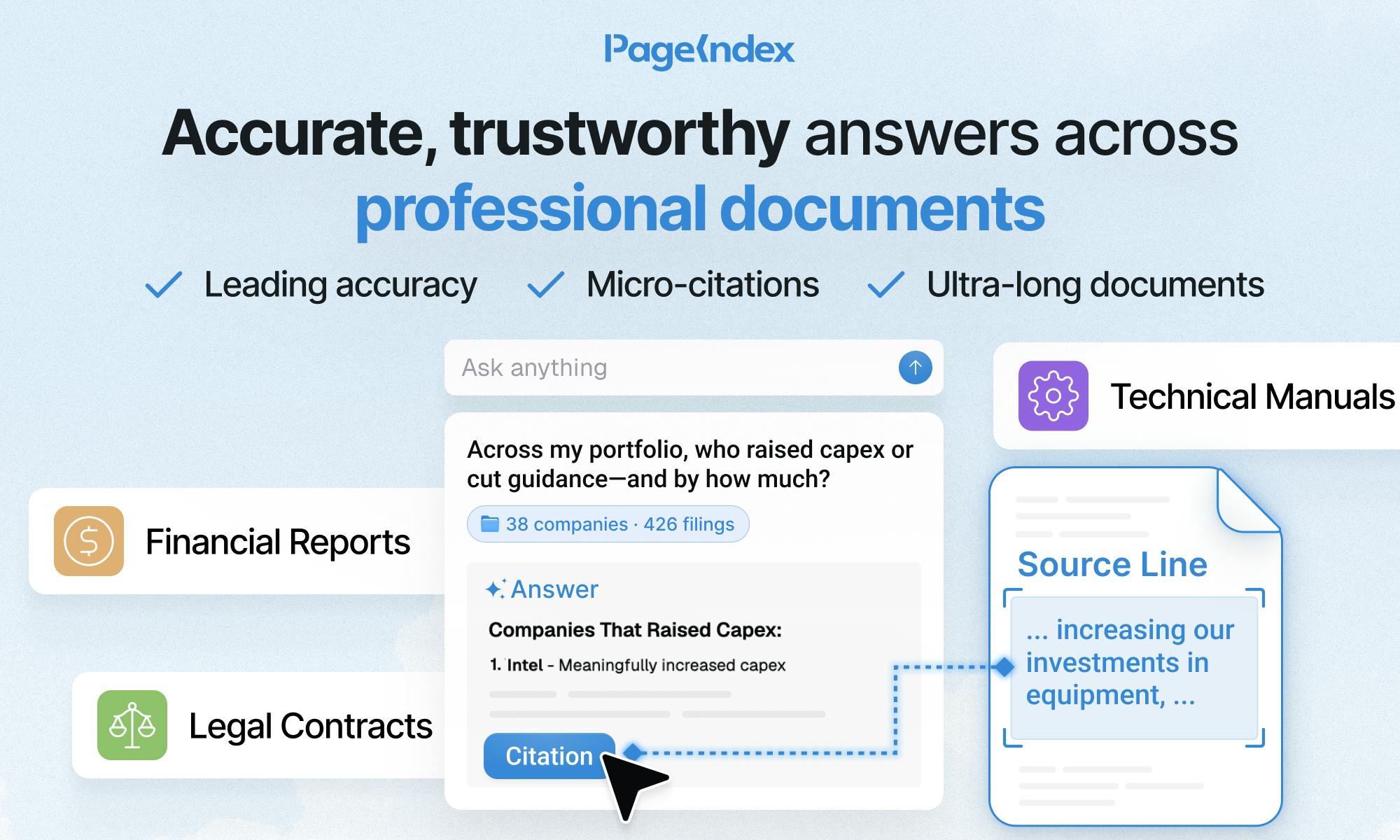
This "answer + precise source tracing" design strikes at the Achilles' heel of current RAG (Retrieval-Augmented Generation) tools. Most AI Q&A products can generate answers, but they struggle to let users quickly confirm exactly which sentence in a document an answer came from. PageIndex treats "click a citation to jump to the highlighted original text" as a first-class feature, elevating verifiability from an add-on to the product's core value.
Market feedback confirms the demand: the product earned 343 upvotes and 46 comments on Product Hunt, topping the daily chart in the "Productivity" and "Artificial Intelligence" categories — proof that there's real, robust demand for trustworthy document Q&A tools.
Why "Trustworthiness" Is Critical for Professional Document Q&A
In general consumer scenarios, occasional AI errors are tolerable. But in professional fields like law, finance, healthcare, and research, a single hallucination can lead to serious compliance risks or flawed decision-making.
AI Hallucination Is the #1 Barrier in Professional Scenarios
Large language models have an inherent tendency to "fabricate": when a model is uncertain about a question, it still generates plausible-sounding content with confident phrasing. For professionals handling critical documents, this means they must verify every single AI claim word by word — actually increasing their workload rather than reducing it.
PageIndex's approach is to make the verification step as lightweight as possible — instead of forcing users to dig through the original text, the answer proactively points to the exact location in the source. This philosophical shift essentially transforms AI from "making decisions for you" to "helping you make decisions faster," with humans always retaining final judgment.
From "Generating Answers" to "Precise Retrieval + Page-Level Positioning"
You may not have noticed what the product name itself implies — PageIndex. It signals a deep commitment to document structure and page-level positioning. Compared to approaches that rely solely on vector retrieval, emphasizing page-level and line-level precise positioning means the team has invested significant engineering effort in document parsing and structured indexing to deliver the seamless "click to jump to highlighted line" experience.
Target Users and Typical Use Cases
PageIndex emphasizes "importing entire document collections," which makes it better suited for large-scale, systematic document libraries rather than ad-hoc Q&A on a single file.
Here are several foreseeable typical use cases:
- Legal Due Diligence: Rapidly locate specific clauses and their sources across dozens of contracts, dramatically shortening review cycles;
- Financial Research & Analysis: Extract key data from earnings reports, prospectuses, and industry reports with source verification;
- Academic Research & Paper Retrieval: Search for evidence chains across large volumes of papers, ensuring citation accuracy;
- Enterprise Knowledge Management: Consolidate internal policies and technical documentation into a queryable, verifiable knowledge base.
These scenarios share common traits: lengthy documents, high specialization, costly errors, and hard requirements for source traceability. PageIndex's product design is practically tailor-made for these high-stakes needs.
Competitive Landscape: How PageIndex Differentiates Itself
The long-document Q&A space is already quite crowded, ranging from general-purpose tools (like ChatGPT's file upload and Google NotebookLM) to a proliferation of vertical solutions. For PageIndex to break through, the key lies in whether it can deliver on "trustworthiness" more thoroughly than competitors.
From a product narrative perspective, PageIndex doesn't emphasize "smarter answers" or "more powerful model capabilities." Instead, it focuses on a practical pain point: "can you verify the answer in seconds?" This is a pragmatic differentiation strategy — in an era of increasingly commoditized model capabilities, the trust experience is becoming the core competitive moat for professional tools.
That said, actual performance still needs to be tested against real documents: when facing complex scanned documents, table-heavy financial reports, and multilingual mixed-layout documents, the accuracy of its page-level positioning will directly determine whether it can deliver on the "trustworthy answers" promise.
Conclusion: The Right Path for AI in Professional Domains
PageIndex's rise in popularity reflects a broader trend of AI applications shifting from "showing off technology" back to "delivering practical value." For professional users, the most valuable AI isn't an omniscient "oracle" — it's an honest, transparent, and auditable intelligent assistant.
Making verifiability the first principle and ensuring every answer is traceable to its source — this may well be the essential path for AI to truly earn trust in professional domains. Whether PageIndex will become the ultimate winner in this niche market remains to be seen, but the "trust-first" design philosophy it represents is worth studying for every AI tool developer.
Related articles

Chain of Thought Isn't Just for AI: How Humans Can Use CoT to Improve Thinking Quality
Chain of Thought isn't just a prompt trick for large models. Starting from a Hacker News discussion, this article analyzes why CoT works for human thinking too, breaks down actionable ways to transfer it, and highlights the key differences between human CoT and machine CoT.
Cloudflare Teams Up with OpenAI: Closi…
Cloudflare Teams Up with OpenAI: Closing the Loop from Vulnerability Discovery to Defense with AI
Cloudflare uses OpenAI Daybreak to investigate security vulnerabilities and generate reviewable remediation plans, while developers use Codex to boost coding efficiency and quality.

Orca Multi-Agent Orchestration in Practice: A Guide to Parallel Collaboration with Claude and Codex
Orca is Stable AI's free open-source agent workbench supporting 34 agents like Claude Code and Codex in parallel. Learn its Git worktree isolation, multi-model orchestration, and mobile management.