Pairon: Shared Conversations Between Teams and AI Coding Agents Break Down Collaboration Barriers

Pairon puts teams and local AI coding agents into one shared conversation to solve context fragmentation.
Pairon is a collaboration tool on Product Hunt positioned as a shared conversation space for teams and local AI coding agents. It targets the pain point of context getting lost between chat windows, passing decisions forward via continuation briefs and project memory while supporting mid-task constraints, parallel tasks, cross-computer handoff, and shared code review, with folder access controlled by the computer owner. It works with Claude Code, Codex, and OpenCode using your own account, and its beta drew over 500 participants. Its success hinges on memory accuracy and changing team habits.
AI coding agents' speed advantage is obvious, but the problem of context getting lost between chat windows is equally frustrating. A product specifically designed to solve this pain point—Pairon—recently made its official debut on Product Hunt. Its core proposition is straightforward: bring team members and locally running AI coding agents into the same shared conversation.
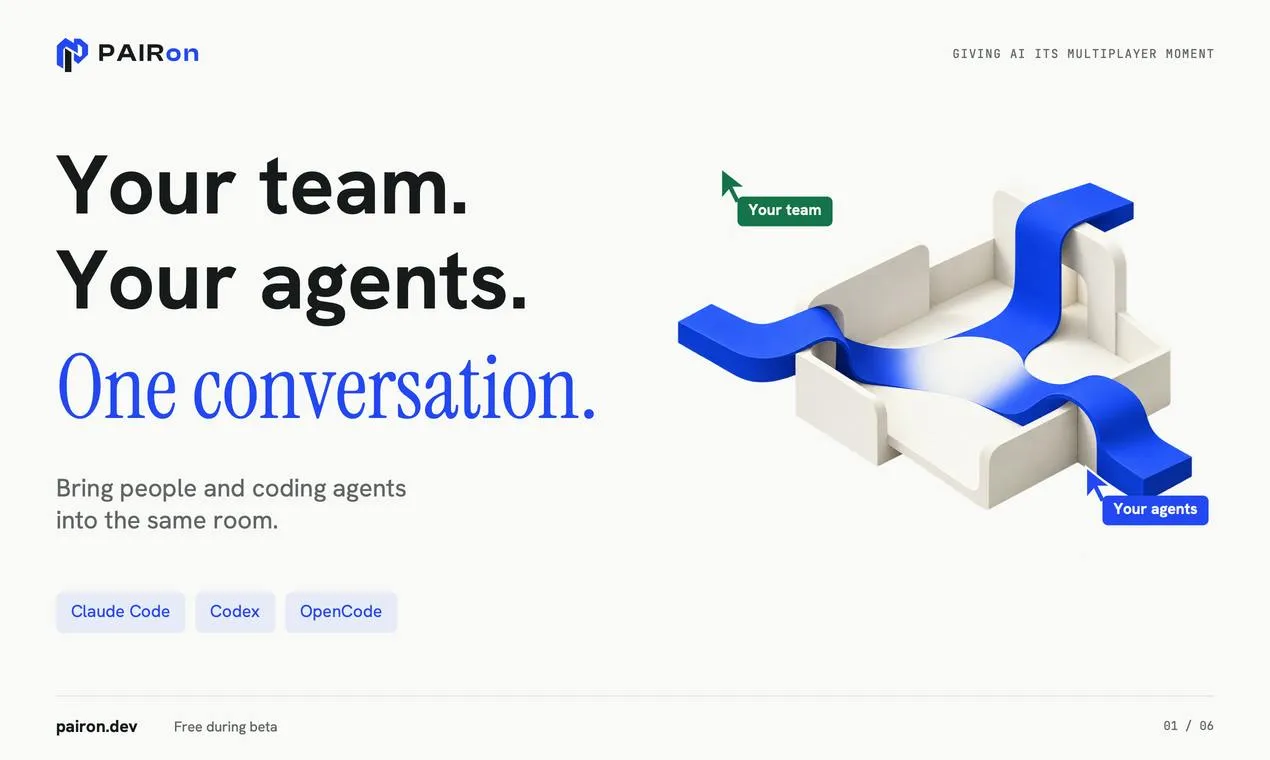
What is Pairon?
Pairon positions itself as "a shared conversation space for teams and AI coding agents." According to its Product Hunt page, teams can add constraints at any point while a task is in progress, run multiple tasks in parallel, hand off work between computers, and review code changes together. A "continuation brief" and "project memory" mechanism is responsible for passing decisions forward. The computer owner controls folder access permissions. Users can connect Claude Code, Codex, or OpenCode using their own agent accounts.
These features point to a clear scenario: when AI agents are producing code at high speed, the way human teams collaborate needs to level up in sync—rather than each person working against separate chat windows.
What problem does it solve? Context fragmentation
The Pairon team points to a very specific problem: AI agents run fast, but context gets lost between chats. In other words, the decisions an agent makes during a task, the corrections humans propose, and the consensus formed through team discussion often end up scattered across different conversation records, making them hard to trace and carry forward.
Pairon's "continuation brief" and "project memory" are designed precisely for this. The former packages and passes along key information at task handoff, while the latter accumulates long-term memory at the project level. This design approach is gradually becoming a consensus among AI coding tools—an agent's performance depends not only on model capability but also on whether it can obtain sufficiently coherent context.
Context windows and state management for coding agents
"Context" here technically refers mainly to the large language model's context window—the total number of tokens the model can read simultaneously in a single inference. Coding agents like Claude Code and Codex typically work in units of "sessions," with each session maintaining an independent conversation history and tool-call record. Once a new session is started or the device is switched, prior file reads and writes, command execution results, and user corrections are not automatically carried over unless explicitly written into some persistent carrier.
Common industry approaches include compressing key information into summary notes written into files at the project root (such as CLAUDE.md, AGENTS.md), or using external memory services for retrieval augmentation. Pairon's "continuation brief" is essentially a manual/semi-automatic state snapshot, while "project memory" is closer to a long-term knowledge base. Understanding this helps clarify the boundaries of its value: the accuracy of memory depends on writing and retrieval strategies, not on the model itself—and this is also where such products are most prone to problems.
Team collaboration and agent parallelism
Pairon's collaboration features deserve a closer look. Team members can add constraints midway through task execution, which is more efficient than reworking afterward. Running tasks in parallel means multiple agents can handle different workflows simultaneously, while cross-computer handoff means work is no longer tied to a single device.
Collaborative review of code changes is also incorporated into the same conversation flow. This is especially practical for engineering teams: review is no longer a separate step after the fact but part of the conversation.
On the permissions side, Pairon leaves folder access control to the computer owner—a pragmatic security design: teams share conversations, but the data boundaries on the physical machine remain in the owner's hands.
Supported agents and how to get started
Pairon supports Claude Code, Codex, and OpenCode. Users connect using their own agent accounts without needing to purchase additional agent services. This "bring your own account" model lowers the barrier to adoption and lets teams continue using their existing toolchain habits.
According to its page information, Pairon underwent beta testing before its public launch, with more than 500 participants. This scale suggests the product has been tested in real-world scenarios to a considerable degree.
Differences between Claude Code, Codex, and OpenCode
All three are command-line coding agents that run on the developer's local machine, but their positioning differs. Claude Code is Anthropic's terminal agent, capable of reading and writing local files, executing shell commands, and invoking Git, with an emphasis on completing multi-step tasks in real repositories. Codex originally referred to OpenAI's series of code models and later extended to the agentic coding capabilities in its coding products, often combined with cloud or IDE environments. OpenCode, by contrast, is an open-source terminal coding agent that lets users freely choose the underlying model provider, with a stronger community orientation.
"Bring your own agent account" means Pairon does not proxy model calls or bear token billing; instead, it acts as a collaboration and memory layer on top of these tools. This model reduces cost and compliance risks, but it also brings compatibility challenges: different agents' session formats, permission models, and tool protocols are not unified, and the shared conversation layer needs adaptation to ensure consistent behavior.
Market positioning and observations
On Product Hunt, Pairon received 9 votes and 9 comments, ranking 20th for the day in the productivity, developer tools, and artificial intelligence categories. This data represents a middling performance in the early launch period, but the fact that the number of comments equals the number of votes suggests that discussion interest may be higher than the vote data indicates.
From an industry perspective, the team collaboration layer for AI coding agents is becoming an independent competitive field. Individual agent capabilities are already strong, but enabling multiple agents and multiple humans to work together in the same context remains a relatively blank area. Pairon's entry point is conversation sharing and memory continuity, which differentiates it from pure task orchestration tools.
Its success may depend on two things: whether project memory can truly remain accurate without becoming misleading, and whether teams are willing to change their existing chat-based work habits. The former is a technical problem; the latter is a behavioral one.
Key takeaways
Pairon puts teams and local AI coding agents into the same shared conversation, using continuation briefs and project memory to solve context fragmentation. It supports adding constraints midway, parallel tasks, and cross-device handoff, and lets computer owners control folder permissions. It supports Claude Code, Codex, and OpenCode, and can be used with your own agent account. More than 500 people participated in the beta phase.
One-line Summary
Pairon puts teams and local AI coding agents into the same shared conversation to solve context fragmentation.
Paragraph Summary
Pairon is a collaboration tool unveiled on Product Hunt, positioned as a shared conversation space for teams and local AI coding agents. The core pain point it addresses is that AI agents run fast but context gets lost between chat windows, making decisions, corrections, and consensus hard to trace. The product passes decisions forward through "continuation brief" and "project memory" mechanisms, supports adding constraints midway through tasks, running multiple tasks in parallel, cross-computer handoff, and collaborative review of code changes, with folder access permissions controlled by the computer owner. Users can connect Claude Code, Codex, and OpenCode using their own accounts, and more than 500 people participated in the beta phase. The article argues that its success depends on the accuracy of project memory and changes in team work habits.
Related articles

Private Key Set to 4? CA's Elementary Mistake Leaves TLS Exposed
CA eMudra set private keys to tiny values like 4, making TLS certificates brute-forceable. A Computerphile video demonstrates the full process from extracting public keys to forging certificates, and explores the fragility of the PKI trust chain.

How Gen Turns Data into Decisions with ChatGPT Work
In an OpenAI user case, business leader Gen shares how ChatGPT Work turns data into decisions: within hours of launch, teams can judge whether integrations and onboarding flows work, shifting decision iteration from hundreds of trial-and-error attempts to a fast feedback loop.

ChatGPT vs. Claude In-Depth Comparison: Strong at Coding but Weak at Research — How to Bridge the Gap?
A user considers switching from ChatGPT to Claude, finding Claude stronger at coding but shallower at research. We analyze the differences and share tips to make Claude's research deeper.