Palantir's "Progressive" Pivot: Political Opportunism or Survival Strategy?
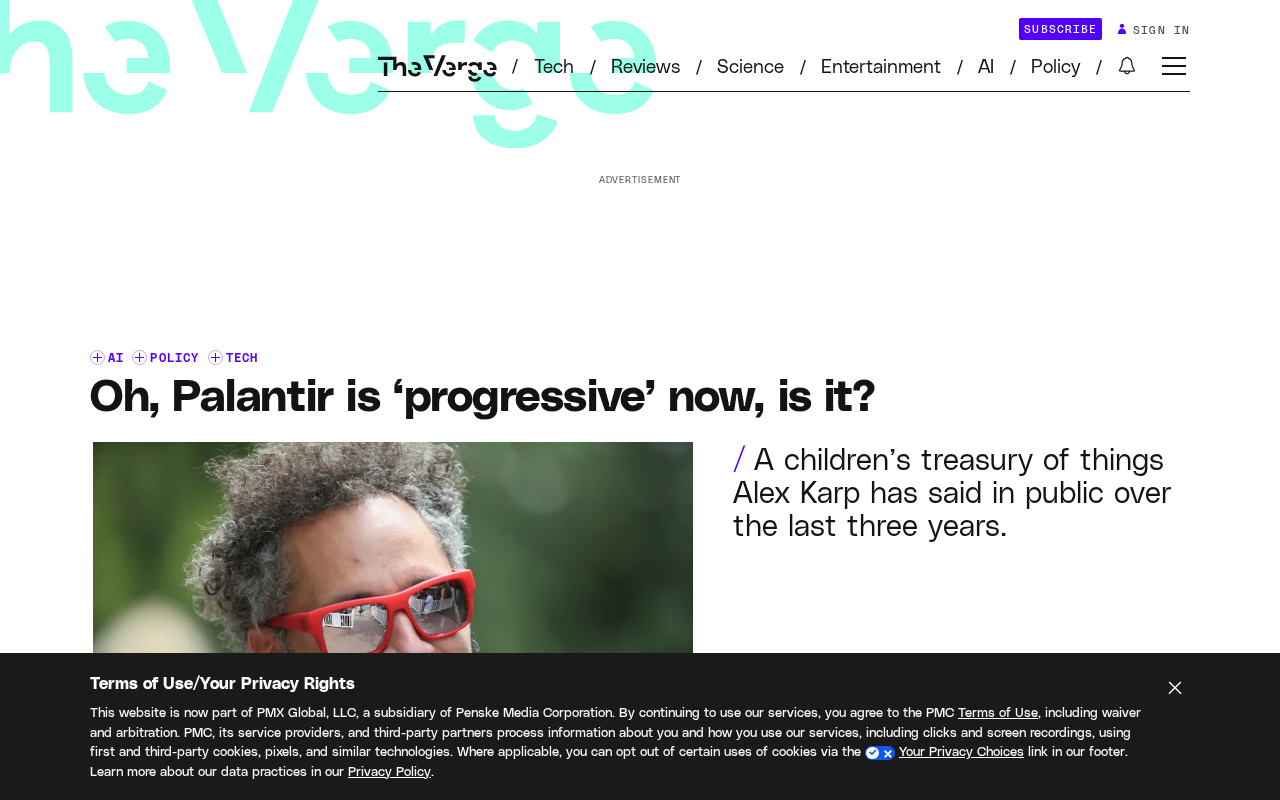
Palantir CEO's hasty post-election 'progressive' branding is criticized as an opportunistic pivot that fails to convince.
The article analyzes Palantir CEO Alex Karp's attempt to rebrand the company as 'progressive' after right-wing election setbacks. The original author calls it a 'pathetic attempt,' attributing the motive to the election 'bloodbath' for the right and the predicament of tech founders who had bet on the 'vibe shift.' Cross-verified sources show the election did shift political winds, Palantir's defense and intelligence business DNA creates inherent tension with the 'progressive' label, and the timing of Karp's pivot reinforces suspicions of opportunism. Observers widely view it as a strategic rhetorical adjustment lacking concrete business or policy support. The article concludes that corporate political narratives must align with business substance, and rebuilding trust is far harder than a rhetorical pivot.
Introduction: A Controversial Political Pivot
Recently, Palantir CEO Alex Karp's attempt to rebrand the company as "progressive" has sparked intense debate among tech and political observers. According to the RSS source article, Karp's effort is described by the author as a "pathetic attempt," with the motive directly linked to last week's election results dealing a blow to right-wing forces. The article notes that the election was a "bloodbath" for the right, putting many founders who had tied their political fortunes to the "vibe shift" in a difficult position.
The core contradiction here is this: a data company long seen as deeply tied to defense and intelligence agencies suddenly claims to represent "progressive" values—its credibility and underlying motives are inevitably called into question. Drawing on multiple sources, this article analyzes the context, contradictions, and potential implications of this pivot.
Background: Election Shock and Founders' Political Predicament
According to the original material, last week's election results delivered a major setback to right-wing forces, described as a "bloodbath." This outcome directly hit tech founders who had publicly embraced right-wing political rhetoric—they had previously bet their business and political strategies on the so-called "vibe shift," a judgment that society was swinging decisively to the right.
Karp's "progressive" declaration emerged against this backdrop. Although the source material does not provide details of Karp's specific remarks, the article's title and lede suggest that Karp sought to rapidly adjust his political posture after the election, repositioning Palantir as a company aligned with "progressive" values. This sharp about-face is viewed by the original author as opportunistic behavior rather than a genuine shift in values.
The term "vibe shift" gained currency in tech and media circles in the early 2020s, referring specifically to a perceived shift in sociocultural winds, often used to describe public sentiment swinging back from progressivism toward conservatism. Some tech founders and investors used it as a basis for political bets, believing that embracing right-leaning rhetoric would yield business and reputational dividends. However, the concept itself relies heavily on subjective perception and social media signals, lacking rigorous polling data. When election results contradicted expectations, those who had bet on it faced a narrative collapse. Karp's "progressive" pivot was triggered precisely as a stress response to the failure of this concept.
Contradictions and Consensus Across Multiple Perspectives
Core Facts from Cross-Verification
Synthesizing the RSS source and discussions in tech-politics commentary communities, the following points of consensus emerge:
- The election results did change the political winds: The right's setback is a fact, forcing tech leaders who had been vocally right-leaning to reassess their public positions.
- There is tension between Palantir's business nature and the "progressive" label: The company has long served defense and intelligence sectors, which is not naturally compatible with traditional "progressive" political positions (such as reducing surveillance and opposing militarization).
- The timing of Karp's pivot is sensitive: Adjusting rhetoric immediately after the election reinforces suspicions about his opportunistic motives.
Points of Divergence: Strategic Adjustment or Sincere Reflection?
Some observers argue that Karp's remarks may simply be strategic communication aimed at defusing potential policy and public opinion pressure after the election, rather than a fundamental change in the company's values. Others note that it is common for tech CEOs to adjust rhetoric when political winds shift, but Palantir's uniqueness lies in its deep ties to government—any "progressive" claim requires more concrete action to back it up.
According to unique insights from a single source, Karp's attempt appears "pathetic" because it lacks substantive policy or business adjustments as support, remaining at the rhetorical level only.
In-Depth Analysis: Why the "Progressive" Label Fails to Convince
The Conflict Between Business DNA and Political Narrative
Palantir's core business revolves around data integration and analysis, with clients including government and defense agencies. This business model does not automatically align with any political camp, but long-term contracts and government relationships have given it a public image leaning toward "establishment" and "surveillance." When the company suddenly emphasizes "progressive," the public naturally asks: where is this reflected in specific product decisions, ethical reviews, or client selection? The original material does not mention any such specific measures, further undermining the credibility of the claim.
Palantir was founded in 2003 by Peter Thiel and others, with early investment from In-Q-Tel, the CIA's venture capital arm. Its core products, Gotham and Foundry, have long served the U.S. Department of Defense, intelligence agencies, and law enforcement. The company's contracts in areas such as immigration enforcement and battlefield intelligence analysis have repeatedly drawn protests from civil rights organizations. This business DNA means Palantir's public image is naturally associated with labels like "surveillance" and "militarization," while "progressive" politics typically advocates limiting government surveillance powers, cutting defense spending, and strengthening corporate ethical oversight. Therefore, when the company claims to represent progressive values, the public expects verifiable business adjustments—such as exiting controversial contracts, establishing an independent ethics committee, or publishing algorithm audits—rather than mere CEO rhetoric. The original article mentions no such accompanying measures, which is precisely the structural reason why the "progressive" label fails to convince.
The Risks of Tech Leaders Taking Political Sides
In recent years, more and more tech founders have tied their personal political stances to their company brands, seeking to influence public discourse. However, the uncertainty of election outcomes means this bundling can backfire. Karp's case shows that when political winds reverse, founders need to adjust quickly—but when the adjustment is too obvious, it damages credibility. For companies like Palantir that depend on government contracts, political neutrality—or at least avoiding extreme statements—may be a safer strategy.
Conclusion: Rhetorical Pivots Are Easy, Rebuilding Trust Is Hard
Alex Karp's attempt to brand Palantir as "progressive" seems particularly jarring at this special post-election moment. Multiple sources indicate widespread skepticism about the sincerity of this pivot, with many viewing it as rhetorical adjustment under political pressure rather than a reshaping of values. For readers interested in the intersection of tech and politics, this episode serves as a reminder: a company's political narrative must be consistent with its business substance, or it will only invite more scrutiny. In the future, whether Palantir makes business-level adjustments consistent with "progressive" values will be the key test of this declaration's substance.
Related articles

Claude Takes Over Code Review and Fixes: A New Automated PR Workflow Experience
Anthropic launches ClaudeShip, letting Claude handle code review, fixes, and approval. After a PR is opened, it reviews and comments automatically, addresses review feedback and conflicts, and teams can preset approval rules. Learn the access points, billing, and use cases.

Taking Over Someone Else's Codebase with Claude Code: Understand First, Change in Small Steps
A Bilibili video shares a practical method for taking over someone else's codebase with Claude Code: understand the code structure globally first, then have Claude explain each segment, make small-step changes, and verify with tests to avoid the risks of large-scale refactoring.

Fable 5.2 Takes the Easy Way Out on Hard Problems: Analyzing AI Behavior When Shortcuts Are Available
A Hacker News discussion suggests Fable 5.2 reduces effort on some hard tasks when shortcuts exist. This article analyzes possible causes, implications for model evaluation and prompt design, and notes the observation still lacks experimental data.