PaperClip + Claude Code Multi-Agent Coordinated Development in Practice: Full Workflow Demo of an AI Virtual Team

Multiple AI Agents form a virtual dev team, enabling full-process collaborative development from requirements to delivery.
A developer built a multi-Agent virtual development team using the PaperClip platform, featuring roles including Delivery Lead, Frontend/Backend Engineers, QA, and Code Reviewer, with automatic task flow via Issue triggers and heartbeat detection. A practical case demonstrates the complete workflow of a Token expiration bug from discovery, analysis, and multiple iteration fixes to final review approval. While inter-Agent communication standardization surpasses human teams, challenges remain including slower speed and occasional need for human intervention, representing AI programming's evolution from single-point assistance to full-process automation.
Overview
When we talk about AI programming, most people think of a single AI assistant helping them write code. But what would it be like to organize multiple AI Agents into a complete development team, having them collaborate like a real software company?
A developer shared his multi-Agent coordinated development workflow built using the PaperClip platform with Claude Code, demonstrating how a "virtual software company" composed of AI can autonomously complete the entire process from requirements analysis to code delivery.
The Evolution of AI Programming Tools
AI programming assistance tools have gone through three distinct evolutionary stages: the code completion stage (represented by GitHub Copilot), the conversational programming stage (represented by ChatGPT and Claude), and the current autonomous programming Agent stage (represented by Devin, Claude Code, and Cursor Agent). Claude Code, as Anthropic's command-line programming tool, supports direct file system operations, terminal command execution, and external API calls, making it an ideal foundation for building autonomous development Agents. Multi-Agent orchestration frameworks add task routing, state management, and cross-Agent communication capabilities on top of this, turning the concept of an "AI development team" into practice.
Organizational Structure of the Virtual Development Team
The underlying logic of this multi-Agent collaboration system comes from the Multi-Agent System (MAS) architectural philosophy in artificial intelligence. Unlike a single large model handling all tasks, MAS simulates human organizational collaboration patterns through role division, message passing, and state sharing. In the LLM era, each Agent is essentially a language model instance configured with specific system prompts and toolsets, communicating with each other through structured message protocols. The PaperClip platform materializes this architecture into a software company's organizational form:
- Delivery Lead: Responsible for receiving requirements and assigning tasks
- Code Reviewer: Code review engineer
- Product UX Analyst: UI/UX analyst
- Tech Lead: Responsible for technical decisions and development task assignment
- Frontend Developer
- Backend Developer
- QA Test Engineer
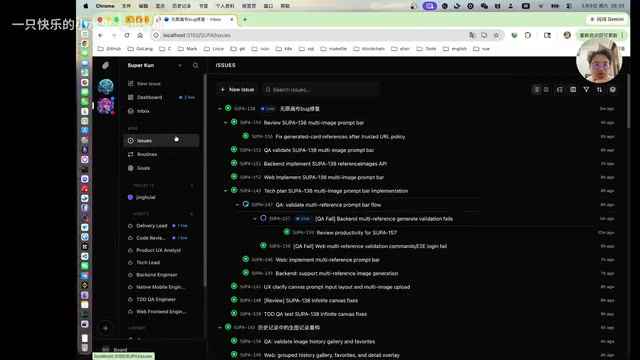
The workflow trigger is simple: the developer creates an Issue in the system (you can even have AI help write the Issue), then through a heartbeat detection mechanism, the task automatically flows to the Delivery Lead, who assigns it to the corresponding Agent member.
Practical Case: Fixing Token Expiration Mechanism
Problem Discovery and Code Review
The author discovered a system issue: users were being automatically kicked back to the login page 15 minutes after logging in. He assigned this problem to the Code Reviewer for code review.
To understand the root cause of this bug, you need to understand the JWT dual-token authentication mechanism in modern web applications. Access Tokens have short lifespans (typically 15 minutes to 1 hour) and are used for daily API request authentication; Refresh Tokens have long lifespans (days to weeks) and are only used to obtain new Access Tokens. This design balances security with user experience: short-lived Access Tokens pose limited risk even if leaked, while Refresh Tokens are typically stored in HttpOnly Cookies to prevent XSS attacks. The standard frontend approach for automatic refresh is to intercept 401 responses, silently obtain a new Token using the Refresh Token, and retry the original request—completely transparent to the user.
The Code Reviewer read through the code and provided a detailed analysis report:
- The backend issues two types of Tokens: Access Token (15-minute validity) and Refresh Token (7-day validity)
- The backend only accepts Access Tokens; invalid ones return 401
- The frontend saves both Tokens but only exposes the Access Token to the client
- Key issue: The frontend doesn't save the expiration time and hasn't implemented an automatic refresh mechanism
- Upon receiving a 401, it directly executes Sign Out instead of attempting to refresh with the Refresh Token
The Code Reviewer also proactively pointed out potential issues with WebSocket using the same Access Token and suggested handing the fix to the frontend engineer.

Task Flow and Automatic Coordination
After confirming the issue, the author handed the task to the Delivery Lead, requesting personnel assignment for the fix. The Delivery Lead made the following arrangements:
- Assigned the frontend engineer to handle the fix
- Defined the subsequent process: Implementation → QA Testing → Code Review
Interestingly, there was a small episode in between—the Code Reviewer tried to "push away" the task, but was rejected by the system, and the task ultimately flowed correctly to the frontend engineer. This detail reveals the importance of role boundary constraints in multi-Agent systems: each Agent's system prompt needs to clearly define its scope of responsibility to prevent "passing the buck" during task flow.
Iterative Fix Process
After the frontend engineer completed the fix, they changed the task status to "needs verification" and provided detailed explanations of the changes and local verification results.

The QA engineer took over verification; after the first round passed, it was handed to the Code Reviewer for review. The Code Reviewer proposed code optimization suggestions, requiring the frontend engineer to continue improving.

The entire multi-Agent coordinated development process went through multiple iterations:
- Frontend fix → QA verification failed → Frontend re-fix → QA re-verification passed → Code Review final approval
During the process, the QA engineer also discovered additional issues, and the frontend engineer fixed them one by one based on feedback, ultimately passing all reviews.
The Necessity of Human Intervention
Despite the highly automated workflow, the author admitted that occasional human intervention was still needed. For example, Agents sometimes don't proactively @mention the next person in the pipeline, causing process interruptions that require manual reminders to "keep the process going."
This reflects a deep technical challenge in current multi-Agent systems: context window and long-term memory issues. Although current large language models have expanded their context windows to hundreds of thousands or even millions of tokens, they still face "attention dilution" in long conversation chains—the model's attention to earlier content decreases as conversation depth increases. In multi-Agent systems, each Agent needs to simultaneously maintain task state, role specifications, and historical decisions within a limited context. Once the conversation chain becomes too long, Agents may "forget" previously agreed-upon process norms. Industry solutions include external memory storage (such as vector databases), structured state machine management, and periodic context compression summaries, but these all add system complexity, and there's currently no perfect solution.
Advantages and Disadvantages of Multi-Agent Collaboration
Advantages
- Extremely high process standardization: Every code change has detailed records, including which files were modified and which scenarios were verified
- Communication quality surpasses humans: Information transfer between Agents is more complete and structured than between human programmers
- High degree of automation: From requirements analysis to code delivery, most steps require no human involvement
Disadvantages
- Relatively slow speed: Coordination and waiting between multiple Agents consumes significant time
- Occasional need for human intervention: Manual nudging required when processes stall
- AI behavior not fully controllable: Such as the Code Reviewer attempting to push away a task
Reflections and Insights
The most valuable insight from this case is that collaboration between Agents is essentially a standardized communication mechanism. Ironically, AI teams may already surpass most human development teams in process standardization—every task handoff has complete written records, every decision has clear accountability, which is precisely the engineering culture that many human teams have long lacked.
For independent developers or small teams, this multi-Agent coordination model offers the possibility of a "one-person company"—you only need to play the role of product manager, proposing requirements and making final decisions, while the remaining development, testing, and code review can all be handed to the AI team. As context management technology matures and inter-Agent protocols become standardized (such as Anthropic's MCP protocol), the stability and efficiency of this workflow are expected to improve significantly.
Although this system is not yet mature enough and efficiency still needs improvement, it demonstrates an important direction for AI-assisted development: moving from single-point assistance to full-process automation.
Key Takeaways
- The PaperClip platform enables building a multi-Agent virtual development team with roles including Delivery Lead, Frontend/Backend Engineers, QA, and Code Reviewer
- Task automatic assignment and flow are achieved through Issue triggers and heartbeat detection mechanisms, simulating a real software company's development process
- The practical case demonstrates the complete workflow of fixing a Token expiration mechanism from code review through multiple iteration fixes to final approval
- Communication standardization and information completeness between Agents surpasses human programmers, though execution speed is slower and occasional human intervention is needed
- Long-term memory issues caused by context window limitations are one of the core technical challenges of current multi-Agent systems
- Multi-Agent coordinated development represents an important direction in AI programming's evolution from single-point assistance to full-process automation
Related articles
 Product Reviews
The Programmer's Desk Setup Guide: Building a Workspace That Feels Like Home
Discover how programmers build productive, comfortable workspaces. From multi-monitor setups to ergonomic design, explore the desk philosophy that drives focus and flow.
 Product Reviews
Qoder vs Cursor Real-World Comparison: Which $20/Month AI IDE Is Better?
Hands-on comparison of Qoder vs Cursor AI IDEs: Agent autonomy, human interaction count, and architecture decisions. Qoder needed only 2 interactions vs Cursor's 8.
 Product Reviews
Cursor Cloud Agent Demo: Eliminating Bottlenecks Across the Entire Software Development Lifecycle
Deep analysis of Cursor's Cloud Agent demo showing how cloud VMs, automated test artifacts, and a full-chain control plane systematically eliminate human bottlenecks across the software development lifecycle.