PapersGPT: The Most Powerful AI Plugin for Zotero, Supporting 20+ LLMs and MCP Protocol

PapersGPT is a Zotero plugin integrating 20+ AI models with MCP protocol for intelligent literature management.
PapersGPT is a Zotero AI plugin that integrates over ten mainstream LLMs from both international and Chinese providers, including ChatGPT, Claude, and DeepSeek, enabling researchers to perform paper summarization, translation, and literature review generation directly within their reference management workflow. Its core highlight is MCP protocol support for deep AI-literature interaction. With 2,300+ GitHub stars and active development, it's a top choice for academic researchers, though users should remain mindful of AI hallucination and data privacy concerns.
What is PapersGPT? A Zotero AI Plugin Integrating 20+ Models
PapersGPT is a Zotero AI plugin built specifically for academic researchers, integrating mainstream large language models including ChatGPT, Claude, DeepSeekAd, and more. It brings intelligent literature management and paper reading assistance directly into Zotero. With over 2,300 stars on GitHub, it's one of the most popular Zotero AI plugins available today.
Zotero is a free, open-source reference management software developed by the Center for History and New Media at George Mason University. Since its release in 2006, it has become one of the most widely used reference management tools in academia worldwide. It supports one-click capture of paper metadata from browsers, automatic extraction of citation information from PDFs, generation of reference lists in multiple formats, and continuous functionality expansion through its plugin ecosystem. Zotero 7, the latest major version, adopts an entirely new architecture that provides more powerful API interfaces for third-party plugin development—this is the technical foundation that enables deep integration for AI plugins like PapersGPT.
Zotero's plugin ecosystem is one of its core advantages over commercial reference management software like EndNote and Mendeley. After Zotero 7 was rebuilt on Firefox's Gecko engine, the plugin development framework migrated from XUL to a new web-technology-based architecture, allowing developers to build with modern JavaScript/TypeScript. The Zotero plugin community currently has hundreds of active plugins covering areas such as enhanced literature capture (e.g., Zotero Connector), note management (e.g., Better Notes), and citation format extensions. AI plugins have been the fastest-growing category since 2023, reflecting academia's strong demand for AI-assisted research tools.
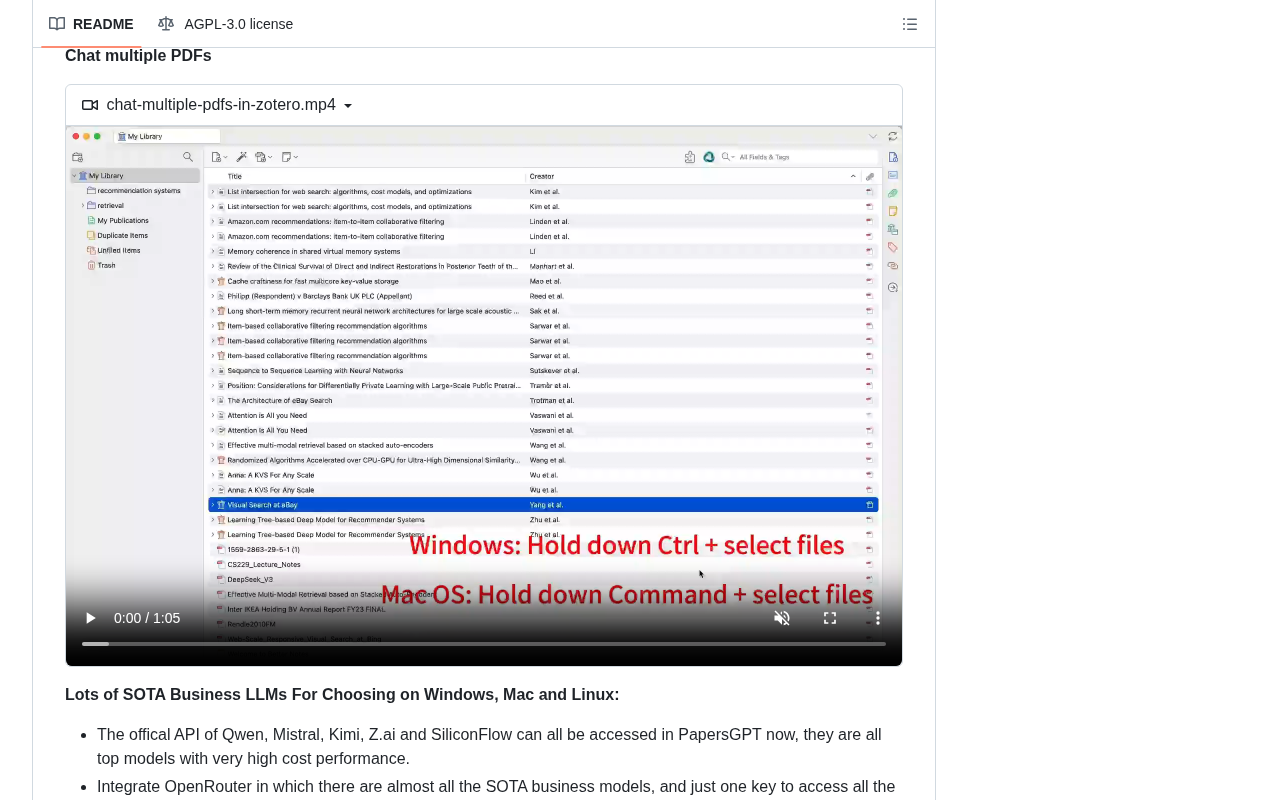
For researchers who process large volumes of literature daily, constantly switching between Zotero and various AI tools is both inefficient and disruptive to their workflow. PapersGPT embeds AI capabilities directly into the literature management process, truly achieving seamless integration between "reading papers" and "asking AI."
Which AI Models Does PapersGPT Support?
Full Coverage of International Mainstream Models
PapersGPT offers exceptionally broad model support, covering nearly all mainstream options:
- ChatGPT: OpenAI's flagship conversational model with well-balanced overall capabilities
- Gemini 3.1: Google's latest-generation multimodal model, excellent at processing charts and formulas
- Claude: Anthropic's high-quality reasoning model with outstanding long-text analysis capabilities
- Grok: xAI's large language model
- Gemma 4: Google's open-source model series, friendly for local deployment
Deep Integration with Chinese LLMs
For researchers in China, PapersGPT also deeply integrates the domestic LLM ecosystem, accessible without a VPN:
- DeepSeek V4: The latest version from DeepSeek, with outstanding Chinese academic writing capabilities
- Kimi 2.5: Moonshot AI's long-context model, suitable for processing lengthy papers
- GLM 5: The latest-generation model from Zhipu AI
- Qwen 3.5: Alibaba's Tongyi Qianwen series, strong in multilingual capabilities
- SiliconFlow: SiliconFlow's model service, offering excellent cost-effectiveness
The application of large language models (LLMs) in academic research began with the explosive growth following ChatGPT's release in late 2022. Academic scenarios have special requirements for LLMs: they need to process long texts dense with specialized terminology, understand complex logical reasoning chains, and accurately cite and summarize viewpoints from literature. Different models perform differently across these dimensions—Claude is known for its 200K token ultra-long context window, suitable for processing entire papers at once; Gemini's multimodal capabilities allow it to understand charts and formulas in papers; DeepSeek's training on Chinese academic corpora makes its Chinese output more aligned with academic norms. This is the core reason PapersGPT chose to integrate multiple models rather than binding to a single one.
Here's a key concept worth explaining: A token is the basic unit that large language models use to process text. One English word typically corresponds to 1-2 tokens, and one Chinese character typically corresponds to 1-2 tokens. The context window refers to the maximum number of tokens a model can process in a single conversation. For academic paper processing, context window size directly determines whether the model can read an entire paper at once—a typical academic paper is about 8,000-15,000 words, corresponding to approximately 10,000-20,000 tokens. Claude's 200K context window means it can simultaneously process the content of roughly 10 complete papers, which is critical for literature reviews and cross-paper analysis.
Flexible Access via Aggregation Platforms
Through aggregation platforms like OpenRouter and GPT-oss, users can flexibly access even more models. OpenRouter is an AI model API aggregation platform that provides a unified API interface to access hundreds of large language models from different providers. Developers only need to integrate with OpenRouter's API once, enabling users to freely switch between underlying models without separately managing API keys and billing from OpenAI, Anthropic, Google, and other providers. This architecture is particularly advantageous for plugin developers—when new models are released, OpenRouter quickly integrates them, and the plugin can support new models without releasing an update. Users can also flexibly choose the most cost-effective option based on different models' pricing and performance.
The benefit of this design is that even when new LLMs emerge in the future, they can be quickly accessed through aggregation platforms without waiting for plugin updates.
MCP Protocol Integration: The Bridge Connecting AI and Your Literature Library
One of PapersGPT's core highlights is its support for the MCP (Model Context Protocol). MCP is an open standard officially released by Anthropic in November 2024, designed to solve the fragmentation problem of connections between AI models and external data sources, providing a unified interface for AI models to interact with external tools and data sources.
The emergence of the MCP protocol solves a core pain point in AI application development: every AI application needs to write separate integration code for each data source, creating an M×N complexity problem. MCP simplifies this to M+N—data sources only need to implement an MCP Server once, and AI applications only need to implement an MCP Client once to connect with each other. This is similar to how the USB protocol unified peripheral interface standards. As of 2025, MCP has gained support from mainstream AI coding tools including Cursor, Windsurf, and Cline, and is becoming the de facto standard for the AI tool ecosystem. PapersGPT's pioneering adoption of MCP in the academic tools space means that in the future, users can access Zotero literature data with any AI client that supports MCP.
In MCP's technical architecture, applications act as "MCP Clients" to initiate requests, while data sources or tools act as "MCP Servers" to provide services. The protocol defines three core capabilities: Resources (resource access), Tools (tool invocation), and Prompts (prompt templates). In PapersGPT's scenario, the Zotero library serves as the MCP Server, and AI models query literature metadata, full-text content, and note annotations through standardized interfaces without needing a separate adaptation layer for each model. This means that whether you use ChatGPT, Claude, or DeepSeek, they can all access your literature data through the same protocol.
Through MCP integration, PapersGPT enables AI models to directly access your Zotero literature data for deeper intelligent interactions:
- Intelligent Q&A based on your library: Ask questions directly about your collected papers, and the AI will answer based on specific literature content
- Cross-paper knowledge correlation analysis: Automatically discover methodological connections, citation relationships, and viewpoint similarities/differences across different papers
- Automated literature review generation: Quickly generate review frameworks based on your existing library, mapping out research trajectories
Put simply, an AI plugin without MCP just opens a chat window inside Zotero; with MCP, the AI truly "understands" your library and can provide targeted answers based on your research context.
Technical Architecture and Core Features
The project is developed in JavaScript and runs as a native Zotero plugin. Zotero plugins are built on a Web Extension-style architecture and can access Zotero's internal database (based on SQLite), directly manipulating data objects such as literature entries, attachments, tags, and notes. PapersGPT running as a native plugin means it doesn't fetch literature data through external HTTP calls but directly accesses data within the Zotero process, resulting in lower latency and more complete data access permissions, while also being able to embed interactive components in the PDF reader interface.
This means it integrates deeply into Zotero's workflow without requiring switching between multiple applications. You can directly invoke AI capabilities while reading and managing literature to perform the following operations:
- Core argument extraction: Quickly capture a paper's research questions, methods, and conclusions
- Automatic full-text summary generation: Compress lengthy papers into structured summaries
- Complex methodology explanation: Explain technical details like statistical methods and algorithm principles in accessible language
- Key passage translation: Perform high-quality academic translation of selected passages
Typical Use Cases for PapersGPT
Scenario 1: Quickly Understanding English-Language Literature
For researchers who need to read large amounts of English-language literature, PapersGPT can quickly generate paper summaries, explain complex concepts in plain language, and translate key passages, compressing what would originally take hours of intensive reading into minutes for initial comprehension. This efficiency boost is particularly noticeable during the literature survey phase—you can quickly filter out which papers are truly worth reading in depth.
Scenario 2: Assisting with Literature Review Writing
Through intelligent analysis of your Zotero library, AI can help you map out research trajectories, discover connections between papers, and identify research gaps, greatly improving literature review writing efficiency. For example, you can directly ask "Among these 20 papers I've collected, what are the common findings and disagreements regarding XX method?" and the AI will provide analysis based on actual literature content.
Scenario 3: Multi-Model Comparison for Task-Specific Selection
The advantage of supporting multiple models is that you can choose the most suitable model for different tasks—use Claude for deep reasoning analysis, Gemini for processing multimodal papers with charts, DeepSeek for Chinese academic writing, and Kimi for processing extremely long documents. Different models have different strengths, and flexible switching maximizes value.
How Does PapersGPT Compare to Other Zotero AI Plugins?
Compared to similar plugins like Zotero GPT and Aria, PapersGPT's core competitive advantages are reflected in four areas:
| Advantage Dimension | Specific Performance |
|---|---|
| Broadest Model Coverage | Simultaneously supports over ten mainstream models without binding to a single provider |
| Forward-Looking MCP Protocol | First to integrate the MCP standard, preparing for the AI Agent ecosystem |
| Chinese LLM Friendly | Chinese users can use multiple domestic LLMs without a VPN |
| High Community Activity | 78 forks and continuous updates; the project is in active development |
Usage Considerations: Limitations of AI-Assisted Research
Despite AI's powerful capabilities in literature management, researchers should remain aware of its limitations. Large language models have a "hallucination" problem—they may generate seemingly reasonable but actually non-existent citations or incorrect factual statements. In academic contexts, AI-generated summaries and analyses should serve as auxiliary references rather than final conclusions, and key arguments still need to be verified against the original text. Best practice is to use AI for preliminary screening and comprehension acceleration, not as a replacement for critical reading. Additionally, sending paper content to cloud APIs requires attention to data privacy, especially when dealing with unpublished research. Local model deployment (e.g., running Gemma via Ollama) may be a safer choice.
Conclusion: An AI Literature Management Tool Worth Trying for Academic Researchers
PapersGPT represents an important direction in the intelligentization of academic tools—rather than asking you to leave your familiar workflow to adapt to new tools, it brings AI capabilities to your existing workflow. As LLM capabilities continue to improve and standard protocols like MCP become widespread, AI-assisted academic research is evolving from "nice to have" to "indispensable."
If you're a heavy Zotero user looking for an AI plugin that truly integrates into your research workflow, PapersGPT is one of the most worthwhile installations available today. Whether you prefer international models like ChatGPT and Claude, or Chinese models like DeepSeek and Kimi, you'll find a suitable solution in this plugin.
Key Takeaways
- PapersGPT integrates over ten mainstream AI models including ChatGPT, Gemini, Claude, and DeepSeek, providing comprehensive AI-assisted research capabilities for Zotero users
- Supports MCP (Model Context Protocol), enabling deep interaction between AI models and Zotero literature data
- Covers both international and Chinese LLMs, particularly friendly for researchers in China
- The project has earned 2,300+ stars with high community activity and is continuously updated
- Use cases cover core academic research needs including accelerated literature reading, research review writing, and multi-model comparative analysis
- Users should be aware of AI hallucination issues; key academic arguments should be verified against original texts, and local model deployment should be considered for sensitive data
Related articles
 Product Reviews
The Programmer's Desk Setup Guide: Building a Workspace That Feels Like Home
Discover how programmers build productive, comfortable workspaces. From multi-monitor setups to ergonomic design, explore the desk philosophy that drives focus and flow.
 Product Reviews
Qoder vs Cursor Real-World Comparison: Which $20/Month AI IDE Is Better?
Hands-on comparison of Qoder vs Cursor AI IDEs: Agent autonomy, human interaction count, and architecture decisions. Qoder needed only 2 interactions vs Cursor's 8.
 Product Reviews
Cursor Cloud Agent Demo: Eliminating Bottlenecks Across the Entire Software Development Lifecycle
Deep analysis of Cursor's Cloud Agent demo showing how cloud VMs, automated test artifacts, and a full-chain control plane systematically eliminate human bottlenecks across the software development lifecycle.