Parakeet Redux: The Open-Source Trap Behind a 178MB Speech Model

Parakeet Redux shrinks a speech model from 1.2GB to 178MB, but open weights come with a closed-source engine catch.
The Moondream team applied extreme ternary quantization to NVIDIA's Parakeet 0.6B v3, compressing encoder weights to just three values (-1/0/+1) and shrinking the model from 1.2GB to 178MB with minimal English accuracy loss and even improved multilingual performance. At 178MB it can run on CPU or be bundled into apps, with ~3x speedup over comparable open-source runtimes on CPU — though the GPU advantage disappears on Apple Silicon. The critical caveat: while weights are CC-licensed, the Photon inference engine powering them is closed source with an opaque license, and was previously a paid product. The real fight in local AI isn't over who releases weights, but who controls the runtime.
A speech-to-text model that originally weighed 1.2GB has been compressed down to just 178MB — roughly one-seventh of its original size — with almost no drop in English recognition accuracy, and even improved performance on multilingual tasks. This sounds like magic, but behind it lies both a genuine technical breakthrough and an open-source trap worth watching out for.
The Extreme Approach: Compressing Weights Down to Three Values
This model is called Parakeet Redux, and it comes from the Moondream team. It's built on top of NVIDIA's Parakeet 0.6B v3 — already one of the best open-source speech models available. What Moondream did on top of that is quite radical: every single weight in the encoder is forced into one of only three values — -1, 0, or +1.
Think of each weight as a precision volume knob. Normally, that knob can be turned to an infinite number of positions. Ternary quantization is like yanking the knob off entirely and replacing it with a three-position toggle switch. You lose a massive amount of precision, but in exchange the model size collapses to roughly one-seventh of the original.
By conventional wisdom, collapsing precision should collapse accuracy too — but that didn't happen here. English word error rate (WER) did go from 6.26 to 6.55, which is a step backward, but the margin is tiny. Even more counterintuitively, multilingual scores improved from 11.62 to 10.56, and long-audio scores improved from 2.71 to 2.51. The model supports 25 European languages with automatic language detection.
Ternary Quantization is one of the most extreme techniques in model compression. Mainstream quantization typically reduces 32-bit floating-point weights to 8-bit (INT8) or 4-bit (INT4), where each weight can still represent hundreds to billions of distinct values. Ternary quantization goes further, mapping all weights to just three discrete values: -1, 0, and +1. In theory, each weight only needs about 1.58 bits of storage (log₂3 ≈ 1.58), which is where the term "1.58-bit model" comes from. The usual price of such extreme compression is precision loss — fine-grained adjustment information gets wiped out. The reason it works here is partly that the original Parakeet model was trained on massive amounts of data and has relatively concentrated weight distributions. Moondream also targeted the encoder (the component that converts audio into feature vectors) rather than the decoder, preserving precision on the language modeling side. This "encoder-only quantization" strategy is the key context for understanding why accuracy loss was so minimal.
What 178MB Actually Means
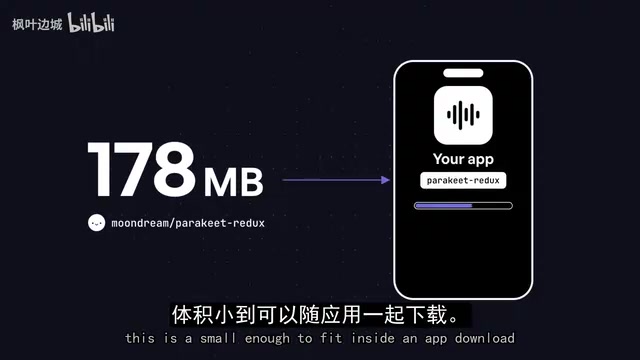
The significance of 178MB goes far beyond saving disk space. It's small enough to bundle directly into an app's install package, and it can run on aging laptops. More importantly, it can run on CPU, freeing up the GPU for tasks like local large language models.
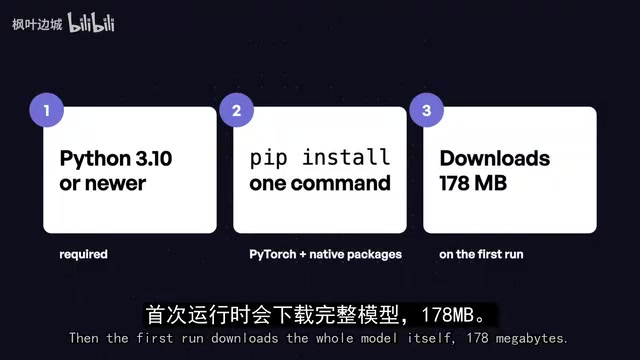
In practice, a pip install and a few lines of Python is all it takes. On disk, Parakeet Redux takes 178MB, compared to 1.6GB for Whisper Large V3 Turbo (the Whisper CPP version). The API design is also quite friendly: it supports three output modes — no timestamps, segment-level timestamps, and word-level timestamps — and accepts WAV, MP3, FLAC, M4A, and raw byte streams. It can also extract transcriptions from specified start and end times within a long recording.
For real-time audio, it offers an async mode that reads audio chunks directly from the microphone, delivering a first preview after a few seconds and refreshing every two seconds. There's one small gotcha here: each streaming update replaces the previous result, so if you naively append and print each result, you'll end up printing the same sentence repeatedly.
Speed Numbers Depend on Your Machine

Speed is a key selling point for this model, but the numbers have to be read in context. In Moondream's official M2 MacBook Air benchmark (CPU-only), Redux achieved 38x real-time speed, while the popular open-source runtime Parakeet CPP hit only 12x — roughly a 3x lead according to official figures.
But once you switch to the Mac's GPU, that advantage largely evaporates: Redux reaches 43x, while other solutions land around 38–39x — essentially a tie. As for the headline-grabbing "113x real-time" figure, there's a detail worth noting: that wasn't measured on a Mac. It was on an AMD EPYC server with AVX512 support. So yes, 113x is real — it's just probably not the machine you have on your desk.
Head-to-head comparisons also involve trade-offs. Compared to the original Parakeet, Redux is about seven times smaller and includes a built-in voice activity detector that segments audio into chunks under 30 seconds. Compared to Apache-licensed Parakeet Mix, GPU performance is close (43 vs. 37). Compared to Whisper, the differences are sharper: Whisper supports around 99 languages, while Redux supports only 25, all European — but Redux can stream transcription directly from a live microphone and continuously refine the text as more audio comes in.
The Real Reason Isn't Cost Savings — It's Privacy
Here's a question worth pausing on: why run speech-to-text locally in the first place?
Many people instinctively say it's to save money, but that's actually a misconception. Cloud APIs are already pretty cheap — Deepgram's Nova 3 is roughly $0.004 per minute, OpenAI's mini-transcribe is around $0.003 per minute, meaning a full hour of audio costs just cents. If the only motivation for going local is to avoid API fees, that's not actually a very compelling reason.
The real value is privacy: working offline, without depending on a network connection. That's the core justification for local transcription.
Open Weights, Closed Engine

The technology is impressive — but there's a real trap hidden here. The model weights are genuinely open, released under a Creative Commons license. However, the engine that actually runs them, called Photon, is not open source.
When you pip install, you also pull in a package called Kestrel Kernels. Its license text reads: if you haven't signed a certain agreement, you have no authorization to use this software. It's free to download, but what that "agreement" actually entails isn't entirely clear.
Making things more complicated: Photon is free today, but it was a paid product before June. Moondream also sells a cloud-based version of Photon, with team cloud plans priced at around $350 per month. What you end up with is open weights running inside a closed-source engine from a company whose terms have already changed once. There's no standard answer for how to feel about that — just a reason to proceed carefully.
Another pitfall worth noting is noise. On noisy audio benchmarks, the error rate jumps from 6.72 to around 9 — roughly a one-third increase. The model card itself acknowledges that Redux is more prone to substituting phonetically similar words.
This touches on an increasingly common pattern in the local AI ecosystem: the separation of Weights from Runtime. Weights are the learned parameters of the model — they determine what the model can do. The runtime is the underlying engine that loads those weights into memory and executes matrix operations — it determines how fast the model runs and where it runs. Open weights mean you can inspect, redistribute, and even run those parameters on a different runtime; but if the runtime is closed source, you're still effectively locked into a specific vendor's tech stack. This is a different path from how Meta opened LLaMA weights and the community subsequently built independent runtimes like llama.cpp — Parakeet Redux's performance currently depends deeply on Photon, and no mature community alternative exists yet. The Creative Commons license protects only the weight files themselves, not the kernel code used to run them efficiently. This is precisely the dynamic the article points to at the end: the real competition is over who controls the underlying runtime.
Should You Use It?
If you're working on a CPU-only machine, an older laptop, or building an app where every megabyte counts, this model is worth trying: on CPU it's about 3x faster than Parakeet CPP per official benchmarks, at roughly one-seventh the model size. Install it, run it on your own hardware, and see.
But if you're on an M-series Mac already using GPU, open-source runtimes will give you essentially the same speed, with a license you can actually read and understand. If you're working with noisy audio, you're better off sticking with the original.
The fact that a 1.58-bit version of Parakeet made the leap from research paper to pip install is genuinely remarkable — a model that was once 1.2GB can now fit in around 178MB while retaining most of its accuracy.
But Parakeet Redux also exposes a new problem: open weights don't automatically mean an open stack. The next battleground in local AI probably won't be about who releases model weights — it'll be about who controls the underlying runtime.
Related articles

Chain of Thought Isn't Just for AI: How Humans Can Use CoT to Improve Thinking Quality
Chain of Thought isn't just a prompt trick for large models. Starting from a Hacker News discussion, this article analyzes why CoT works for human thinking too, breaks down actionable ways to transfer it, and highlights the key differences between human CoT and machine CoT.
Cloudflare Teams Up with OpenAI: Closi…
Cloudflare Teams Up with OpenAI: Closing the Loop from Vulnerability Discovery to Defense with AI
Cloudflare uses OpenAI Daybreak to investigate security vulnerabilities and generate reviewable remediation plans, while developers use Codex to boost coding efficiency and quality.

Orca Multi-Agent Orchestration in Practice: A Guide to Parallel Collaboration with Claude and Codex
Orca is Stable AI's free open-source agent workbench supporting 34 agents like Claude Code and Codex in parallel. Learn its Git worktree isolation, multi-model orchestration, and mobile management.