Parallax: One-Stop Management for All AI Coding Agents

Parallax unifies 40+ coding agents in one interface with a BYOS model to solve multi-tool management pain points.
Parallax is a developer tool launched on Product Hunt that manages all AI coding agents through a single interface. It integrates 40+ agents including Claude Code and Codex and supports access to 240+ models via users' existing subscriptions under a BYOS model. Key features include Captain for busywork, Fast Merge for one-click PR merging, and Auto Fallback when quotas run out. It reflects the shift from building more agents to managing existing ones, though its quality depends on third-party stability, and context consistency remains unverified.
When AI Coding Assistants Start to "Proliferate" Out of Control
In the AI coding space, an increasingly obvious contradiction is emerging: more and more developers are simultaneously using multiple AI coding assistants — Claude Code, GitHub Copilot, OpenAI Codex, and various coding agents based on open-source models. According to developer community feedback, power users often keep 3 to 5 AI coding tools running at the same time, each corresponding to different subscription accounts, different model capabilities, and different use cases.
While this "multi-agent parallel" approach raises the efficiency ceiling, it also introduces new management costs: scattered subscriptions, difficulty maintaining unified context, and frequent task switching.
Parallax is a product born precisely to target this pain point. It debuted on Product Hunt with the slogan "Every coding agent you run, in one place," earning 81 upvotes and ranking 10th for the day in the Developer Tools and AI categories.
Positioning differences between Claude Code, GitHub Copilot, and OpenAI Codex: Although all three are AI coding assistants, their forms are not the same. GitHub Copilot started with in-IDE code completion and later expanded into Chat and Agent modes, with its strength being deep integration with the editor; Claude Code is a command-line agent from Anthropic, focused on autonomously reading and writing files, executing commands, and completing multi-step tasks in the terminal; OpenAI Codex refers both to the early code generation model and to the later cloud-based coding agent built on that capability, emphasizing task delegation and parallel execution. The three differ in their interaction entry points (IDE, terminal, cloud) and levels of autonomy — which is precisely the fundamental reason developers need to keep multiple tools at once and switch back and forth between them.
What is a "coding agent": Unlike traditional code completion, a coding agent has goal-oriented autonomy — it can read project files, plan steps, invoke terminals or tools, and self-correct based on errors until the task is complete. This capability relies on the model's long-context understanding and function calling mechanisms. The cost is that each task consumes far more tokens than completion, making subscription quotas a hard constraint in practice and directly giving rise to the "balance anxiety" and auto-fallback needs mentioned later.
One App to Manage 40+ Coding Agents
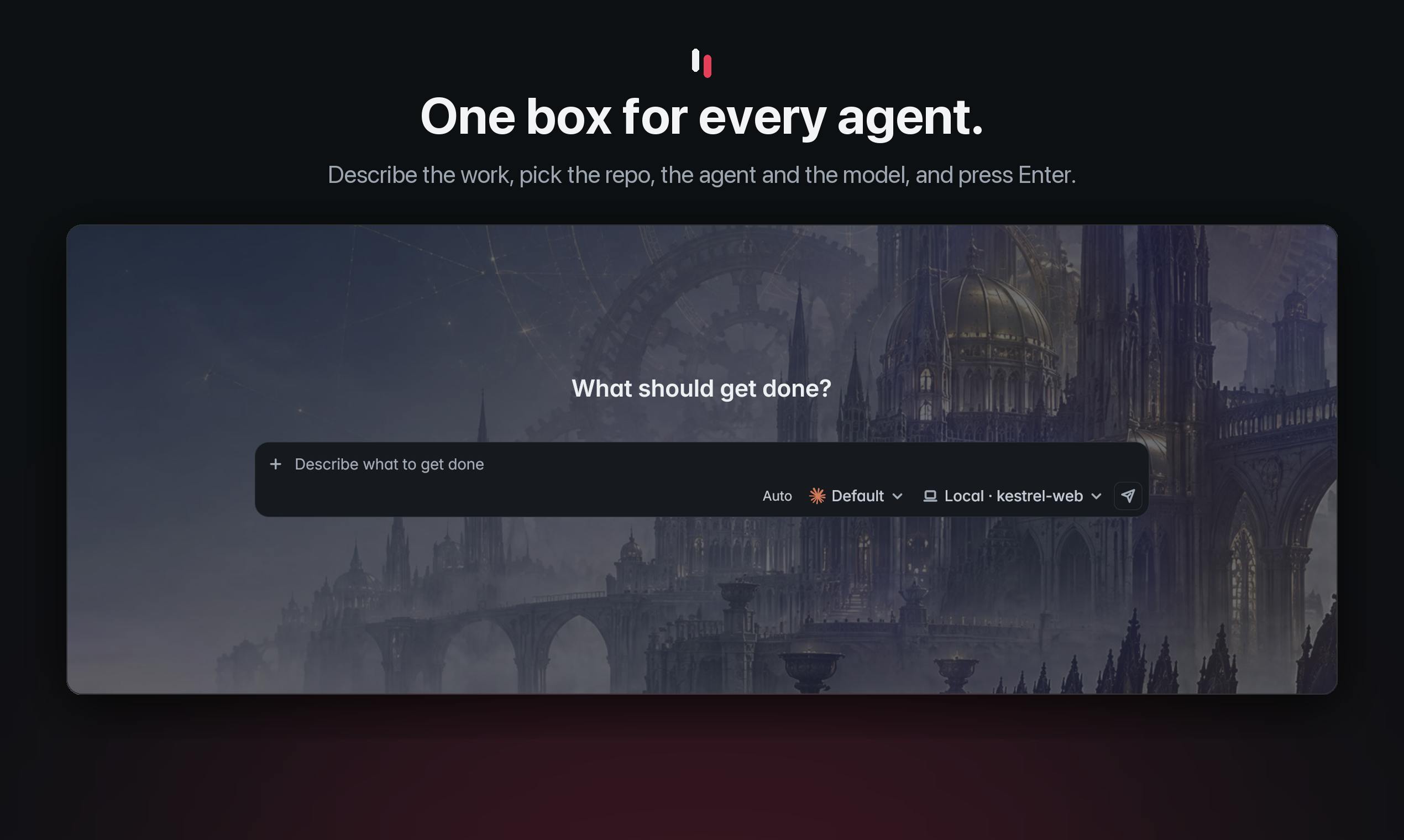
Parallax's core value proposition can be summed up in one sentence: let developers run and manage all coding agents in a single unified interface.
Specifically, it integrates over 40 coding agents including Claude Code and Codex, and supports access to more than 240 AI models through the developer's existing subscription accounts. This means users don't need to open separate accounts, configure API keys, or switch work environments for each tool — Parallax acts as a unified orchestration layer.
This approach directly corresponds to the current fragmentation of AI coding tools. Most developers aren't loyal to any single agent, but flexibly choose based on task type: one tool for code completion, another for complex refactoring, yet another for code review. Parallax aims to become the "control panel" for these scattered tools.
BYOS (Bring Your Own Subscription) model: Parallax employs a bring-your-own-subscription model, similar to a variant of BYOK (Bring Your Own Key). Traditional SaaS aggregation tools typically purchase model quotas centrally and resell them to users, who pay by usage; BYOS lets users continue using their existing Claude, ChatGPT, and other subscriptions, with the platform only providing orchestration and the interface layer. The advantage of this model is that the platform doesn't bear model costs, users don't pay twice, and the barrier to trying it is low; the risk is that the platform has no control over the underlying agents' interfaces — once a third party adjusts its API, restricts automated calls, or bans accounts, the aggregation layer becomes ineffective. Therefore, the long-term stability of a BYOS product essentially depends on its relationship with upstream vendors rather than its own technology.
Three Notable Feature Designs
In its product description, Parallax highlights three differentiating features, each targeting a specific friction point in the coding workflow:
Captain — handling trivial matters. Parallax has a built-in assistant called Captain, responsible for "busywork" — those repetitive operations that consume developer time but don't require deep thinking. Although the official description doesn't detail Captain's specific capability boundaries, based on naming logic, it seems more like a task scheduling layer above the agents rather than another independent coding agent.
Fast Merge — one-click PR submission. After code is written, the process from commit to merge often involves multiple steps. Fast Merge allows developers to complete PR submission and merging with a single click, reducing the friction of switching back and forth between the GitHub interface and the local development environment.
Auto Fallback — no dropping the ball when subscriptions run out. This is one of Parallax's most practical features. When a subscription account's quota is exhausted, Parallax automatically switches the task to the next available account or model, ensuring the workflow isn't interrupted. For developers who rely on piecing together usage quotas across multiple subscriptions, this feature directly solves "balance anxiety."
Subscription quotas and rate limits: Mainstream AI coding tools generally adopt a "fixed monthly fee + usage cap" model, with quotas usually calculated by time window (e.g., number of messages per 5 hours or per week), beyond which you must wait for reset or downgrade to a weaker model. Heavy developers can exhaust a single subscription within a day, so they stack multiple accounts to piece together total capacity. While this increases total available capacity, it turns "which account still has quota" into a burden that requires manual memory. Auto Fallback automates exactly this judgment logic: after detecting the current account has hit its cap, it automatically routes the task to the next available account or a model with similar capability, so the workflow doesn't get stuck due to quota interruptions.
The Value and Challenges of Unified Multi-Agent Management
From a product positioning perspective, Parallax is entering a market that is growing rapidly but not yet standardized. The number of AI coding agents has exploded over the past year, with each agent vying for developer attention and subscription budgets. But what developers truly need may not be "more agents," but rather "better use of existing agents."
Parallax's "bring your own subscription" (BYOS) model is noteworthy. It doesn't require users to purchase additional model quotas, but instead leverages users' existing subscriptions. This lowers the barrier to entry, but also means Parallax's experience quality largely depends on the stability and interface openness of third-party agents.
Another potential challenge: when Parallax orchestrates multiple agents simultaneously, how does it ensure code context consistency? Different agents may have differing understandings of the same project. Whether the convenience of a unified management interface comes at the cost of deep integration is a question that requires actual use to verify.
The technical difficulty of context consistency: When multiple agents process the same project in parallel, the biggest hidden danger is "context drift." Each agent maintains its own understanding of the codebase — which files it has read, what assumptions it has made, which branches it has modified — and these states are not shared by default. If Parallax merely distributes tasks without uniformly maintaining a shared context (such as project structure, conventions, and current branch state), two agents could produce mutually conflicting code or make erroneous modifications based on outdated information. There are usually two solution paths: first, treat the repository itself as the single source of truth, constrained by frequent synchronization and branch isolation; second, have the orchestration layer centrally maintain a context summary that can be injected into each agent. Which is more viable depends on whether upstream agents open up context injection interfaces.
Practical Significance for Developers
For individual developers, the core problem Parallax solves is "switching cost." When a developer maintains subscriptions to multiple AI coding tools simultaneously, a unified entry point can significantly reduce the time spent on environment switching and quota management.
For teams, if Parallax can support team-level agent management and permission allocation, it has the potential to become an infrastructure layer for AI coding workflows. However, based on the information currently available on the Product Hunt page, the level of detail for team collaboration features remains unclear.
Parallax's emergence in some sense reflects the phased change the AI coding tool market is undergoing: from "building more agents" to "managing existing agents well." Whether this direction holds depends on whether developers are truly willing to hand over agent management authority to an intermediary layer — a dual test of both product experience and trust.
One-line Summary
Parallax unifies 40+ coding agents in a single interface, using a BYOS model to solve multi-tool management pain points.
Paragraph Summary
Parallax is a developer tool unveiled on Product Hunt, focused on managing all AI coding agents through one interface. It integrates over 40 agents including Claude Code and Codex, and supports access to 240+ models through users' existing subscriptions, adopting a BYOS model to lower the barrier to entry. The product highlights three features: the Captain assistant for handling repetitive tasks, Fast Merge for one-click PR submission and merging, and Auto Fallback that switches to the next available account when subscription quota runs out. The article argues that Parallax targets the management pain point caused by the fragmentation of AI coding tools, reflecting the market's shift from 'building more agents' to 'managing existing agents well,' but its experience quality depends on the stability of third-party agents, and context consistency during multi-agent parallelism remains a challenge to be verified.
Related articles

Chain of Thought Isn't Just for AI: How Humans Can Use CoT to Improve Thinking Quality
Chain of Thought isn't just a prompt trick for large models. Starting from a Hacker News discussion, this article analyzes why CoT works for human thinking too, breaks down actionable ways to transfer it, and highlights the key differences between human CoT and machine CoT.
Cloudflare Teams Up with OpenAI: Closi…
Cloudflare Teams Up with OpenAI: Closing the Loop from Vulnerability Discovery to Defense with AI
Cloudflare uses OpenAI Daybreak to investigate security vulnerabilities and generate reviewable remediation plans, while developers use Codex to boost coding efficiency and quality.

Orca Multi-Agent Orchestration in Practice: A Guide to Parallel Collaboration with Claude and Codex
Orca is Stable AI's free open-source agent workbench supporting 34 agents like Claude Code and Codex in parallel. Learn its Git worktree isolation, multi-model orchestration, and mobile management.