Parenting Reflections in the AI Era: What Kind of People Should We Raise Our Children to Be?

A reflection on how parents should raise children for an unpredictable AI-driven future.
Starting from an original poem shared on Reddit, this article explores how AI is rendering traditional career-focused parenting obsolete. It argues that parents should shift from teaching children specific skills to cultivating irreplaceable human qualities — critical thinking, emotional intelligence, resilience, and the art of asking questions — while maintaining the irreplaceable warmth of human connection.
A Poem About Parenting in the AI Era
In the Reddit community, a parent posed a seemingly simple yet profoundly deep question through an original poem: What do I want to be? The poem doesn't explore career choices in the traditional sense — rather, it examines how parents should think about their role and how to guide the next generation's growth at a time when artificial intelligence is reshaping everything.
This topic resonates so widely because it touches on a reality that's rapidly approaching: the answers to "what to become" that our generation grew up with may have already become entirely obsolete for the next generation.
When AI Rewrites the Concept of "Career"
Traditional Answers Are Failing
In the past, "What do you want to be when you grow up?" was a question with a standard answer bank — doctor, teacher, engineer, lawyer. These careers represented stable skill paths and clear social divisions of labor. However, as generative AI rapidly advances in coding, writing, art, medical diagnostics, and other fields, many skills once considered "iron rice bowls" are being redefined.
Generative AI refers to artificial intelligence systems capable of creating entirely new content based on training data. Representative products include OpenAI's GPT series, Google's Gemini, and image generation tools like Midjourney and Stable Diffusion. Since ChatGPT's release in 2022, these technologies have demonstrated capabilities in legal document drafting, code writing, medical image analysis, and artistic creation that approach or even surpass those of average practitioners — all within just two years. A McKinsey Global Institute report predicts that by 2030, approximately 30% of current work hours could be replaced by automation technologies. This means that children born today, entering the workforce in the 2040s, will face a labor market landscape radically different from the current one.
For children born today, the career landscape when they reach adulthood will likely be completely unimaginable to us now. This is the core of the parental anxiety behind the poem: How do we prepare children for an unknown world?
From "What to Do" to "What Kind of Person to Become"
The poem's title deserves careful consideration — it asks "what do I want to be," not "what job do I want to do." This subtle distinction points directly to the fundamental shift in parenting philosophy that the AI era may bring:
- When specific skills are easily replaced or augmented by AI, a person's character, values, and creativity become all the more precious;
- The focus of education should shift from "imparting knowledge that can be automated" to "cultivating human qualities that are difficult for machines to replicate";
- Parents' own role is also transitioning from "knowledge transmitter" to "values guide" and "growth companion."
Three Reflections for Parents in the AI Era
Reflection One: The Root of Anxiety Lies in Our Craving for Certainty
Much of parental anxiety fundamentally stems from a craving for certainty. We want to pave a "correct" path for our children. But the biggest change AI brings is precisely the intensification of uncertainty. The poem gently reminds us: rather than trying to predict tomorrow's hot careers, we should help children build psychological resilience and continuous learning capabilities to face uncertainty.
In developmental psychology, "Resilience" refers to an individual's capacity for positive adaptation when facing adversity, trauma, threats, or significant sources of stress. Closely related is Stanford psychologist Carol Dweck's "Growth Mindset" theory — the belief that abilities can be developed through effort and learning, rather than being fixed. In the AI era, the importance of these two psychological traits is amplified further: when the external environment is highly uncertain and career paths are no longer linear, individuals who can recover from failure and view challenges as learning opportunities will be more adaptable than those who rely on fixed skills and stable paths. Education reforms in countries like Finland have already begun incorporating these "meta-capabilities" into their core curriculum frameworks — a trend worth noting for parents worldwide.
Reflection Two: The Power of Leading by Example Cannot Be Overlooked
The poem uses first person to ask "What do I want to be," implying parental self-examination. Children learn largely by imitating their parents' behaviors and attitudes. In an era of rapid AI iteration, whether parents themselves maintain curiosity, willingness to learn new things, and a healthy, open attitude toward technology — all of these subtly influence how the next generation approaches AI and the future.
Reflection Three: The Irreplaceable Human Connection
No matter how powerful AI becomes, the emotional connection, companionship, and love between parent and child cannot be replaced by algorithms. This is perhaps the poem's warmest landing point: in a world increasingly dominated by machine-driven efficiency, the most precious things parents can give their children are precisely those "inefficient" yet warmest offerings — patient listening, shared experiences, and unconditional acceptance.
Educational Thinking Amid Technological Waves
Core Capabilities for Raising "AI Natives"
Today's children will be true "AI natives," just as millennials were "digital natives." The concept of "Digital Natives" was coined by education scholar Marc Prensky in 2001 to describe a generation that grew up surrounded by the internet, computers, and mobile phones. Now, the "AI natives" analogy is being widely adopted, referring to children who from birth live in an environment where AI assistants, intelligent recommendation algorithms, and automated systems are ubiquitous. Similar to how digital natives naturally adapted to the internet, AI natives will view interaction with AI as a natural part of life rather than a new skill requiring additional learning. This generational difference will profoundly impact every aspect of educational models, cognitive approaches, and social interactions.
Facing a future of deep human-AI coexistence, the core capabilities they'll need may include:
- Critical thinking: In an environment where AI generates massive amounts of content, the ability to discern truth from falsehood and form independent judgments is crucial;
- The art of asking questions: When standard answers are readily available, those who can ask good questions will truly stand out;
- Human-AI collaboration literacy: Understanding how to effectively use AI tools to amplify one's own capabilities, rather than being dominated or replaced by them. Human-AI Collaboration refers to a working model where humans and AI systems complement each other in their respective areas of strength to achieve better outcomes. AI excels at pattern recognition, large-scale data processing, and repetitive task execution, while humans retain irreplaceable advantages in creative thinking, moral judgment, contextual understanding, and complex interpersonal communication. Emerging practice areas such as "Prompt Engineering" and "AI-assisted decision-making" have already appeared in the industry. Research from Harvard Business School shows that human+AI collaboration often outperforms either humans alone or AI alone on many tasks. Cultivating children's human-AI collaboration literacy means helping them understand AI's capability boundaries, learning to use AI as a thinking partner rather than a replacement, and maintaining human agency and critical judgment in the collaboration;
- Emotional and social intelligence: Empathy, communication skills, teamwork — this is the domain most difficult for machines to reach, and humanity's most core competitive advantage.
Maintaining Balance Rather Than Blind Resistance
Facing AI's impact on education and careers, parents need neither panic blindly nor take a completely hands-off approach. A healthy attitude is to view AI as a tool and collaborator, guiding children to understand its capabilities and limitations, while wholeheartedly protecting those qualities that define what makes us human — curiosity, empathy, creativity, and the capacity to love.
The Question Itself Matters More Than the Answer
The value of this original poem from Reddit lies not in providing standard answers, but in prompting every parent to pause and think seriously. "What do I want to be?" — this question has been given entirely new weight and meaning in the AI era.
Perhaps the best parenting approach isn't rushing to answer for our children, but exploring together with them in a world full of change. As technology continuously disrupts the answers to "what to do," the fundamental question of "what kind of person to become" becomes ever clearer and more precious.
In this sense, a simple little poem gives voice to the shared thoughts and reflections of countless parents in this era.
Related articles
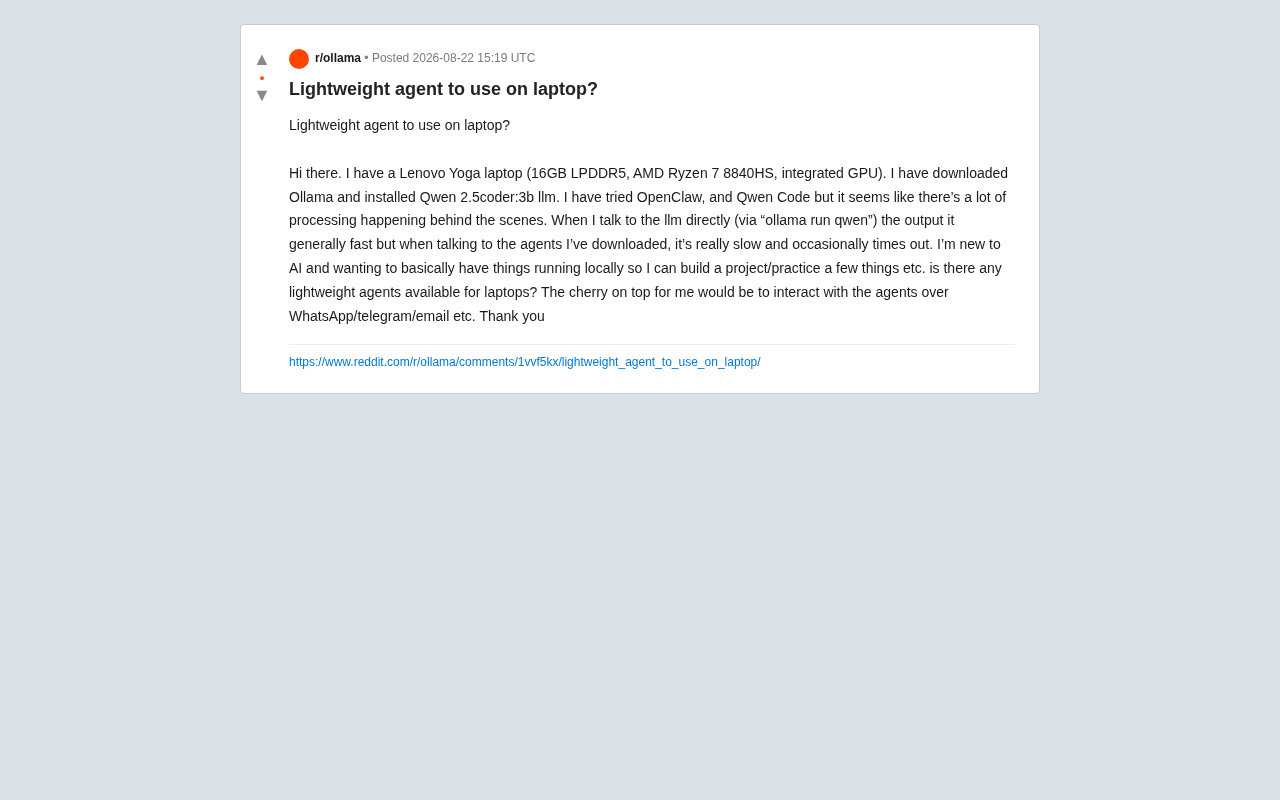
Local AI Agent Deployment Too Slow? A Lightweight Optimization Practical Guide
Local AI Agent deployment slow and timing out? This guide covers Agent framework overhead, hardware bottlenecks, and practical optimizations including context trimming, quantization, and Telegram Bot integration.

Choosing a Laptop for AI Studies: MacBook vs NVIDIA Laptop — An In-Depth Comparison Guide
In-depth analysis for AI students choosing laptops: MacBook Air M5 with remote GPU vs NVIDIA laptop, comparing CUDA support, portability, battery life, and value.

Self-Hosted LLM Tech Stack: A Complete Guide to Managing Your Local AI Cluster from the Terminal
A deep dive into self-hosting LLM tech stacks: inference engines, model management, vector databases, and how to manage your local AI cluster from the terminal.