Parley: A Federated, Decentralized Chat Tool with Native IRC Compatibility

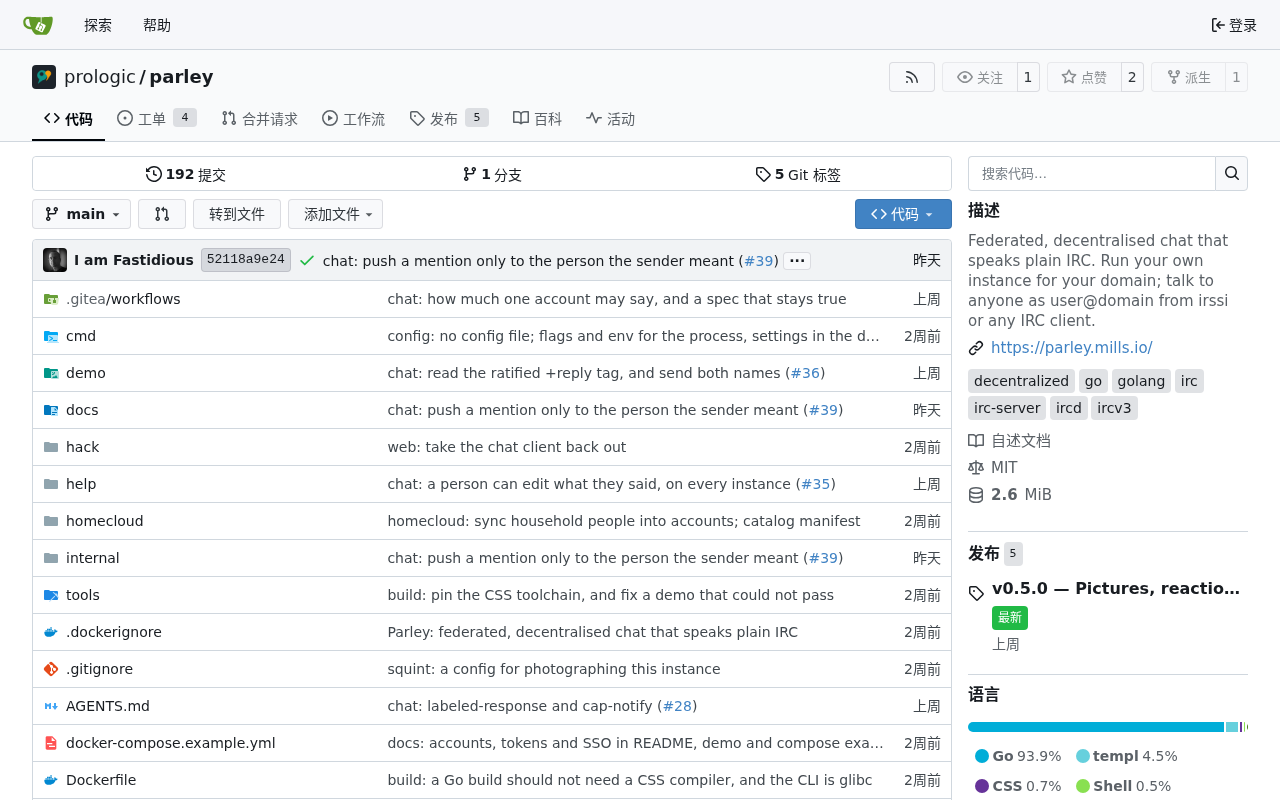
Parley layers a federated architecture on top of IRC to create a decentralized instant messaging network.
Parley is an emerging instant messaging project positioned as "federated, decentralized, and compatible with plain IRC." Its core differentiator is preserving the decades-old IRC ecosystem rather than discarding it, adding modern distributed networking so existing users can keep using clients like WeeChat or irssi while gaining fault tolerance and censorship resistance. Compared to Matrix, XMPP, and Nostr, Parley takes a restrained approach — extending rather than reinventing. The key challenges ahead are bridging IRC's lack of message history sync, end-to-end encryption, and rich media support without breaking compatibility, and attracting enough node operators to build meaningful network scale.
What Is Parley
Parley is a new instant messaging project that can be summed up with three keywords: federated, decentralized, and compatible with plain IRC. The project gained 21 points and 6 comments on Hacker News — not a viral hit, but enough to spark discussion in technical circles focused on decentralized communication.
For developers and tech enthusiasts who have long relied on IRC, Parley's biggest appeal is that it doesn't abandon this decades-tested protocol. Instead, it layers a modern federated architecture on top of it. This means existing users can connect with their familiar IRC clients while also benefiting from the censorship resistance and fault tolerance that distributed networks provide.
The Value of Federation and Decentralization
In recent years, the concept of "federation" has re-entered mainstream technical discussion, driven by projects like Mastodon and Matrix. The core idea is straightforward: rather than relying on a single central server, a network is composed of independently operated nodes that exchange messages via standard protocols. Users can choose a node they trust — or even self-host.
Parley follows this model. Compared to centralized platforms like Slack or Discord, a federated architecture prevents any single company from exercising absolute control over the entire communication network, reducing the impact of sudden shutdowns, policy changes, or data breaches. Decentralization takes this further by ensuring that even if some nodes go offline, the network as a whole continues to function.
This design philosophy has real-world relevance today. More and more technical communities are paying attention to ownership and data sovereignty in their communication tools, and IRC — as one of the earliest open communication protocols — is a natural fit for the spirit of decentralization.
From a technical implementation standpoint, federation typically relies on an open Server-to-Server Protocol. Matrix, for example, has servers exchange events via a Federation API and maintain distributed copies of room state; Mastodon uses ActivityPub to push activity streams between instances. The key distinction between federation and full decentralization (such as peer-to-peer networks) is that federated networks still depend on addressable server nodes — user accounts belong to a specific instance rather than being server-agnostic. This brings advantages in operational simplicity and compatibility with existing internet infrastructure, but it also means individual node operators retain a degree of control over their users' data. Understanding this boundary is essential for accurately assessing the practical privacy and data sovereignty guarantees that Parley can offer.
Why Commit to IRC Compatibility
Parley's decision to "speak plain IRC" is a design choice worth examining. The IRC protocol is mature, syntactically simple, text-based, and easy to implement — and it's still actively used by a large number of open-source communities and technical teams. By maintaining native IRC compatibility, Parley removes the need for users to switch clients or re-educate a large existing user base.
This kind of backward-compatible strategy typically lowers the barrier to adoption. Users can continue with mature IRC clients like WeeChat, irssi, and HexChat, while the underlying federated network remains relatively transparent to them. For communities that want to retain their IRC workflows while gaining modern distributed capabilities, this is a pragmatic choice.
That said, compatibility with a legacy protocol also means making trade-offs on feature expansion. IRC natively lacks message history sync, end-to-end encryption, rich media support, and other features that modern IM users take for granted. How to fill these gaps without breaking protocol compatibility will be one of Parley's central technical challenges.
The IRC (Internet Relay Chat) protocol was designed by Jarkko Oikarinen in 1988, with its core specification defined by RFC 1459 (1993) and the subsequent RFC 2810–2813 series. The protocol uses plain-text, line-based TCP connections with extremely concise command syntax (e.g., JOIN, PRIVMSG, NICK), meaning a basic IRC client can be implemented in just a few hundred lines of code. IRC networks have a native server-linking mechanism that allows multiple servers to form a tree topology — but this scheme is prone to netsplits at scale and lacks a modern identity authentication system. One of Parley's core technical challenges is maintaining compatibility with standard IRC clients while using a federation layer to address these inherent limitations of native IRC network topology.
Its Place in the Decentralized Communication Landscape
The decentralized communication space already has multiple established players — Matrix (and its reference implementation Synapse), XMPP, Nostr, and others — each with different priorities. Matrix emphasizes feature completeness and end-to-end encryption, but its protocol is complex and server resource consumption is high; XMPP has a long history but a relatively fragmented ecosystem; Nostr is known for its minimalism and censorship resistance.
Parley's differentiation lies in making "plain IRC compatibility" its top priority — a relatively restrained position in a landscape full of projects reinventing protocols from scratch. Rather than creating an entirely new standard, Parley gives the battle-tested IRC protocol a new life through federation. Whether this approach succeeds depends on whether it can attract enough node operators and communities to form a meaningful network at scale.
Nostr (Notes and Other Stuff Transmitted by Relays) is a minimalist protocol that has emerged over the past couple of years, and its design philosophy offers a useful point of comparison for Parley's approach: user identity is based on key pairs rather than server accounts, messages are broadcast through multiple relays, and anyone can run a relay node. This design is more robust against censorship than the federated model, but the trade-off is that message routing, history sync, and spam filtering complexity all shift to the client. XMPP represents another direction — a highly modular protocol where nearly any feature can be layered on through its XEP (XMPP Extension Protocol) system, but this very flexibility leads to inconsistent interoperability across implementations. Parley's choice to use IRC as its base layer is essentially a bet on "good enough" — avoiding the trap of over-engineering, but also inheriting IRC's historical limitations in terms of feature expressiveness.
Conclusion
Parley represents a pragmatic branch within the decentralized communication trend: rather than tearing down existing protocols, it injects modern federated and decentralized capabilities into the classic IRC framework. For technical communities that value data sovereignty and censorship resistance but don't want to abandon their IRC workflows, it offers a low-migration-cost option.
Given the limited public information currently available, the specific implementation details, performance characteristics, and community size of Parley remain to be seen. Whether it can carve out a meaningful position in a competitive decentralized communication landscape will ultimately require more real-world deployments and user feedback to validate.
Related articles

Chain of Thought Isn't Just for AI: How Humans Can Use CoT to Improve Thinking Quality
Chain of Thought isn't just a prompt trick for large models. Starting from a Hacker News discussion, this article analyzes why CoT works for human thinking too, breaks down actionable ways to transfer it, and highlights the key differences between human CoT and machine CoT.
Cloudflare Teams Up with OpenAI: Closi…
Cloudflare Teams Up with OpenAI: Closing the Loop from Vulnerability Discovery to Defense with AI
Cloudflare uses OpenAI Daybreak to investigate security vulnerabilities and generate reviewable remediation plans, while developers use Codex to boost coding efficiency and quality.

Orca Multi-Agent Orchestration in Practice: A Guide to Parallel Collaboration with Claude and Codex
Orca is Stable AI's free open-source agent workbench supporting 34 agents like Claude Code and Codex in parallel. Learn its Git worktree isolation, multi-model orchestration, and mobile management.