PassiveShorts Review: AI Auto-Generates Short Videos and Publishes to TikTok and YouTube

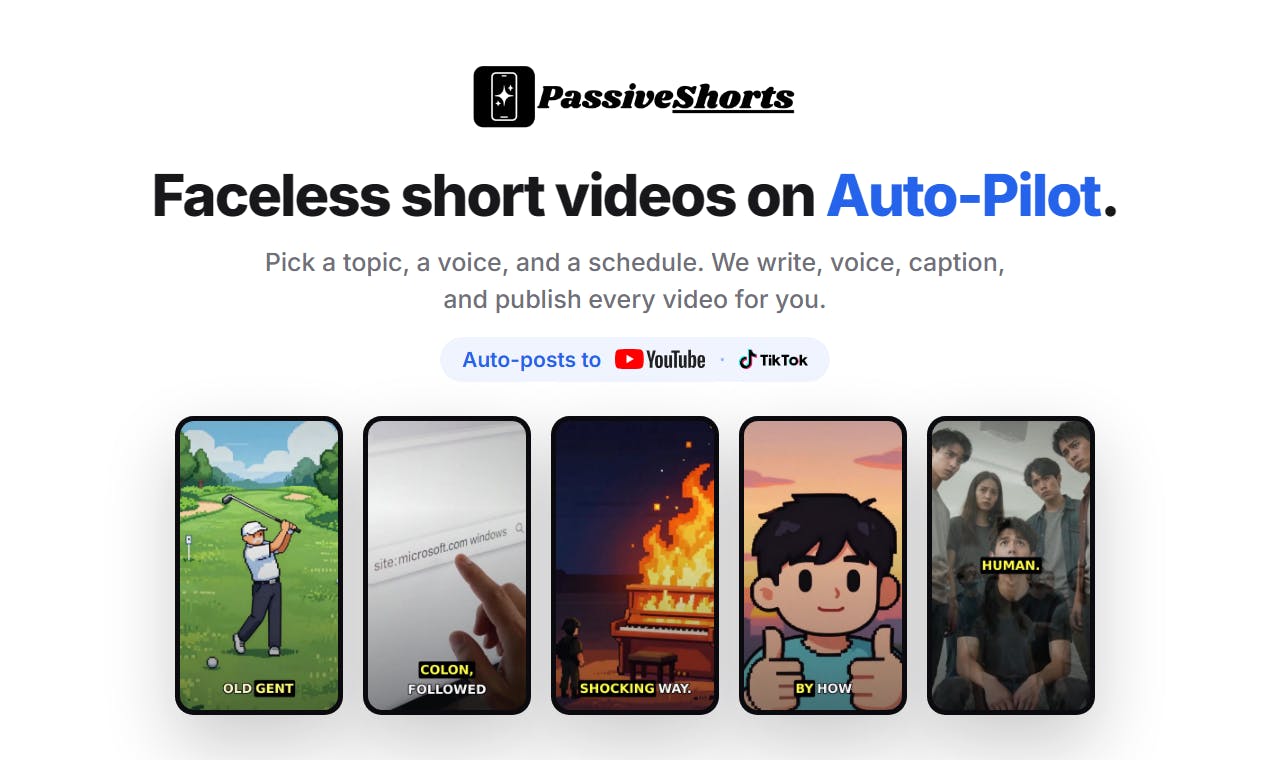
PassiveShorts automates faceless short video creation and publishing to TikTok and YouTube using AI.
PassiveShorts is an AI-powered tool that automates the entire short video production pipeline—from topic selection and scripting to voiceover, captions, and scheduled publishing on TikTok and YouTube. While it offers significant efficiency gains for creators entering the faceless video niche, users should be aware of content homogenization risks and tightening platform policies around AI-generated content.
What Is PassiveShorts, the Short Video Automation Tool
Short-form video has become the most traffic-valuable content format today, but consistently producing high-quality Shorts is a massive time burden for individual creators: topic selection, scripting, voiceover, subtitles, editing, publishing—every step demands energy. PassiveShorts, which recently reached #14 on the Product Hunt leaderboard, targets exactly this pain point by attempting to fully automate the entire content production pipeline with AI.
The product's positioning is remarkably straightforward—an AI faceless video generator for TikTok and YouTube. Its core promise can be condensed into one sentence: you only need to choose a topic, a voice, and a publishing schedule—the AI handles all the scripting, voiceover, subtitles, and publishing. After launch, it received 92 upvotes and was categorized under both "Social Media" and "Artificial Intelligence."
From a technical implementation perspective, this type of short video automation tool involves the coordinated work of multiple AI technologies: Large Language Models (LLMs) handle script generation and topic expansion, Text-to-Speech (TTS) technology converts copy into naturally-intoned voiceovers, Automatic Speech Recognition (ASR) technology ensures precise synchronization between subtitles and audio, and finally, platform APIs or automation scripts enable scheduled publishing. These underlying technologies underwent significant maturation between 2023-2024—speech synthesis solutions like ElevenLabs and OpenAI TTS can now generate voices approaching human quality, and models like GPT-4 have script-writing capabilities far surpassing earlier template-based tools. Together, these advances transformed end-to-end video production pipelines from concept to reality.
Why Faceless Video Has Become a Hot Niche
"Faceless Video" refers to short videos that don't require a real person on camera, instead relying on a combination of visual footage, voiceover narration, and subtitles. This type of content is especially popular in verticals like trivia, storytelling, motivational quotes, and financial commentary.
Faceless video isn't an entirely new concept. Even in YouTube's early days, many channels produced content using slideshows paired with voiceovers—"Top 10" list videos and Reddit story narration channels were early examples. But advances in AI have fundamentally transformed both quality and production efficiency—AI can now automatically match relevant footage, generate smooth transitions, and synthesize near-human-quality multilingual voices. According to industry observations, top-ranking faceless channels on YouTube can earn thousands to tens of thousands of dollars monthly (monetized through AdSense revenue sharing, affiliate marketing, and digital product promotion), and this considerable monetization potential has attracted a flood of tool developers and solo entrepreneurs into the space.
No Camera Required, Dramatically Lowering the Creation Barrier
The biggest appeal of faceless video is that it lowers the barrier to content creation. Creators don't need to face a camera, worry about their appearance, or invest in professional filming equipment. This gives opportunities to a large population of people who want to monetize content but prefer not to show their face. PassiveShorts targets precisely this group's needs.
On a deeper level, faceless video also solves geographic and language limitations in content production. Since it doesn't rely on a real person appearing on screen, the same video can be quickly localized to different markets by swapping the voiceover language, providing natural convenience for multilingual matrix operations. Additionally, a faceless video's "IP assets" are entirely deposited in the account and content style rather than tied to a specific individual, meaning accounts can be more flexibly transferred, team-collaborated, or scaled through replication.
From Batch Generation to Fully Automated Publishing
Many tools could already help generate faceless videos in the past, but most remained at the "assisted generation" stage, requiring users to manually download, edit, and upload. PassiveShorts differentiates itself by bridging the "last mile" between generation and publishing: it can automatically publish to YouTube and TikTok. Once users set up a publishing schedule, the system continuously produces and pushes content at the configured cadence. This "set it and forget it" model is the true meaning of "Passive" in the product name.
This differentiation may seem like merely adding an "auto-publish" step, but in actual operations, it's enormously significant. The manual publishing step is often the biggest resistance point that causes creators to give up—when you need to log into multiple platforms daily, upload videos one by one, and fill in titles, descriptions, and tags, the psychological burden far exceeds content creation itself. PassiveShorts reduces this friction to zero, making a "set up once, run continuously for weeks" operational model possible.
PassiveShorts Core Features: A Detailed Breakdown
According to official descriptions, PassiveShorts' workflow can be broken down into these key stages:
-
Topic Selection (Pick a topic): Users specify a content theme direction, and the AI generates content scripts around that theme. Topic selection is the most strategic step in the entire pipeline—a good topic direction determines the base traffic pool size and competitive intensity. Users can choose specific verticals (such as psychology facts, historical trivia, personal finance, etc.), and the system automatically finds and generates specific topics within that domain.
-
AI Scripting (We write): AI automatically writes video copy, eliminating time spent brainstorming and polishing scripts. Short video script writing has unique requirements—it needs to establish suspense, deliver information, and encourage interaction within an extremely short timeframe (typically 30-60 seconds). The AI scripting engine is usually based on large language models fine-tuned on short video corpora, capable of mimicking the narrative rhythm and hook structures of high-completion-rate videos.
-
AI Voiceover (Pick a voice): Choose from multiple AI voices to generate natural narration for the video. Current mainstream TTS technology can achieve near-human tonal variations, emotional expression, and rhythm control. Some tools also support cloning specific voice profiles or selecting different accents to match target audience preferences.
-
Auto Captions (Caption): Automatically adds synchronized subtitles to videos—crucial for improving short video completion rates. Research data shows that over 80% of mobile short video users browse content with sound off, making subtitles not just supplementary information but the primary channel for content to reach users. Furthermore, dynamic captions (word-by-word appearing subtitles with highlighting, scaling, and other motion effects) have been proven to effectively boost viewer attention and completion rates.
-
Scheduled Publishing (Schedule & Post): Automatically publishes to both TikTok and YouTube according to preset schedules. Through OAuth authorization or platform-provided Creator APIs, the system can automatically complete uploads, fill in titles and descriptions, set tags, and handle all other publishing operations at specified times.
The value of this workflow is that it compresses what originally required stringing together multiple tools and hours of work into just a few clicks of configuration. For creators wanting to run matrix accounts or test multiple content directions, this automation capability means a multiplicative increase in operational efficiency.
PassiveShorts: Advantages and Potential Risks
Efficiency Gains: Solving the Consistency Problem
For users who want to enter the short video space but lack time and skills, PassiveShorts provides clear value. Consistent updates are one of the key factors favored by short video platform algorithms, and automated scheduling directly solves "update gaps"—the most common reason creators fail.
Short video platform recommendation algorithms typically give higher initial traffic allocation to consistently active accounts. TikTok's recommendation mechanism is based on content quality signals (completion rate, engagement rate, share rate, etc.), but publishing frequency and account activity are also important factors affecting content distribution weight. YouTube Shorts similarly tends to recommend recent content from active channels in its discovery page (Shorts Feed). Multiple creator community experience summaries indicate that maintaining a publishing cadence of 1-3 posts per day is one of the optimal strategies during a short video account's cold-start phase, and once updates are interrupted for more than a few days, the account's recommendation weight drops significantly, with recovery requiring additional time investment. This is precisely where automated scheduling delivers its core value.
Content Homogenization Risk Cannot Be Ignored
However, fully automated generation also brings significant concerns. When more and more creators use similar tools and produce content based on similar templates, content homogenization is almost inevitable. AI-generated scripts and voiceovers, without personalized refinement, easily fall into a "cookie-cutter" trap, ultimately struggling to stand out on information-overloaded platforms.
This homogenization has already manifested in certain niches. Taking "Scary Stories" and "Motivational Quotes"—two of the hottest faceless video sub-categories—as examples, a large number of channels use similar AI voiceover styles, identical stock video footage, and nearly identical subtitle styling, leading to accelerated audience fatigue and continuously declining average views per video. When tools become democratized to the extreme, the source of differentiation will return to dimensions that tools cannot standardize: topic insight, creative content arrangement, and personalized operations.
Platform Policy Tightening Creates Account Risks
Major platforms are continuously tightening their policies on AI-generated content and automated publishing. YouTube has begun requiring AI-generated content labeling, and TikTok similarly has throttling mechanisms for bulk, low-quality content. Operational strategies relying on fully automated publishing need to continuously monitor platform rule changes, or risk account throttling or even bans.
Specifically, since 2024, major platforms have rolled out targeted AI content policies. YouTube added an AI content disclosure option in Creator Studio, requiring creators to proactively indicate during upload whether videos use synthetic or modified media—especially content involving real people's likenesses or content that could be mistaken for real events; non-compliant disclosure may result in video removal or channel penalties. TikTok explicitly states in its Community Guidelines and automation policies that using third-party automation tools to batch-publish low-quality, repetitive, or misleading content may trigger account-level throttling or bans. Meta's Instagram Reels and Facebook have also begun automatically adding "AI-generated" labels to detected AI-generated content. These policy changes mean that fully automated operational strategies must have built-in compliance mechanisms—at minimum, correctly labeling AI usage in video descriptions or upload metadata, and ensuring generated content quality meets the platform's basic requirements for "valuable content."
Conclusion: Is PassiveShorts Worth Using?
PassiveShorts represents a typical example of AI content tools evolving from "generation assistance" to "full-pipeline operations." It integrates the complete chain of topic selection, scripting, voiceover, subtitles, and publishing into a single product, addressing content creators' core demand for efficiency.
However, a tool is ultimately just a tool. What truly determines content success remains the uniqueness of topics, the value density of content, and understanding of the target audience. Automation can solve the "quantity" problem, but differentiation in "quality" still requires the creator's own judgment. For those wanting to try the faceless video niche, PassiveShorts is worth a try as an efficiency tool; but if you place all your hopes on "one-click passive income," you may be underestimating the true competitive intensity of the content industry.
A more pragmatic usage strategy is to treat PassiveShorts as an accelerator for content testing and cold starts—use automation capabilities to quickly validate market feedback across different topic directions, then once you find content directions with strong data performance, invest human effort into deep optimization and differentiated refinement. This hybrid model of "AI validation + manual cultivation" may be the optimal solution for balancing efficiency and quality at this stage.
Related articles
HydraNet-VSM Architecture Analysis: A New Approach to Reasoning Through Parallel Fusion of Mamba and Attention Mechanisms
Deep dive into the HydraNet-VSM hybrid architecture proposal: parallel fusion of Mamba SSM and Attention mechanisms, plus how Verified Step Memory tackles Chain-of-Thought unfaithfulness.

Claude Code Creator's Advice: For Big Changes, Align Before You Code
Claude Code creator Boris shares AI coding best practices: for big changes, read the repo first, confirm the plan, then code and verify immediately. Master this workflow to avoid costly rework.

Seed7 Programming Language: A Unique Design Achieving Memory Safety Without GC
Deep dive into how Seed7 achieves memory safety without GC, exploring its AOT compilation, extensible syntax, integer overflow checking, and comparisons with C++, Rust, and Java.