Paul Graham: AI-Written Emails Feel Like Deception — Founders Should Never Do This
Paul Graham opposes founders using AI to write emails, calling it deceptive and unimpressive.
Y Combinator co-founder Paul Graham publicly stated that he ignores founder emails once he identifies them as AI-written. He views AI ghostwriting as deceptive and a complete failure of competence signaling — since anyone can generate a "perfect email" with AI, it reveals nothing about a founder's independent thinking or sincerity. For founders, authenticity matters far more than polished prose.
The Silicon Valley Godfather's Strong Aversion to AI-Written Emails
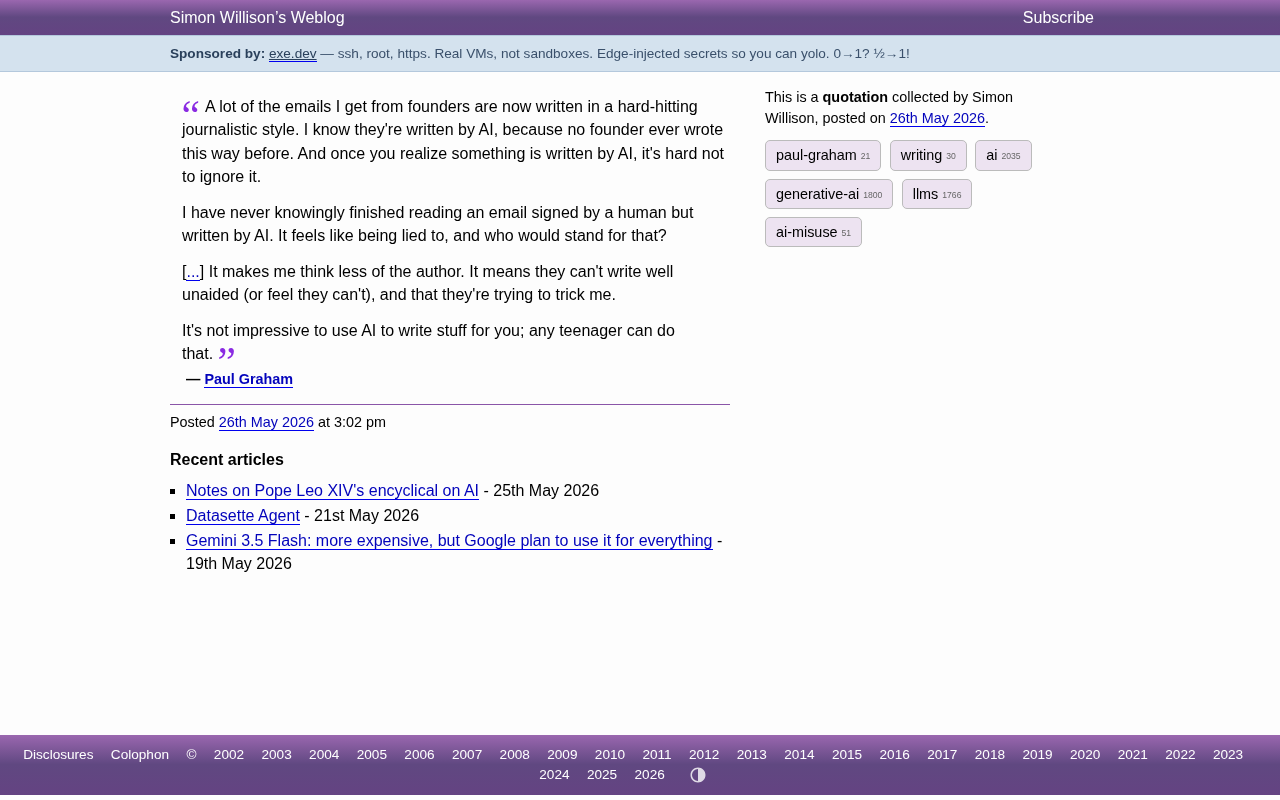
Y Combinator co-founder Paul Graham recently posted a widely discussed statement on Twitter, calling out the growing trend of founders using AI to draft their emails. His stance was unmistakably clear: once he realizes an email was written by AI, it's nearly impossible not to simply ignore it.
Background on Paul Graham and Y Combinator: Y Combinator (YC), founded in 2005, is the world's most influential startup accelerator. It has incubated thousands of companies — including Airbnb, Stripe, Dropbox, and Reddit — with a combined valuation exceeding one trillion dollars. As its co-founder, Paul Graham is not just an investor but a thought leader in the startup world. His essay series, Paul Graham Essays, is widely regarded as the startup bible, covering everything from product philosophy to founder psychology. This is precisely why every public statement he makes sends ripples through the startup community. Each year, YC accepts startup applications from around the world through its batch system, and email communication between founders and YC partners is a critical channel for building relationships — making Graham's aversion to AI-written emails particularly pointed and relevant.
One of Silicon Valley's most influential investors noted that an increasing number of emails from founders exhibit a "hard-hitting journalistic style." He can identify these as AI-generated because no founder has ever written emails this way — the style itself is the biggest giveaway.
Why AI's "hard-hitting journalistic style" is so easy to spot: The style Graham mentions is a hallmark of text output from today's mainstream large language models (LLMs). It manifests as well-structured sentences, cleanly organized paragraphs, heavy use of emphasis words (such as "critical," "crucial," "profound impact"), and overtly explicit logical chains. This style stems from the composition of LLM training data — the vast corpus of press releases, blog posts, and business writing on the internet forms the foundation of these models' training, causing their output to naturally carry a "media tone." Researchers refer to this phenomenon as "stylistic bias." Models from OpenAI, Anthropic, and others are further trained during the RLHF (Reinforcement Learning from Human Feedback) phase to be more "helpful, harmless, and honest," which reinforces the formal and structured feel of their output. For investors who spend years reading vast amounts of human-written text, this stylistic "neatness" ironically becomes the most obvious AI fingerprint.
Why AI-Written Emails Repel Investors
The Collapse of Trust
Paul Graham's own words hit hard:
I have never knowingly finished reading an email that was written by AI but signed by a human. It feels like being lied to, and who would put up with that?
The core issue isn't about the quality of AI writing — it's about integrity. When a founder uses AI to draft an email to an investor, it sends a doubly negative signal: first, they can't write well on their own (or believe they can't); second, they're trying to get away with it.
The Total Failure of Competence Signaling
Paul Graham went further: "Having AI write stuff for you is not impressive. Any teenager can do that."
This statement reveals a deeper logic that can be explained through Signaling Theory in economics. In behavioral economics, a "credible signal" must meet one condition — its cost must be high enough that it cannot be easily faked. Economist Michael Spence won the 2001 Nobel Prize in Economics for this insight. Before AI, a logically clear and precisely worded email was a high-cost signal — it required the founder to genuinely possess clear thinking and communication skills. But when GPT-4 and similar models can generate a "perfect email" in 30 seconds, the cost of that signal drops to nearly zero, and its credibility collapses along with it. The deeper issue is this: when investors evaluate founders, they are fundamentally assessing the quality of their decision-making under high pressure and incomplete information. Writing is the externalization of thinking — how someone organizes language reflects how they organize their thoughts. AI ghostwriting severs this chain of observation, depriving investors of a crucial dimension of assessment.
Worse still, using AI to write your emails actually becomes a negative signal — it suggests you don't even have the sincerity to spend ten minutes writing an email yourself.
Practical Takeaways for Founders
Authenticity Matters More Than Perfection
For founders seeking funding, Graham's stance is a warning that cannot be ignored. Investors don't care about how polished your prose is. What they value is:
- Independent thinking ability: Can you articulate your ideas clearly?
- Genuine attitude: Are you taking this communication seriously?
- Personal character: Your writing style is itself a part of who you are.
A slightly rough but authentic email is far more persuasive than one polished to a shine by AI. Investors read enormous volumes of email every day, and their ability to detect AI-generated content far exceeds what most people imagine.
Where Is the Line Between AI-Assisted and AI-Written?
From a technical standpoint, the use of AI writing tools exists on a spectrum: grammar correction (Grammarly-type tools) → wording refinement → structural suggestions → paragraph expansion → full-text generation. What Graham objects to is clearly the "full-text generation" end of the spectrum, not the assistive uses at the other end. This boundary is equally debated in academia and the workplace — institutions like Harvard and MIT have already begun distinguishing between "AI-assisted" and "AI-generated" work.
Related articles
 Expert Opinions
Rethinking Scaling Laws: Parameters Are Not the Only Answer
Deep analysis of Scaling Law evolution from Kaplan to Chinchilla to the MoE era, exploring why blindly stacking parameters is a mistake, and how GLM-5.3 proves scaling has multiple knobs.
When AI Treats Humans as Subagents: Ro…
When AI Treats Humans as Subagents: Role Reversal and Hidden Risks in Human-AI Collaboration
Exploring the paradigm shift where humans become "subagents" in AI Agent architectures. Analyzes human node design in LangChain and AutoGen, and the risks of ceding control and cognitive atrophy.
 Expert Opinions
The Lazy Person's Productivity Theory: Why Being 'Lazy' Actually Drives Peak Performance
Explore the engineering philosophy behind 'lazy people are most productive': how constructive laziness drives automation, AI tools amplify efficiency, and systems thinking eliminates wasted effort.