PauseBuy: A Mindful Consumption Tool That Hits Pause on Impulse Shopping

PauseBuy inserts mindful pauses when you open shopping apps to combat impulse purchases.
PauseBuy is an Android app that intercepts users when they open shopping apps like Amazon or Temu, inserting personalized reminders, financial goal comparisons, and reflection questions to transform autopilot purchasing into intentional decisions. Grounded in behavioral economics and neuroscience, it applies "friction" to counter e-commerce platforms' frictionless design, offering a digital wellbeing approach to consumer mindfulness.
When "Add to Cart" Becomes a Reflexive Action
Open a shopping app, scroll for a bit, see something appealing, and tap "Buy Now" — for many people, this sequence has become muscle memory. The regret only hits when the package arrives or the credit card statement comes due. This "buyer's remorse" has become an epidemic of the mobile commerce era.
PauseBuy, which recently launched on Product Hunt, targets exactly this pain point. Its product philosophy is simple and direct: force a "mindful pause" every time you open a shopping app, turning impulse buying from an autopilot behavior into a conscious decision.
Currently, PauseBuy primarily covers the Android platform and is categorized under lifestyle, shopping, and personal finance. Built by developer Dambar B. Bista, it received 11 upvotes and 3 comments on its launch day, ranking #17 — not eye-catching numbers, but the problem it addresses is remarkably universal.
PauseBuy's Product Logic: Using "Friction" to Combat Impulse Shopping
Creating a Pause at the Critical Moment
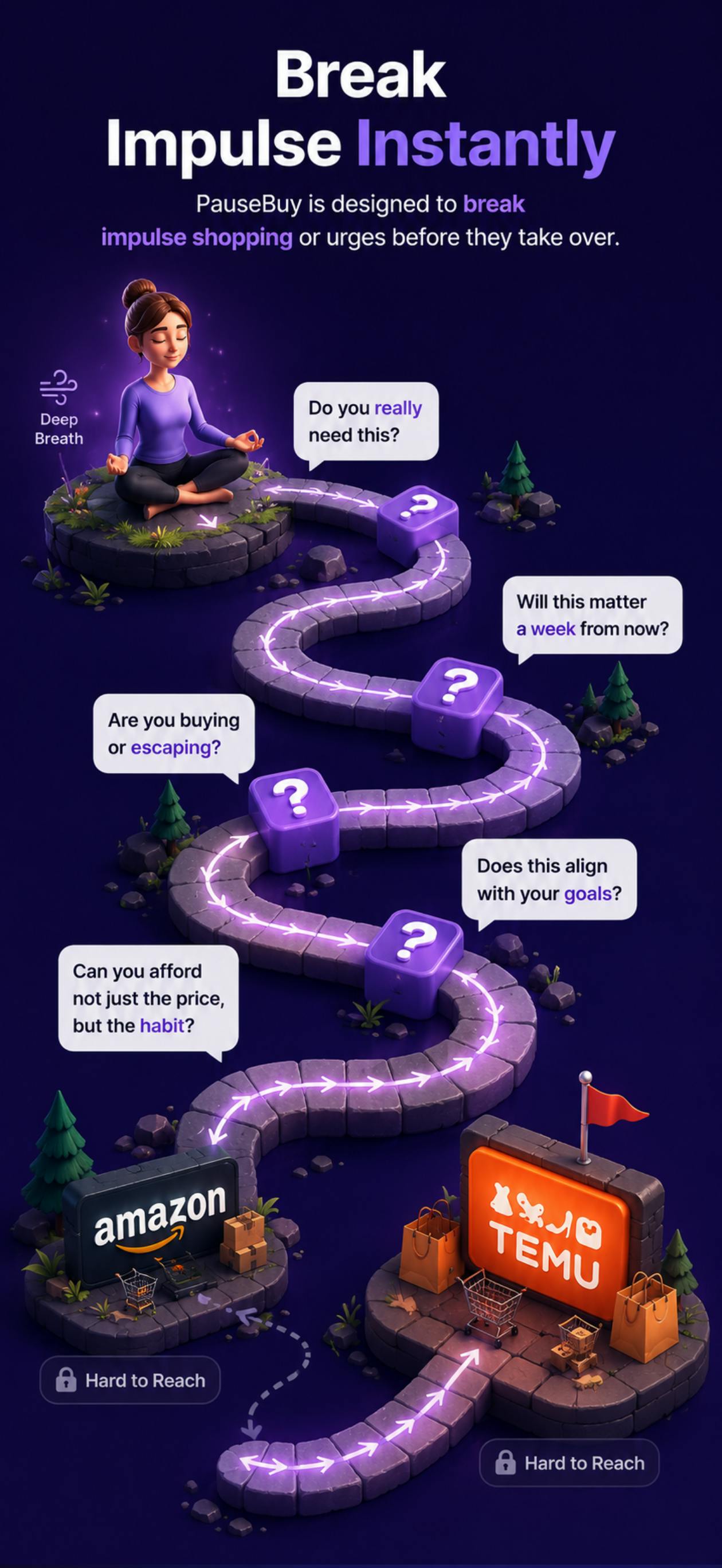
PauseBuy's core mechanism is interception. When users open mainstream shopping apps like Amazon, Temu, Shein, or Walmart, PauseBuy actively intervenes with a series of guided prompts, rather than letting you dive straight into mindless browsing and checkout.
This guidance operates on several levels:
- Personalized reminders: Based on goals you've set yourself, targeted prompts appear when you open a shopping app;
- Financial goal comparison: Connects the money you're about to spend with what you're saving for, creating a visual contrast;
- Reflection questions: Guided questions that prompt you to think "Is this purchase truly necessary?";
- Wishlist cooling-off period: Items you want to buy go into a list for a cooling-off period instead of being purchased immediately.
This design approach is known in behavioral economics as "creating friction." E-commerce platforms invest enormous effort in reducing purchase friction (one-click buying, password-free payments, personalized recommendations), while PauseBuy does the opposite — deliberately adding a thinking step into the consumer decision chain.
"Creating friction" is a concept extensively discussed by behavioral economists Richard Thaler and Cass Sunstein in their book Nudge. The core idea is that human decision-making isn't fully rational but highly dependent on choice architecture. The smoother the execution path and the fewer the steps, the more easily people complete an action without thinking. Conversely, even adding a tiny obstacle — like one extra confirmation click or a few seconds of waiting — can significantly change behavioral outcomes. E-commerce platforms understand this well. Amazon's "1-Click Patent" represents the ultimate in friction elimination, compressing the purchase decision into a single tap and removing all intermediate steps that might let users "cool down." What PauseBuy aims to do is put those deliberately removed "cooling moments" back in place.
From "Autopilot" to "Intentional Purchasing Decisions"
The product's value proposition is clearly stated: helping users transition from "autopilot purchasing" to "intentional purchasing decisions." Behind this lies an increasingly recognized phenomenon — the deep entanglement between the attention economy and impulse consumption.
The concept of the Attention Economy was first proposed by Nobel laureate Herbert Simon, referring to how in an information-overloaded environment, human attention becomes the scarcest resource. Social media and e-commerce platforms continuously compete for user attention through variable reward mechanisms, infinite scroll, and urgency design (such as "only 3 left" or "2-hour flash sale"). B.J. Fogg, founder of Stanford's Persuasive Technology Lab, points out in his Fogg Behavior Model that behavior occurs when three elements are simultaneously present: Motivation, Ability, and Trigger. E-commerce platforms use algorithmic recommendations to precisely stimulate motivation, simplified processes to enhance ability, and push notifications to create triggers — together making impulse consumption nearly inevitable.
Short-video recommendations, flash sales, and infinite-scroll feeds constantly stimulate users' immediate purchase desires. PauseBuy's approach is to insert a "speed bump" into this high-speed consumption loop, giving users a chance to reclaim control over their decisions.
PauseBuy Solves a Psychological Problem, Not a Technical One
You might not have noticed, but PauseBuy isn't a complex technical product. It has no flashy AI features and doesn't involve deep data analysis. At its core, it's a behavioral intervention tool.
Its effectiveness is built on psychological foundations: research shows that impulse purchases often happen within seconds, and simply inserting a pause and reflection moment during that window can significantly reduce the probability of irrational buying. Specifically, modern neuroscience research has found that impulse buying is primarily driven by the brain's reward system, particularly dopamine released by the nucleus accumbens. A classic 2007 study published in Neuron showed that when consumers see a desired product, the brain's pleasure center activates immediately, while the prefrontal cortex responsible for rational evaluation responds with a noticeable delay — meaning emotional decisions always outpace rational ones. The research also found that merely having subjects wait 10 seconds and answer a simple question before purchasing reduced impulse buying rates by approximately 40%. This is precisely the scientific basis for "pause" mechanisms like PauseBuy.
Similar approaches appear in abstinence-type apps — such as screen time management and focus apps — all attempting to help users build healthier habits by "interrupting inertia."
From this perspective, PauseBuy is more like an extension of the "digital wellbeing" category into the consumer domain. Digital wellbeing as a product category traces back to around 2018 — the year Google officially launched its Digital Wellbeing feature at I/O, while Apple simultaneously introduced Screen Time, marking the first time tech giants formally acknowledged that "technology overuse" was a problem worth solving. Since then, numerous related products have emerged: Forest uses gamification to help users reduce phone usage; One Sec forces a one-second breathing pause before users open social media; Opal blocks specific apps to help users reclaim attention. Together, these products form an "anti-tech addiction" ecosystem, all sharing the underlying logic of using technology to combat technology's own negative effects. PauseBuy extends this logic from social media and screen time management to consumer behavior, filling a gap in the "consumer mindfulness" niche.
Its target users are those who recognize their impulse shopping tendencies and actively want to improve.
Potential Challenges Facing PauseBuy
System Permission Barriers for the Interception Mechanism
To implement "automatically showing a reminder when a shopping app opens," PauseBuy requires significant system permissions, such as detecting foreground apps and overlay display windows. On Android, this specifically involves two key system permissions: UsageStatsManager for detecting which app is currently running in the foreground, and SYSTEM_ALERT_WINDOW for displaying content on top of other apps. Starting from Android 10 (API 29), Google tightened permissions for background app detection, requiring apps to obtain explicit user authorization to access usage data.
This is relatively feasible on Android but may face user concerns about permissions, as well as compatibility issues across different manufacturer systems (such as MIUI, ColorOS, HarmonyOS, and other heavily customized systems). On iOS, due to Apple's strict sandboxing mechanism, one app virtually cannot detect which other app the user is currently using, nor can it display overlay content on top of other apps. This is why such tools are extremely difficult to implement on iOS, and the fundamental technical reason PauseBuy currently supports only the Android platform.
Long-term User Retention Issues
All behavioral intervention tools face the same paradox: the people who need it most are also the most likely to turn it off. When someone is eager to buy something, a pop-up reminder is likely to be immediately dismissed.
This paradox is academically known as the "hot-cold empathy gap." Psychologist George Loewenstein's research shows that plans and commitments made in a cold state are often easily overridden in a hot state. You install PauseBuy and set your goals during a rational moment, but when the shopping urge hits, you're likely to think "just this once won't hurt" and skip the reminder.
Several strategies have been developed to address this: commitment devices, such as having users pre-set a rule like "if I dismiss the reminder, I donate to charity"; graduated restriction, escalating from light reminders to stronger interventions; and social accountability, binding consumption goals to friends or communities. Well-known savings app StickK and habit-building app Beeminder both employ a "stakes" model — users face financial penalties for not meeting goals — to solve this retention challenge.
Whether PauseBuy can design a guidance rhythm that's both binding and not annoying enough to trigger uninstalls will be key to its long-term value.
Room for Imagination in the Business Model
As a free or low-cost utility app, PauseBuy's monetization path remains unclear. It could pursue a subscription model (offering richer goal tracking and analytics), or integrate with personal finance and savings products. After all, "money saved for users" is itself a very compelling value anchor.
Conclusion: A Small but Beautiful "Anti-Consumerism" Mindfulness Tool
PauseBuy isn't a disruptive product — its feature list could even be called quite modest. But it targets a real and universal pain point: in a consumption environment meticulously designed by algorithms, ordinary people find it increasingly difficult to make truly rational purchase decisions.
It represents a product direction gaining growing attention: technology shouldn't only be used to push us to consume more — it can also help us consume more wisely. For those wanting to control spending and reduce shopping impulses, the "three-second pause" that PauseBuy offers may be worth more than any coupon.
Related articles

Amazon Bypasses Community Vote to Push AI Data Center: The Clash Between Compute Expansion and Local Governance
Amazon accused of bypassing community voting in Gilroy, CA to push AI data center project. Analysis of tech giants' data center expansion clashing with local governance over energy, water, and democratic rights.

Wails Cross-Platform Compilation in Practice: Current State and Best Practices
Deep dive into Wails cross-platform compilation challenges including CGO dependencies and native WebView limitations, with practical solutions like CI/CD pipelines and container toolchains.

OpenChamber: A Deep Dive into the Development Runtime Environment Built for AI Agents
Deep dive into OpenChamber's agentic development environment design and core capabilities. Learn why AI agents need dedicated isolated sandboxes and observable execution spaces.