Pauta: A Fully Offline Private Meeting Memory Vault
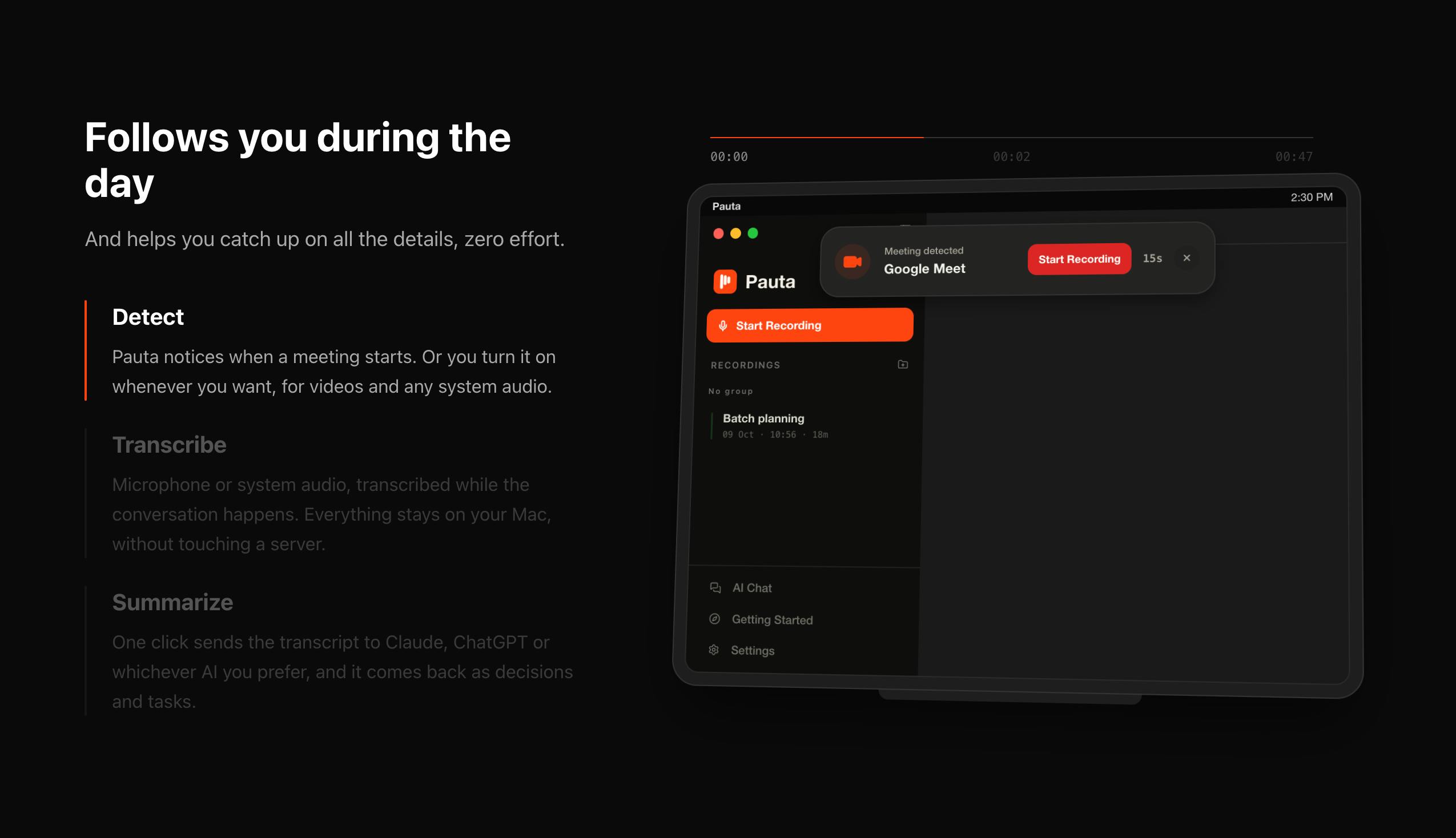
Pauta offers fully offline meeting transcription and summarization, trading local processing for data control.
Pauta is an AI meeting-notes tool that surfaced on Product Hunt, distinguished by its architecture: transcription, summarization, and action item extraction all run locally on-device, with no cloud upload and external AI connected only by user choice. It covers meetings, interviews, and voice notes, but key parameters like models, accuracy, and supported languages aren't disclosed. Its optional cloud AI toggle lets users tier processing by sensitivity. The article notes localized AI tools are driven by compliance pressure and on-device compute advances, but face performance and iteration ceilings. The product is early-stage with only 5 comments, and real-world quality and stability remain unverified.
Pauta: A Private Memory for Every Conversation You Have
At a time when AI meeting-notes tools almost universally rely on cloud processing, a product on Product Hunt is going the opposite direction — Pauta. Its proposition is straightforward: record and transcribe meetings, interviews, and voice notes, then distill summaries and action items, but with everything running fully offline, with data staying only on your device, and connecting to external AI only when you actively choose to.
The product received 66 upvotes and 5 comments on Product Hunt, ranking 11th for the day, and is categorized under privacy, artificial intelligence, and audio. For users who care about data sovereignty, this positioning alone is worth paying attention to.
Offline-First: Treating Privacy as Product Architecture
The core differentiator of Pauta isn't its feature list — it's the architectural choice. The workflow of most comparable tools is: upload recording to the cloud → server-side transcription → LLM generates summary → results sent back. This chain means your meeting content passes through third-party servers at least once, and may even be used for model training.
Pauta moves this entire chain onto the local device. Transcription and summary generation happen on-device, and data never leaves the device. The official description explicitly states it "works fully offline" and "only connects to external AI if you choose" — external AI is an optional enhancement, not a required step.
This design philosophy addresses a real pain point: corporate meetings, doctor interviews, lawyer consultations, and media interviews often involve trade secrets or personal information, and many organizations simply don't allow recordings to be uploaded to external services. Pauta's answer is that rather than crafting clever privacy policies, it's better to ensure data physically never leaves the device.
On-device Inference is the key concept for understanding Pauta's architecture. It refers to running AI models locally on the user's device (phone, laptop) to perform computation, rather than sending data to cloud servers. Its technical foundations include model quantization (compressing large models to a size devices can handle), dedicated inference frameworks (such as llama.cpp, ONNX Runtime, Core ML), and hardware acceleration using NPU/GPU. The biggest advantage of on-device inference is that data never leaves the device, naturally satisfying privacy and compliance requirements; the cost is limited model size, inference speed dependent on device performance, and quality on complex tasks that is usually lower than cloud-based large models. Pauta placing transcription and summarization in local execution is a typical application of on-device inference.
Transcription, Summaries, Action Items: A Complete Local Pipeline
Functionally, Pauta covers the standard trifecta of meeting-notes tools:
- Recording and transcription: handles three input scenarios — meetings, interviews, and voice notes.
- Summary generation: compresses long conversations into quickly scannable key points.
- Action item extraction: identifies to-dos from conversations — the step where meeting tools actually deliver work value.
The difference is that all three steps execute locally. The original text doesn't disclose the specific transcription or summary models used, nor does it provide parameters such as accuracy or number of supported languages, so it's impossible to judge the actual gap between its transcription quality and cloud-based solutions. Considering that local compute is typically weaker than cloud GPU clusters, transcription accuracy and long-audio processing speed may be variables that require hands-on testing to confirm.
You might not have noticed that Pauta retains a toggle for "optional connection to external AI." This means users can tier their usage by scenario: confidential content processed purely locally, non-sensitive content sent to stronger cloud models in exchange for quality. This hybrid strategy is more pragmatic than a pure either-or choice.
Speech-to-Text (ASR) is the technology that converts audio signals into text, and mainstream approaches have shifted from traditional acoustic models to end-to-end neural networks (such as the Whisper series and its distilled, quantized versions). The core metric for evaluating transcription quality is word error rate (WER), and factors affecting WER include accents, background noise, specialized terminology, and overlapping multiple speakers. Cloud solutions typically use large-parameter models combined with speaker diarization, while local solutions must compromise between model size and accuracy. Action item extraction is an information extraction task, typically performed by large language models identifying "who will complete what by when" from transcribed text; its accuracy depends heavily on the quality of the transcribed text and contextual understanding. The original text doesn't disclose the specific models Pauta uses, so these metrics can only be assessed through actual testing.
Privacy-Focused AI Tools Are Forming Their Own Track
Pauta's appearance is not an isolated case. From locally running large language models to on-device inference voice assistants, "data never leaves the device" is transforming from a geek toy into a clear product proposition. There are two driving factors:
Compliance pressure. Personal information protection regulations across regions are imposing increasingly detailed requirements on cross-border data transfer and third-party processing, and enterprises are beginning to treat data flows as a hard threshold when procuring tools.
Compute moving to the edge. The inference capability of end devices continues to strengthen, making it possible to localize transcription and summarization tasks that previously had to rely on the cloud. The feasibility of products like Pauta is fundamentally built on advances in on-device compute.
However, this track also has an obvious ceiling. Local processing means you can't enjoy the scale advantages of cloud-based large models, and feature iteration speed, multilingual coverage, and robustness in complex scenarios may all lag behind. Whether Pauta can find the balance point between "private enough" and "good enough" will determine whether it can move from a privacy niche to the mainstream.
Cross-border data transfer and third-party processing are core concepts in privacy compliance. Taking the EU's GDPR as an example, transferring personal data abroad or handing it to third-party processors requires meeting specific legal conditions and signing data processing agreements; recordings in industries such as healthcare and legal may also constitute sensitive personal information, with even higher processing thresholds. This means that when enterprises procure meeting-notes tools, they must not only look at the wording of privacy policies but also review data flows, storage locations, and retention periods. Pauta's design of "data physically never leaving the device" directly bypasses the compliance chain of third-party processing and cross-border transfer — which is the structural reason it appeals to users in regulated industries.
Who Should Pay Attention to Pauta
From its product positioning, Pauta's target user profile is fairly clear: professionals and small teams sensitive to data flows. Typical scenarios include confidential business meetings, interview records involving personal privacy, and voice memos that are inconvenient to upload to the cloud.
For ordinary users who just record daily meetings and don't care about cloud processing, mature cloud tools will likely have advantages in transcription accuracy and collaboration features. Pauta's value proposition is a trade-off: accepting possible performance compromises in exchange for definite data control.
The product is currently in an early exposure phase on Product Hunt, with only 5 comments, so the community feedback sample is still very small. Key metrics such as transcription quality, local resource consumption, and stability during long meetings still need more real-world usage data to verify. For privacy-first meeting-notes needs, it's a new option worth adding to the candidate list, but it's too early to draw conclusions.
One-line Summary
Pauta focuses on fully offline meeting transcription and summarization, trading local processing for data control.
Paragraph Summary
Pauta is an AI meeting-notes tool that surfaced on Product Hunt, and its core difference lies in its architecture: recording transcription, summary generation, and action item extraction all happen on the local device, with data not uploaded to the cloud and external AI connected only when the user actively chooses. It covers three scenarios — meetings, interviews, and voice notes — but the original text doesn't disclose key parameters such as the models used, transcription accuracy, or supported languages. Its "optional cloud AI" toggle allows users to tier processing by content sensitivity, balancing privacy and quality. The article notes that localized AI tools are driven by both compliance pressure and advances in on-device compute, but face ceilings in performance and iteration speed. The product is currently in an early stage, with a community feedback sample of only 5 comments, and its actual quality and stability still need verification.
Related articles
 Tech Frontiers
Gemini Omni 1.2 Flash: AI Video Moves Toward Draft-Style Editing
Google's Gemini Omni 1.2 Flash update enables conversational, draft-style editing of the same video—swap scenes while keeping products, adjust lighting while keeping characters. Clips up to 15s, 720p costs 30% less than the previous Flash—ideal for e-commerce ads, previs, and short-asset production.

Codex Tutorial: One-Command Install and Run Your First Task
Codex tutorial: one-command install and run your first task. Covers the four Codex forms, sandbox and approval guardrails, AGENTS.md and MCP configs, cloud network policy, and the iron rule of human review—everything you need to get started with this autonomous coding agent.
 Tech Frontiers
Localix: An Open-Source Agentic Development Environment with Multi-Model and Local AI Integration
Localix is an MIT open-source Agentic Development Environment (ADE) supporting seamless Claude Code plugin loading, multi-model cloud and local execution, Mini Apps extensions, and agent context management—an open AI collaboration workbench for developers.