Pawesome Deep Dive: How an AI-Native B2B Inbound Marketing Engine is Reshaping SaaS Customer Acquisition

Pawesome is an AI-Native inbound marketing engine unifying content, leads, and analytics for B2B SaaS.
Pawesome is a new AI-Native inbound marketing engine for B2B SaaS companies that integrates content generation, lead collection, and analytics into a single platform powered by a contextual "company brain." By deeply understanding enterprise context, it aims to replace fragmented marketing tool stacks and form a complete inbound marketing closed loop, though it faces challenges around content quality, onboarding costs, and competition from AI-enhanced incumbents like HubSpot.
What is Pawesome
In the B2B SaaS marketing space, a long-standing pain point persists: content production, lead collection, and data analytics are often scattered across different tools. Teams need to switch between multiple platforms, resulting in low efficiency and difficulty forming a closed loop. According to chiefmartec.com, the number of global marketing technology tools exceeded 14,000 in 2024, spanning dozens of subcategories including content management, email marketing, CRM, and analytics. A typical B2B SaaS marketing team might use 5-15 tools simultaneously, and this fragmentation leads to data silos, broken workflows, and high maintenance costs. Pawesome, which recently debuted on Product Hunt, attempts to solve this challenge with an AI-Native approach.
According to its Product Hunt listing, Pawesome positions itself as a "full-stack AI Native Inbound Marketing Engine" for B2B SaaS companies. It integrates three core capabilities: Content Engine, Lead Collection, and Analytics — all built on top of "a brain that knows your company."
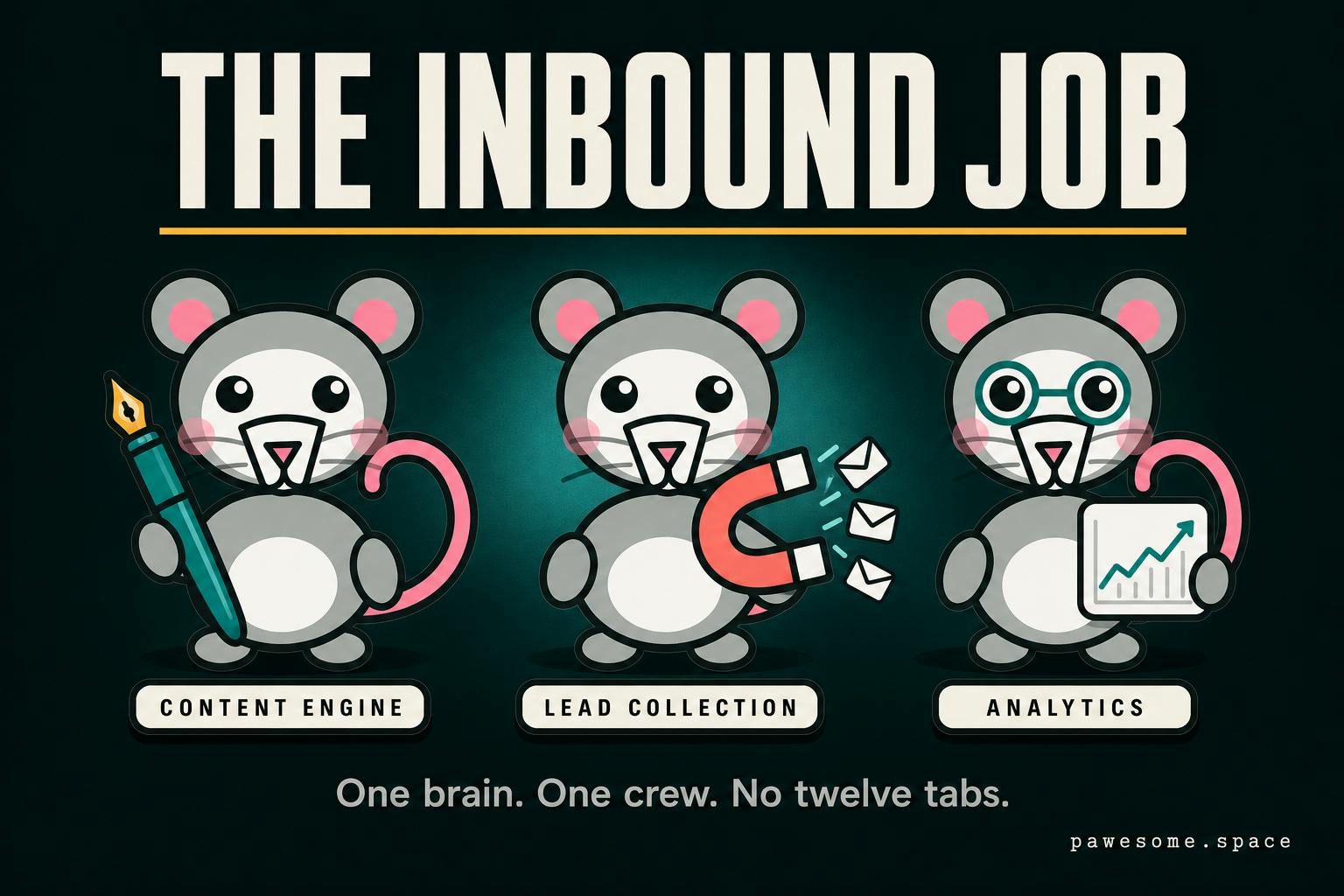
The product currently has 48 upvotes and 14 comments on Product Hunt, ranking #16 for the day, categorized under Marketing, SaaS, and Artificial Intelligence. While still in its early stages, its "AI-Native" positioning reflects an important trend in the evolution of marketing technology stacks.
The Fundamental Difference Between AI-Native and AI-Enhanced
What Does "AI-Native" Mean?
In recent years, virtually every marketing tool has claimed to "integrate AI." But there's a fundamental difference between "AI-Native" and "AI-Enhanced." Traditional tools layer AI feature modules on top of existing product frameworks — for example, adding a button that auto-generates copy. AI-Native products, however, are designed from the ground up with AI at the core of the entire workflow.
From a technical standpoint, AI-Native architecture means the product is designed with large language models or machine learning pipelines at the center — from data models and workflow orchestration to the user interaction layer. In contrast, AI-Enhanced products typically add auxiliary capabilities by calling models like GPT via API on top of existing deterministic software logic. A distinguishing characteristic of AI-Native products is that their core value proposition cannot exist without AI — every system interaction goes through model reasoning, rather than triggering AI only at specific feature points. The advantage of this architecture is cross-module context sharing and continuous learning, but the challenge lies in controlling model hallucinations and ensuring output reliability.
Pawesome's emphasis on "a brain that knows your company" embodies this philosophy. It means the system continuously learns about the enterprise's business context, product positioning, target customers, and brand tone, using this as the foundation to drive content generation, lead identification, and data insights — rather than executing isolated, single-point tasks.
How the Three Engines Work Together to Form a Marketing Closed Loop
Pawesome integrates content, leads, and analytics into a unified platform, with the value lying in forming a complete inbound marketing closed loop. It's worth revisiting the concept of inbound marketing here — it's a marketing methodology proposed by HubSpot co-founders Brian Halligan and Dharmesh Shah in 2006. The core idea is to attract potential customers by creating valuable content that draws them in proactively, as opposed to traditional outbound marketing tactics like cold emails and telemarketing. In the B2B space, inbound marketing typically includes SEO-optimized blog posts, white papers, webinars, case studies, and other content formats, with the goal of building brand trust during the buyer's information-gathering phase.
Pawesome's three engines are built around this methodology:
- Content Engine: Generates blog posts, landing pages, and other inbound content based on enterprise knowledge, solving the core B2B marketing challenge of "continuously producing high-quality content"
- Lead Collection: Converts visitor traffic into actionable sales leads, improving the conversion rate from traffic to opportunities
- Analytics Module: Tracks content performance and conversion effectiveness, feeding back into content strategy optimization so each iteration becomes more precise
When all three share the same "company brain," it theoretically enables automatic data flow from content reach to lead conversion to performance analysis, avoiding the data fragmentation problems inherent in traditional tool chains.
Why Focus on the B2B SaaS Vertical
You might not have noticed, but Pawesome explicitly positions itself as serving B2B SaaS companies rather than being a generalized marketing tool. This is a strategically significant choice.
B2B SaaS marketing has distinct characteristics: long sales cycles, complex decision chains, and high importance of content marketing (Inbound Marketing). Specifically, B2B SaaS purchase decisions typically involve 3-7 stakeholders, with average sales cycles ranging from 3-9 months and deal sizes from thousands to hundreds of thousands of dollars. This means marketing content needs to simultaneously address the information needs of different roles: technical decision-makers focus on architecture and integration capabilities, business decision-makers focus on ROI and efficiency gains, and procurement departments focus on compliance and security. Additionally, SaaS's subscription model makes the ratio of Customer Acquisition Cost (CAC) to Customer Lifetime Value (LTV) a core business metric, requiring marketing teams not only to acquire leads but to ensure lead quality is high enough to support a healthy unit economics model.
Compared to B2C impulse purchases, B2B buyers typically proactively learn about products through search, reading technical blogs, white papers, and similar channels — this is precisely where inbound marketing excels. Therefore, an AI engine that deeply understands SaaS business logic can better address the actual needs of these customers than a general-purpose marketing tool.
This vertical focus is also a common strategy among current AI startups — rather than competing head-on with giants in a massive general market, it's better to build moats through deep understanding in niche scenarios.
Pawesome's Opportunities and Challenges
Potential Value for B2B Teams
For resource-constrained B2B SaaS startup teams, the appeal of tools like Pawesome is obvious: replacing the combination of content tools, CRM forms, and analytics tools with a single integrated platform reduces both costs and the expense of connecting data between tools. For growth-stage SaaS companies with tight budgets but an urgent need to establish an inbound marketing system, this is an option worth considering.
Key Questions to Watch
However, as an early-stage product, Pawesome still faces several critical tests:
- Content Quality: Can AI-generated B2B content meet the standards of professionalism and credibility required? This directly impacts inbound effectiveness
- Cost of Building the "Company Brain": How much enterprise data and how much time does the system need to truly "know" a company?
- Competition with Mature Tools: Mature platforms like HubSpot are also rapidly incorporating AI. Pawesome needs to prove the differentiated value that its "AI-Native" architecture delivers
Regarding the third point, it's worth elaborating on the AI progress of industry giants. HubSpot, as the benchmark company in the inbound marketing space, has intensively launched AI features since 2023, including Content Assistant, ChatSpot (conversational CRM operations), and Breeze AI — a platform-wide AI layer introduced in 2024. Salesforce launched Einstein GPT, and Marketo (Adobe) is also integrating Firefly and Sensei AI capabilities. These giants' AI strategies primarily involve layering generative AI capabilities onto existing product matrices. Their advantage lies in massive existing customer bases and data accumulation, but their disadvantage is that legacy architecture baggage may limit the depth of AI integration — this is precisely the window of opportunity that AI-Native newcomers like Pawesome are trying to seize.
Summary: The Future Direction of AI-Native Marketing Engines
Pawesome represents a microcosm of the marketing technology stack's evolution from a "collection of tools" to an "AI-Native unified engine." Its core proposition — using an AI brain that understands the enterprise to connect content, leads, and analytics — addresses a real pain point in B2B SaaS marketing.
Of course, there's still a long road from early Product Hunt buzz to true market validation. For practitioners focused on marketing automation and AI application deployment, Pawesome is worth continued observation. Whether it can find its foothold amid the AI transformation wave of giants like HubSpot will be an important case study for testing the commercial value of the "AI-Native" concept.
Related articles

Getting Started in Machine Learning Research: Essential Paper Reading List and Research Internship Application Path
A complete path from zero to research internship for ML beginners, covering essential classic papers (AlexNet, ResNet, Transformer), paper reading methods, reproduction tips, and practical advice for research internship applications.

Claude Code Hands-On Tutorial: Complete Guide from Installation to Automated Development
Complete guide to Claude Code covering environment setup, permission configuration, Go Goals autonomous loops, Skills system, MCP protocol integration, and version control for automated development.

Gemini 3.7 Flash Release and GPT-5.6 Ultra-Fast Mode: AI Open Source Enters the Ecosystem Era
Google releases Gemini 3.7 Flash for coding and Agent optimization while OpenAI launches GPT-5.6 Ultra-Fast mode with 14x speed gains. AI open source shifts from open models to open ecosystems.