PCEI Goes Open Source: BitNet + Mamba + FastKAN Power On-Device Embodied Intelligence

PCEI combines BitNet ternary quantization, Mamba, and FastKAN to bypass the memory wall of on-device embodied intelligence.
PCEI is an open-source on-device embodied intelligence project assembling three technologies: BitNet 1.58b ternary quantization cuts parameter memory ~4x, Mamba eliminates KV Cache growth with constant memory, and FastKAN handles 4-stream continuous motion control in MuJoCo. Supporting Mac Apple Silicon and Linux/CUDA, it uses MIT-NC license. Of its 11 papers, one proves an irrecoverable Shannon information loss factor setting a theoretical performance ceiling. Experiments remain simulation-only.
Running embodied intelligence models on-device has always been bottlenecked by memory. The KV Cache of standard Transformer architectures grows linearly with sequence length, and storing parameters in FP16 also takes considerable space. An open-source project called PCEI (Physically Constrained Emergent Intelligence) is trying to sidestep this wall by combining three technologies.
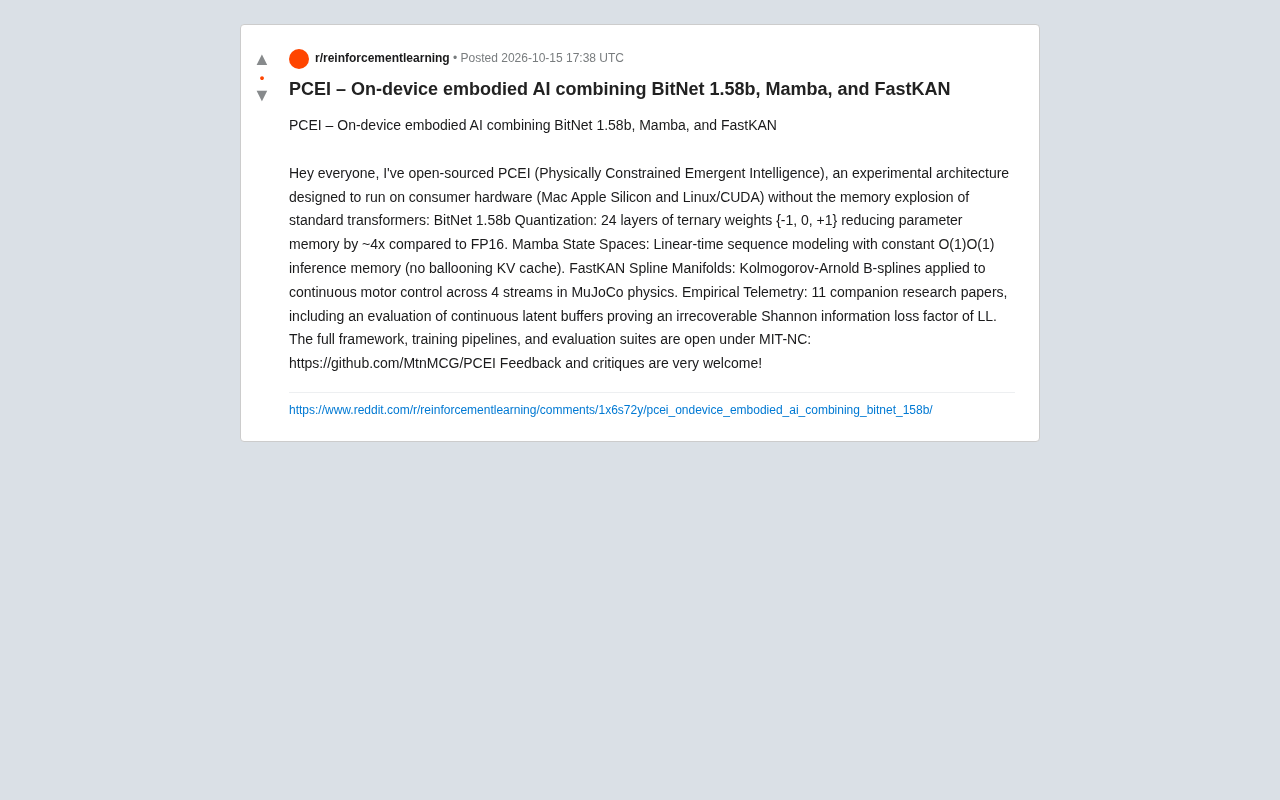
The Rationale Behind the Three-Layer Stack
PCEI's core approach can be summed up in one sentence: use BitNet to compress parameters, use Mamba to eliminate the KV Cache, and use FastKAN to handle continuous control signals. The division of labor among the three is very clear.
BitNet 1.58b quantization handles the weight level. All 24 layers use ternary weights {-1, 0, +1}, directly reducing parameter memory by about 4x compared to FP16 precision. The number 1.58b comes from log₂(3)≈1.58, i.e., the amount of information each weight carries. This extreme quantization allows integer addition to replace floating-point multiplication during inference, further lowering the compute requirements for edge devices.
Mamba state space model handles sequence modeling. Unlike Transformer's attention mechanism, Mamba achieves linear-time-complexity sequence processing through state space recurrence, with constant memory usage during inference that doesn't balloon with context length the way KV Cache does. This is especially critical for embodied intelligence scenarios—robots need to continuously receive sensor streams, and sequences only get longer.
FastKAN spline manifold handles the output level. Kolmogorov-Arnold Networks replace the fixed activation functions of traditional MLPs with B-splines, and FastKAN is its efficient implementation. In PCEI, FastKAN is used for continuous motion control in the MuJoCo physics engine, simultaneously handling 4 control streams. Continuous control signals are naturally suited for fitting with spline functions, which is the core reason for choosing KAN over MLP.
Why KV Cache is the bottleneck for on-device memory: During autoregressive generation, each time a Transformer produces a new token, it must cache the Key and Value tensors of all previous tokens for reuse in attention computation—this is the KV Cache. Its memory footprint is proportional to sequence length, number of layers, number of attention heads, and head dimension, growing linearly with context. For scenarios like robotics that continuously receive sensor streams, sequences extend almost infinitely, and the cache quickly fills up VRAM, becoming a hard ceiling. Mamba compresses historical information into a fixed-size hidden state through state space recurrence, decoupling inference memory from sequence length—a structural replacement precisely targeting this bottleneck.
The essential difference between KAN and MLP: Traditional multi-layer perceptrons place activation functions (like ReLU) at fixed positions, with learnable parameters concentrated in the weights; Kolmogorov-Arnold Networks do the opposite, placing learnable univariate functions (typically parameterized with B-splines) on the edges, with weight nodes performing no nonlinearity. This structure derives from the Kolmogorov-Arnold representation theorem and can theoretically approximate complex functions with fewer parameters, excelling particularly at fitting smooth continuous mappings. The piecewise polynomial nature of B-splines gives them a natural approximation advantage for continuous control signals, which is why PCEI chose FastKAN over MLP for continuous motion control. The cost is higher engineering complexity in spline computation and parameter initialization, and FastKAN is the efficiency-optimized implementation.
Engineering Constraints Matter More Than Architecture Choices
The phrase "Physically Constrained" in PCEI's full name is easy to overlook. It hints at the project's design starting point: not designing architecture first and then considering deployment, but working backward from hardware constraints to architecture.
The real constraints of consumer-grade hardware include: Mac Apple Silicon's unified memory architecture, CUDA devices' VRAM limits, and the latency requirements for real-time inference in robotics scenarios. The three technical components each address one type of constraint—BitNet solves storage constraints, Mamba solves memory growth constraints, and FastKAN solves control precision constraints.
The project supports both Mac Apple Silicon and Linux/CUDA paths, covering the main hardware choices of current on-device AI developers. The training pipeline and evaluation suite are fully open-sourced under the MIT-NC license.
The significance of unified memory architecture: Mac Apple Silicon uses a UMA design where CPU and GPU share the same physical memory pool, eliminating the explicit copying between VRAM and main memory in traditional PCIe setups. It also means the "VRAM" available to the model equals total system memory, which must be shared with the OS and other processes. For on-device embodied intelligence, this is both advantageous (larger models can be loaded) and constraining (bandwidth is contested by multiple parties, and it cannot monopolize large-capacity VRAM like a discrete GPU). PCEI supporting both Mac and CUDA paths is effectively validating the same architecture on two fundamentally different memory models and scheduling strategies.
What's Hidden in the 11 Companion Papers
The PCEI author mentions the project comes with 11 research papers, one of which—on the evaluation of continuous latent buffers—deserves special mention. That paper demonstrates an "irrecoverable Shannon information loss factor," meaning that in the compression process of continuous latent spaces, there exists theoretically irreversible information loss—not because the engineering implementation is insufficient, but because it's a hard lower bound from information theory.
This conclusion has multiple implications. On one hand, it draws a line under the performance ceiling of continuous latent representation methods; on the other hand, it provides a quantitative tool for understanding the information bottleneck in the "perception-decision-action" chain of embodied intelligence. How exactly this loss factor is derived and under what conditions it holds requires consulting the original paper to determine its applicability boundaries.
The number of 11 papers is quite impressive for a one-person open-source project, but the peer review status and experimental reproducibility of these papers also warrant attention.
Background on the Shannon information loss factor: Shannon information theory uses entropy to characterize the average amount of information a source carries under optimal encoding, with the core conclusion that any lossy compression has an insurmountable lower bound—once discarded information exceeds source redundancy, lossless recovery is impossible. The so-called "irrecoverable Shannon information loss factor" refers to the theoretical hard lower bound on the portion of information discarded when compressing continuous latent representations into finite dimensions, independent of the engineering implementation of the compression algorithm. This means continuous latent space methods have a performance ceiling that cannot be broken merely by tuning parameters. Understanding this helps assess how far architectures like PCEI can go on the perception-decision chain.
The Route Debate in On-Device Embodied Intelligence
PCEI represents a "extreme compression + linear architecture" technical route, which fundamentally diverges from another route of "distilling large models to the edge."
The compression route's advantage lies in the determinism of inference efficiency—memory usage and computation both have clear upper bounds. The disadvantage is that expressiveness may be limited; after all, the information capacity of ternary weights is finite. The distillation route retains more parameter precision, but its adaptation to edge hardware depends on the quality of the distillation strategy, and the Transformer's KV Cache problem still exists (unless combined with other attention optimizations).
PCEI's experiments are concentrated in the MuJoCo simulation environment. Sim-to-real transfer is a classic challenge in embodied intelligence, and whether FastKAN's spline fitting capability demonstrated in MuJoCo can generalize to the noisy environments of real robots remains unknown.
The project author explicitly states "feedback and criticism welcome" at the end of the Reddit post—an open attitude that is important for iterating on experimental architectures. If you've run similar on-device inference pipelines on Mac or CUDA devices, PCEI's code and papers are worth a look.
One-line Summary
PCEI combines BitNet ternary quantization, Mamba, and FastKAN to try to bypass the memory wall of on-device embodied intelligence.
Paragraph Summary
PCEI is an open-source on-device embodied intelligence project whose core is assembling three technologies into a physically-constrained architecture: BitNet 1.58b ternary quantization reduces parameter memory by about 4x, Mamba state space models eliminate KV Cache growth with constant memory, and FastKAN spline networks handle 4-stream continuous motion control in MuJoCo. The project emphasizes deriving design from hardware constraints, supports both Mac Apple Silicon and Linux/CUDA inference paths, and uses the MIT-NC license. Among its 11 companion papers, one proves an irrecoverable Shannon information loss factor in continuous latent space compression, drawing a theoretical boundary for such methods' performance ceiling. Experiments remain simulation-only; sim-to-real transfer and paper review status await verification.
Related articles

Chain of Thought Isn't Just for AI: How Humans Can Use CoT to Improve Thinking Quality
Chain of Thought isn't just a prompt trick for large models. Starting from a Hacker News discussion, this article analyzes why CoT works for human thinking too, breaks down actionable ways to transfer it, and highlights the key differences between human CoT and machine CoT.
Cloudflare Teams Up with OpenAI: Closi…
Cloudflare Teams Up with OpenAI: Closing the Loop from Vulnerability Discovery to Defense with AI
Cloudflare uses OpenAI Daybreak to investigate security vulnerabilities and generate reviewable remediation plans, while developers use Codex to boost coding efficiency and quality.

Orca Multi-Agent Orchestration in Practice: A Guide to Parallel Collaboration with Claude and Codex
Orca is Stable AI's free open-source agent workbench supporting 34 agents like Claude Code and Codex in parallel. Learn its Git worktree isolation, multi-model orchestration, and mobile management.