PDF Document Auto-Classification in Practice: Why Embedding Models Fall Short and Better Alternatives

Why embedding similarity fails for PDF classification and three proven alternatives.
This article analyzes why using embedding models like bge-m3 for PDF document classification via similarity matching is unreliable, due to label description sensitivity, long-document semantic dilution, and lack of reasoning ability. It presents three superior approaches: direct LLM classification, embedding features with supervised classifiers, and multimodal structure/metadata feature fusion, along with practical implementation guidance.
The Problem: The Challenge of Automated Technical Document Classification
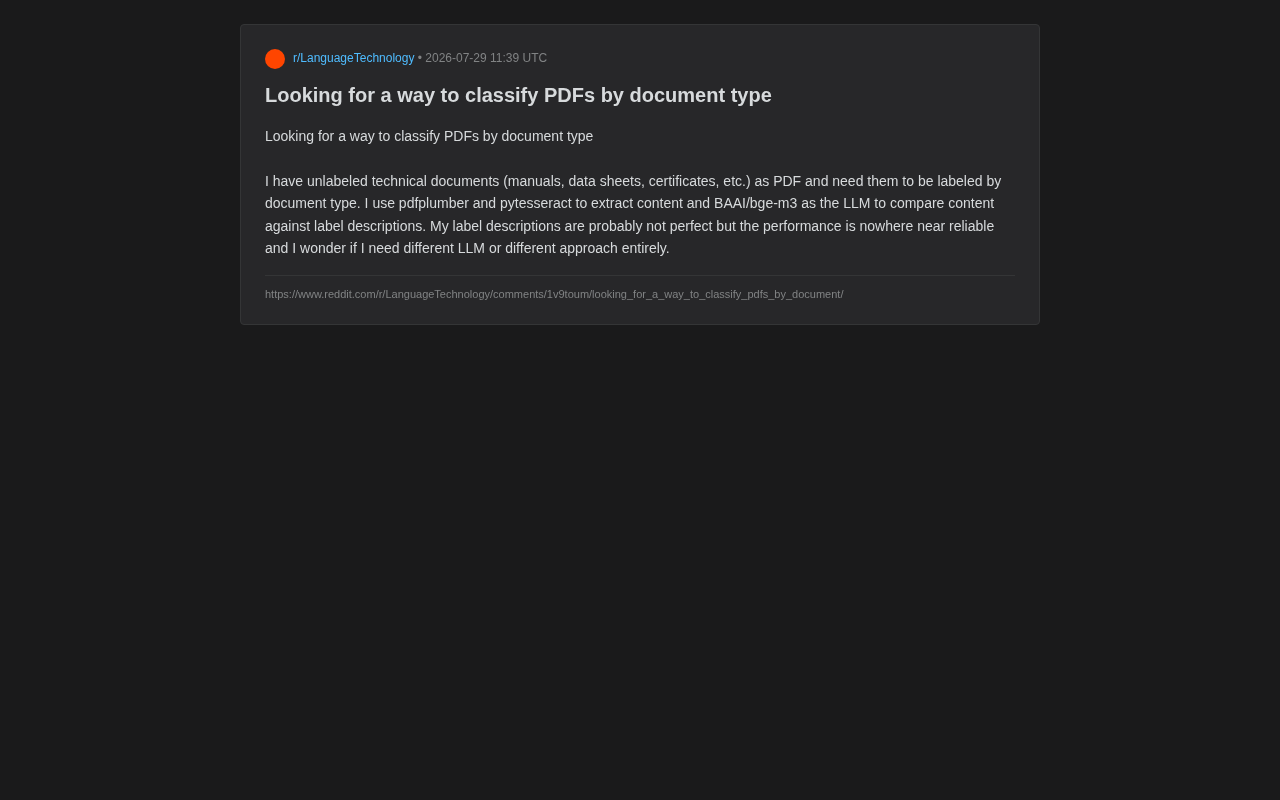
In enterprise digital transformation, automatically classifying massive volumes of unlabeled technical documents (such as product manuals, datasheets, certification certificates, etc.) by type is a common yet tricky engineering problem. Recently, a developer shared their practical dilemma on Reddit: they used pdfplumber and pytesseract to extract PDF content, then employed BAAI/bge-m3 as an embedding model to compare document content against preset label descriptions via similarity matching — but the classification results were far from reliable.
This case is highly representative, exposing a core misconception many people have when building document classification systems — using an Embedding Model as a classifier. This article will analyze the root cause of this problem in depth and provide more reliable technical approaches.
Why Embedding Similarity Cannot Replace Classification
The Positioning and Limitations of bge-m3
First, we need to clarify a conceptual misconception. The original poster referred to BAAI/bge-m3 as an LLM (Large Language Model), but strictly speaking, bge-m3 is a text embedding model. Its purpose is to map text into vectors for semantic retrieval and similarity computation — not for direct classification reasoning.
bge-m3 was developed by the Beijing Academy of Artificial Intelligence (BAAI), with M3 standing for Multi-Linguality, Multi-Functionality, and Multi-Granularity. The model supports over 100 languages and can simultaneously perform dense retrieval, sparse retrieval, and multi-vector retrieval, with a maximum input length of 8192 tokens. It excels on benchmarks like MTEB (Massive Text Embedding Benchmark), but its core design objective is semantic retrieval — optimized through contrastive learning for vector distances between semantically similar texts, not for discriminative boundaries between categories. This design intent determines that it is not suitable for direct use as a classification tool.
The idea behind using embedding similarity for classification is: convert each label description into a vector, convert the document content into a vector, compute cosine similarity, and select the closest label. Mathematically, cosine similarity measures directional consistency by computing the cosine of the angle between two vectors, with a range of [-1, 1]. When used for zero-shot classification, it's essentially doing nearest-neighbor matching in high-dimensional space — comparing the document vector against each label description vector and selecting the label with the smallest angle. This method barely works when label semantics are clear and document content is clean, but it has several fatal weaknesses:
- High sensitivity to label description quality: The author themselves acknowledged that "label descriptions may not be perfect." The entire approach's effectiveness depends almost entirely on manually written label descriptions — once descriptions are vague or don't match actual document wording, similarity calculations become distorted.
- Semantic dilution in long documents: Technical manuals often span dozens of pages, and compressing all content into a single vector loses critical discriminating information. Datasheets and manuals may share substantial overlapping terminology, making vectors difficult to distinguish. For example, a product datasheet and a product manual may describe the same product, resulting in very close vectors in embedding space, yet they belong to completely different document types.
- Lack of reasoning capability: Classification often requires "understanding" a document's structure and intent, not just lexical-level semantic similarity. A true classifier needs to learn discriminative hyperplanes or nonlinear decision boundaries, which should be learned from labeled data rather than implicitly defined by manually specified label descriptions.
The Impact of OCR Noise on Classification Performance
Another easily overlooked issue lies in the content extraction stage. pytesseract is a Python wrapper for Google's Tesseract OCR engine. While it's open-source, free, and supports multiple languages, its architecture based on traditional LSTM networks has clear limitations when handling complex layouts. Multi-column layouts, nested tables, mathematical formulas, and engineering drawing annotations common in technical documents often lead to significantly higher error rates. This OCR noise further contaminates downstream embedding representations, creating error accumulation — incorrectly recognized characters generate tokens that deviate from correct semantics, producing distorted vector representations, and ultimately making similarity calculations unreliable.
Three More Reliable PDF Document Classification Approaches
Approach 1: Direct LLM Classification
For this type of task, directly using a true large language model (such as GPT-4o, Claude, Qwen, etc.) for classification often yields significantly better results. The core idea is to construct a clear prompt:
You are a document classification expert. Please determine which type the following document belongs to:
- manual (product manual)
- datasheet (data sheet)
- certificate (certification certificate)

Document content excerpt:
{extracted first 1000 characters}

Return only the type name.
LLMs possess genuine semantic understanding and reasoning capabilities, making judgments based on document structural features, language style, and domain-specific terminology. They don't require carefully designed "label description vectors" — just clear category definitions. To control costs, you can extract only the first few pages or key pages (such as the cover page, table of contents) to feed into the model. The advantage of this approach is that it works zero-shot without labeled data, and its robustness to document formats is far superior to vector similarity-based methods.
Approach 2: Embedding Features + Supervised Learning Classifier
If document volumes are massive, cost control is needed, and some labeled data is available, then supervised learning is the more engineering-oriented choice. The workflow is:
- Use an embedding model (bge-m3 is still usable) to convert documents into feature vectors;
- Instead of doing similarity comparison, train a lightweight classifier (such as logistic regression, SVM, XGBoost);
- Train with a small number of manually labeled samples (dozens to hundreds per class).
This "embedding + classification head" combination is far more reliable than pure similarity matching because the classifier learns discriminative boundaries between different categories rather than relying on manual descriptions. In this architecture, the embedding model maps documents to fixed-dimensional feature vectors (bge-m3 outputs 1024 dimensions), while the classifier learns decision boundaries in this feature space. Compared to end-to-end fine-tuning of the entire embedding model, this method has extremely low training costs — logistic regression or SVM can complete training in seconds on a few hundred samples. More importantly, the classifier automatically discovers which feature dimensions are most important for distinguishing categories, without relying on humans' subjective understanding of label descriptions. In practice, even with only 30-50 labeled samples per class, this method typically exceeds zero-shot similarity matching accuracy by 10-20 percentage points.
Approach 3: Structure and Metadata Feature Fusion
Technical document types are often strongly correlated with their layout structure. Datasheets typically contain numerous tables and parameters, certificates have fixed layout templates and stamp positions, and manuals have chapter tables of contents. Therefore, the following features can be fused:
- Text content features (keywords, terminology frequency)
- Layout features (number of tables, page count, image ratio)
- Metadata (filename, PDF properties, generating software)
This multimodal feature fusion approach has been proven more effective than pure text methods in the document understanding field. The most representative example is the LayoutLM series proposed by Microsoft Research, whose core innovation lies in jointly modeling text content, 2D positional information, and visual features. From LayoutLM v1 to LayoutLMv3, the model progressively achieved unified multimodal pre-training of text-layout-image. These models significantly outperform pure text methods on tasks like document classification, information extraction, and table understanding, because document type determination often depends not only on textual content but also on layout structure — such as the centered alignment, border decorations, and stamp positions of certificates, or the dense table structure of datasheets. Similar models include Alibaba's StructuralLM, Google's Pix2Struct, and others, providing rich technical options for different scenarios.
Practical Implementation Recommendations
For the original poster's specific situation, the following priority order is recommended:
- Change your approach — use LLM direct classification first: This offers the best return on investment. Usually just a few lines of prompt can dramatically improve accuracy, allowing quick feasibility validation.
- Accumulate labeled data: Regardless of the final approach chosen, labeling a batch of high-quality samples is necessary — it can both train classifiers and evaluate performance.
- Optimize content extraction: For scanned documents, consider stronger OCR solutions. PaddleOCR (open-sourced by Baidu, based on the PP-OCR series architecture) has significant advantages in layout analysis and table recognition, supporting structured layout analysis. Alternatively, directly use vision-capable multimodal models (such as GPT-4o, Qwen-VL) to read page images, completely bypassing traditional OCR workflows for more robust handling of complex layouts.
- Establish an evaluation set: The author mentioned "performance is far from reliable" but provided no quantitative metrics. Building a labeled test set and computing accuracy and confusion matrices enables targeted improvements. Confusion matrices intuitively show which categories are easily confused, guiding subsequent feature engineering or label system optimization.
Conclusion
Document classification appears simple but actually involves the coordination of multiple stages: content extraction, feature representation, and classification decisions. The original poster's core problem lies in misusing embedding similarity as a classification method — a fragile approach highly dependent on the quality of manual descriptions.
More robust approaches include: leveraging LLM reasoning capabilities for direct classification, training a true supervised classifier with embedding features, or even fusing layout structure features. Tool selection matters, but what's more critical is matching the right methodology to the task — embedding models excel at retrieval, while classification requires discriminative capability. Understanding this distinction is the first step toward building reliable document intelligence systems.
Related articles

Differential Heuristics: Optimizing A* Search Efficiency with Landmark Precomputation
Deep dive into Differential Heuristics: using landmark precomputation and triangle inequality to build tighter heuristic functions that significantly reduce A* node expansions and boost pathfinding performance.

The Scaling Dilemma of Vertical AI Engine MLOps: Engineering Practices from Prototype to Scale
Exploring MLOps scaling challenges for vertical AI engines moving from prototype to production, covering model iteration pipelines, data drift detection, and inference cost optimization.

The Boy Who Cried Wolf Effect in AI Safety Warnings: Why the Public No Longer Believes "Dangerous"
The AI industry's repeated claims that new models are "too dangerous" have severely depleted public trust. This article analyzes how AI safety warnings became marketing tactics and how to rebuild credible risk communication.