The Boy Who Cried Wolf Effect in AI Safety Warnings: Why the Public No Longer Believes "Dangerous"

Overuse of "dangerous" rhetoric in AI has numbed the public, risking inability to respond when real threats emerge.
The AI industry's pattern of declaring every new model "too dangerous" has created a boy-who-cried-wolf effect, eroding public trust in safety warnings. This article examines how safety rhetoric has become marketing, identifies real AI risks being drowned out by noise, provides a framework for distinguishing genuine warnings from hype, and argues for independent third-party evaluation mechanisms to rebuild credible safety communication.
When "Dangerous" Becomes a Marketing Buzzword
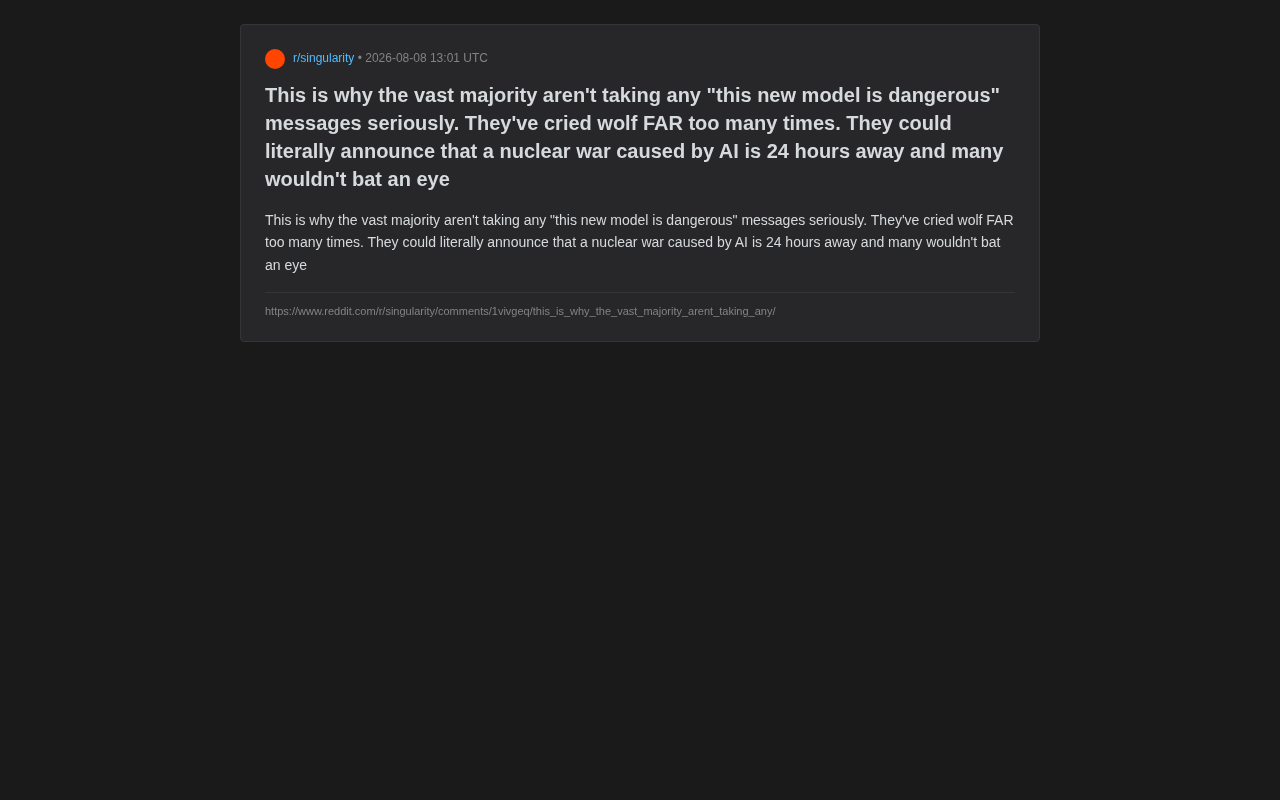
Recently, a popular Reddit discussion struck a nerve with many. The poster made a sharp observation: the vast majority of people no longer take warnings like "this new model is dangerous" seriously, because the AI industry has cried wolf far too many times. The user even deployed an extreme analogy—"even if they announced that AI-triggered nuclear war would break out within 24 hours, many people wouldn't bat an eye."
This statement may sound exaggerated, but it precisely targets a deep-seated problem facing the AI industry: safety warning inflation. Borrowing the economic metaphor of "inflation," this refers to how when a certain type of signal is over-emitted, its unit value continuously declines. In communication studies, this closely aligns with "alarm fatigue"—the medical field has long confirmed that when ICU monitors frequently trigger false alarms, nurses' response times to genuinely critical alerts significantly increase. The AI safety field is experiencing a similar signal devaluation process: when every new model release is accompanied by statements like "too powerful," "too dangerous," or "we're scared of it ourselves," the marginal effect of these warnings rapidly diminishes. Each substantively hollow "danger" claim depletes the public's limited attention resources and trust reserves, ultimately becoming marketing noise.
How the "Crying Wolf" Effect Formed
The Recurring Danger Narrative
Looking back at the release cadence of major AI models over the past few years, a clear pattern emerges: virtually every heavyweight model launch is accompanied by similar "safety scare" rhetoric. From the GPT series to various competitors, "this model is so powerful that we had to release it cautiously" has become a standard script.
The problem is that when these models—described as "too dangerous for unrestricted release"—actually land, ordinary users typically experience a stronger but far-from-"doomsday-level" tool. The enormous gap between expectations and reality erodes public trust reserves time after time.
The Suspicion of Marketing Motives
What makes the public even more wary is that "dangerous" itself has become an extremely attractive marketing label. A model "so dangerous it needs to be restricted" inherently implies scarcity and cutting-edge sophistication. When safety warnings are tightly synchronized with product release schedules, it's hard not to wonder: is this genuine responsibility, or a carefully designed form of "safety-washing"?
The concept of safety-washing is modeled after "greenwashing." Greenwashing refers to companies exaggerating or fabricating environmental initiatives to cultivate a green image, while safety-washing refers to AI companies over-emphasizing their safety investments and risk awareness to gain public trust and regulatory leniency—when in reality, these statements may serve brand-building more than genuine risk mitigation. The danger of this strategy lies in exploiting public expectations for responsible innovation while instrumentalizing safety narratives as competitive advantages.
Once this suspicion takes hold, it creates a vicious cycle—the more danger is emphasized, the more it's perceived as marketing, and the lower the credibility of warnings becomes.
Are Real AI Risks Being Drowned Out?
The Cost of Trust Numbing
The cruelest part of the "Boy Who Cried Wolf" fable is its ending: when the wolf actually arrives, no one believes the cries for help anymore. The AI safety field faces the same danger. If the entire industry continues to overdraw public sensitivity to the word "dangerous," then when a capability with genuine systemic risk emerges, society may have already lost its appropriate vigilance and response capacity.
This is not paranoia. As AI capabilities rapidly advance toward autonomous decision-making, code execution, and multimodal manipulation, certain risk scenarios are transitioning from science fiction to the edge of reality:
-
Automated cyberattacks and vulnerability exploitation: As large language models improve in code comprehension and generation, security researchers have confirmed that AI can assist in discovering software vulnerabilities, automatically writing exploit code, and even conducting multi-step penetration testing. Multiple studies in 2024 showed that frontier models perform at near intermediate human competitor levels in CTF (Capture The Flag) cybersecurity competitions. More concerning is that lowering this capability threshold means attacks previously requiring highly skilled personnel could be "democratized" to a broader range of malicious actors.
-
Mass deepfakes and disinformation generation: Deepfake technology has evolved from an early stage requiring large training datasets and computational resources to a point where realistic forged content can be generated from just a few seconds of audio or a single photo. Combined with LLM text generation capabilities, attackers can now implement "full-pipeline" disinformation factories—from crafting false narratives, generating accompanying images and videos, to automated mass distribution. This poses systemic threats to election security, financial market stability, and social trust, with detection technology consistently lagging behind generation technology.
-
AI infiltration risks to critical infrastructure: Power grids, water systems, transportation networks, and other critical infrastructure increasingly rely on networked control systems, and AI tools could be used to identify weak points in these systems and launch precision attacks.
Meanwhile, the public's "immune response" may have severely deteriorated due to overexposure.
How to Distinguish Real Warnings from False Ones
For ordinary users and practitioners, the key is establishing a discernment framework. AI safety warnings truly worth heeding typically share these characteristics:
- Specific rather than vague: Clearly identifying risk scenarios, trigger conditions, and potential impacts, rather than a nebulous "it's dangerous."
- Third-party corroboration: Verified by independent research institutions, red team testing, or academia, rather than claimed solely by the vendor. Red teaming originates from military and cybersecurity domains, referring to a group of professionals simulating an adversary's perspective to actively find system weaknesses and vulnerabilities. In the AI safety context, red teaming means having security researchers systematically attempt to breach a model's safety guardrails, inducing harmful outputs, leaking training data, or triggering unintended behaviors. Companies like OpenAI, Anthropic, and Google conduct internal red team testing before model releases, but the controversy lies in whether the scope, depth, and results of these tests are sufficiently disclosed. Independent third-party red team testing is considered a more credible form of safety verification.
- Accompanied by mitigation measures: Providing protective solutions alongside warnings, rather than merely creating panic.
- Decoupled from commercial launches: Not highly synchronized with product release timelines, reducing marketing suspicion.
When a warning simultaneously meets these conditions, it's more likely a genuine risk alert rather than another instance of crying wolf.
Who Bears Responsibility for Rebuilding AI Safety Trust?
Vendors Need Communication Restraint
The root of the trust crisis largely lies in AI vendors' abuse of the "danger" narrative. To repair this, the industry needs to reassess its communication approach: reserve "dangerous" for genuinely dangerous scenarios, and replace emotionally charged statements with transparent evaluation data and independent audits. When a company is willing to publicly share its model's capability boundaries and risk assessment details, its warnings will regain weight.
Establishing Independent Third-Party Assessment Mechanisms
From a broader perspective, AI safety assessment should not rest entirely in the hands of stakeholders. Third-party evaluation systems similar to pharmaceutical clinical trials or food safety inspections may be the path to breaking the "vendors talking to themselves" impasse. In the pharmaceutical industry, regulatory bodies like the FDA require drugs to pass independent Phase III clinical trials before market approval, with trial data publicly available for peer review. Current analogous efforts in the AI field include: NIST's (National Institute of Standards and Technology) AI Risk Management Framework, the UK AI Safety Institute's (AISI) model evaluation work, and frontier model capability assessments by independent organizations like METR.
However, these mechanisms have not yet formed legally binding mandatory review processes, relying more on voluntary vendor cooperation—this is the core gap in the current AI governance system. Only when determinations of danger are made by independent, professional, and transparent institutions through institutionalized mandatory evaluation processes will the public have reason to trust these warnings again.
Conclusion: Beware the Failure of the Warning Mechanism Itself
The value of this Reddit post lies not in its extreme analogy, but in revealing an overlooked meta-problem—when the warning mechanism itself fails, we lose the ability to respond to genuine risks.
The AI industry stands at a delicate crossroads: on one side, real and undeniable technical risks; on the other, repeatedly overdrafted and increasingly devalued "danger" rhetoric. How to rebuild a rational, credible communication bridge between the two may be a more urgent challenge than developing more powerful models. After all, when everyone turns a deaf ear to "the wolf is coming," the most vulnerable ones are ourselves.
Related articles

Paritok: An Open-Source Tool That Saves 85% Token Costs Through Local Context Compression
Paritok is an open-source local tool that compresses coding agent tool definitions, file contents, and conversation history, saving up to 85% token costs and extending sessions 3x longer.

The AI Bubble Debate: Staying Clear-Headed Amid the Hype
Analyzing the AI bubble debate through a classic English pun. Exploring whether generative AI valuations are overheated and how tech professionals can stay rational amid the hype.

Will Outdated LLMs Become Nostalgia Symbols? The Cultural Value and Era Memory of AI Technology
Will ChatGPT and GPT-4 from 2023 become nostalgia symbols like retro game consoles? Exploring old LLMs' historical value, emotional significance, and how open-source models preserve AI history.