Peach Co-Pilot: An MCP Tool That Connects AI Assistants to WhatsApp

Peach Co-Pilot connects AI assistants to WhatsApp via MCP protocol for reading, searching, and drafting messages.
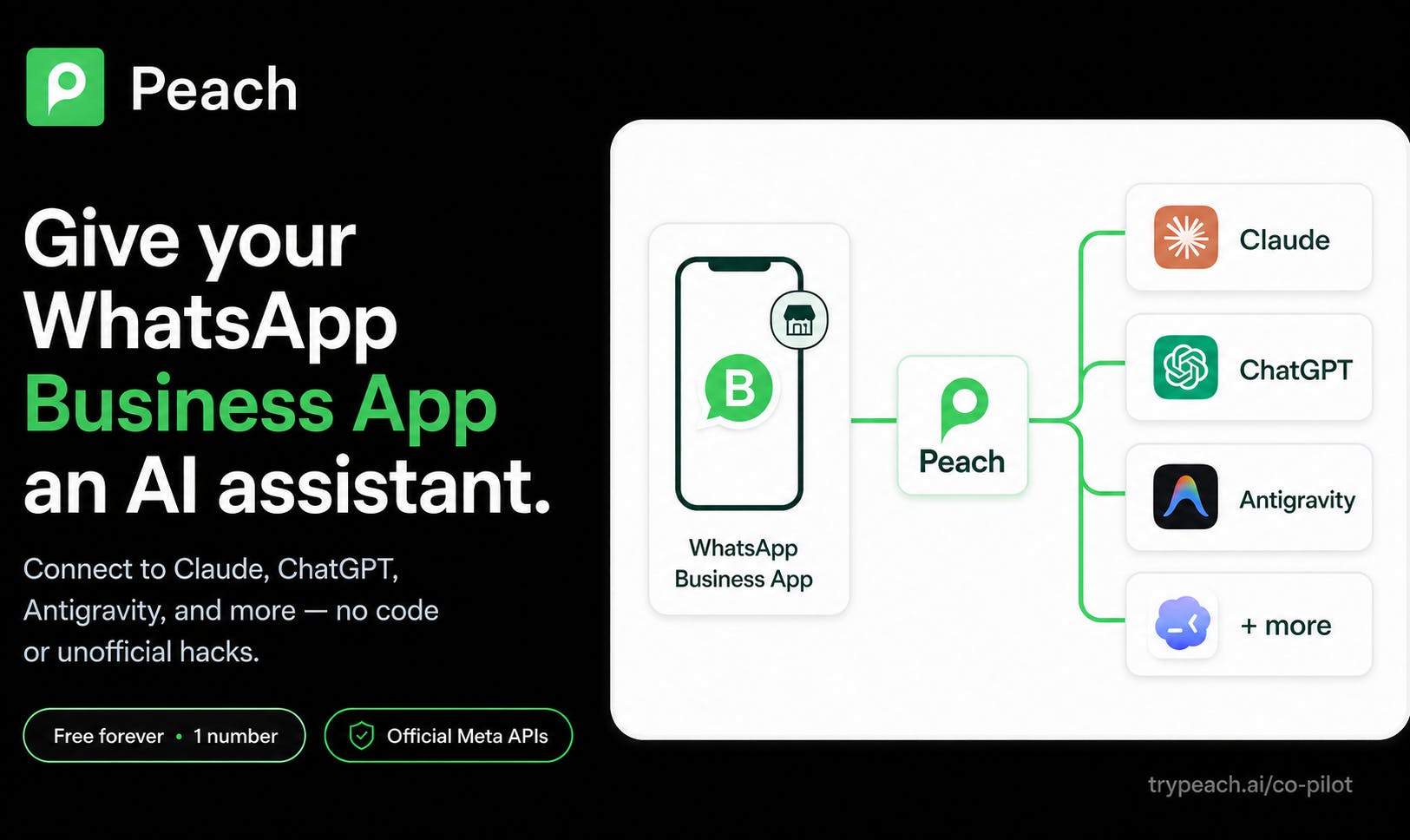
Peach Co-Pilot is a hosted WhatsApp MCP server that enables AI assistants like Claude, ChatGPT, and Cursor to securely read, search, and draft WhatsApp messages. Built on Anthropic's Model Context Protocol, it targets busy professionals using WhatsApp Business App who struggle with information overload, repetitive replies, and response delays, offering a plug-and-play AI co-pilot without requiring technical deployment.
In an era where instant messaging has become the primary battlefield for business communication, WhatsApp carries massive volumes of customer conversations, order confirmations, and team collaboration. Yet for busy professionals, the information overload from these messages is becoming an efficiency bottleneck. Peach Co-Pilot, recently launched on Product Hunt, aims to solve this pain point in a clever way — by connecting mainstream AI assistants directly to your WhatsApp.
Positioned as a "WhatsApp Sidekick for busy professionals," the product garnered 78 upvotes and 9 comments after launch, ranking 16th on its launch day, categorized under Productivity, Messaging, and Artificial Intelligence.
What Is Peach Co-Pilot: A Hosted WhatsApp MCP Server
Peach Co-Pilot's core positioning is as a hosted WhatsApp MCP server, designed specifically for users of the standard WhatsApp Business App. It provides a full set of capabilities to AI tools like Claude, ChatGPT, Cursor, and Zed, enabling these models to securely read, search, and draft messages.
In other words, you no longer need to manually scroll through historical conversations in WhatsApp or type out replies word by word. Through an AI assistant, you can issue commands in natural language — for example, "Find all conversations about quotes from last week" or "Draft a reply to the client's delay request" — and the AI will access WhatsApp data to complete the task.
MCP Protocol: The Key to Connecting AI with WhatsApp
Understanding this product requires grasping the concept of MCP (Model Context Protocol). MCP is a standardized protocol officially released and open-sourced by Anthropic in late 2024, designed to let large language models securely connect to external data sources and tools. It essentially gives AI models a "universal outlet," enabling them to plug into various applications and services in a unified way.
Before MCP, every AI application that wanted to connect to an external service (such as a calendar, email, or CRM) needed custom integration code, creating M×N complexity. MCP simplifies this to M+N: the tool side only needs to expose an MCP-compliant interface (an MCP Server), and the AI client side only needs to implement an MCP Client — then the two can plug and play. The protocol's core includes three capability types: Resources (data reading), Tools (tool invocation), and Prompts (prompt templates). Currently, Claude Desktop, Cursor, Zed, and others natively support MCP Client, while the community has produced hundreds of MCP Servers covering mainstream services like GitHub, Slack, Google Drive, and databases.
Peach Co-Pilot wraps WhatsApp into an MCP-compliant service, making it yet another connectable node in this rapidly expanding ecosystem. This means any AI client that supports MCP can instantly gain the ability to operate WhatsApp without developing separate integrations for each model.
What WhatsApp Pain Points Does Peach Co-Pilot Solve?
To understand this product's value, we first need to recognize WhatsApp's unique position in the global business ecosystem. WhatsApp has over 2 billion monthly active users, covering more than 180 countries, and holds an absolute dominant position in instant messaging markets like India, Brazil, Indonesia, Germany, and Nigeria. Similar to how China's business ecosystem centers around WeChat, WhatsApp has become the de facto commercial communication infrastructure in many emerging markets — from corner shops taking orders, to cross-border trade quotations, to customer after-sales support, massive amounts of business activity happens directly in WhatsApp conversations.
For salespeople, customer service agents, freelancers, and small business owners who heavily rely on WhatsApp for communication, the biggest daily frustrations are:
- Information fragmentation: Important information scattered across hundreds or thousands of conversations, difficult to retrieve quickly;
- Repetitive work: Much of the reply content is similar, manually composing each one is time-consuming and labor-intensive;
- Response delays: Inability to process messages promptly can mean missed business opportunities or degraded customer experience.
Peach Co-Pilot's three core capabilities — "read, search, draft" — directly address these three pain points. AI can act as a tireless assistant, helping you sort through conversation threads, locate key information, and batch-generate reply drafts, while the final send decision remains in the user's hands.
It's worth noting that the AI here is not a traditional chatbot. Traditional chatbots operate on preset rules or simple intent recognition, executing fixed actions in fixed scenarios. The AI Agent behind Peach Co-Pilot possesses the ability to perceive its environment, autonomously plan, invoke tools, and iteratively execute — it can understand ambiguous natural language instructions, break them down into multi-step operation plans, sequentially invoke different tools to complete tasks, and dynamically adjust strategies based on intermediate results. For example, when a user says "Organize all client quote discussions from this month and generate a summary," the Agent needs to search relevant conversations, filter by time range, extract key information, and finally produce a comprehensive output, involving multiple rounds of tool invocation and reasoning.
Hosted Service Lowers the Barrier to Entry
You might not have noticed, but the product emphasizes that it's a hosted service. This lowers the barrier to entry — users don't need to deploy and maintain servers themselves or have a technical background; it works out of the box. For the target users (busy professionals), this "hassle-free" positioning aligns perfectly with its value proposition.
Additionally, the service targets standard WhatsApp Business App users, rather than requiring enterprises to connect through the official WhatsApp Business API (which is complex to deploy and more expensive). This distinction matters: the WhatsApp Business App is a free mobile application for micro and small businesses, offering basic features like business profiles, quick replies, and label categorization, with over 200 million businesses worldwide using it. The WhatsApp Business API (now called WhatsApp Business Platform) targets medium and large enterprises, requires integration through official partners (BSPs), supports high-concurrency message pushing, Webhook callbacks, CRM integration, and other advanced capabilities, but has high deployment costs, complex approval processes, and per-message pricing.
By choosing to serve Business App users, Peach Co-Pilot likely implements message reading and writing through WhatsApp Web's multi-device protocol or similar technical paths, bypassing the API's high barriers and directly reaching the vast population of small merchants who "manage their business on their phone." This choice targets a market that is enormous in scale but remains underserved.
Security and Privacy: Core Considerations for AI-WhatsApp Integration
Connecting AI to a private instant messaging tool makes security undoubtedly the foremost concern for users. The official description repeatedly emphasizes the keyword "securely" — this is the critical threshold for whether such products will be accepted.
To understand the complexity of this issue, one needs to understand WhatsApp's encryption mechanism. WhatsApp uses end-to-end encryption (E2EE) by default — messages are encrypted on the sender's device and decrypted on the receiver's device, and even Meta itself cannot read the content during transmission. When a third-party tool (like Peach Co-Pilot) needs to read messages, it must obtain decrypted plaintext data on the user's device or through WhatsApp Web's multi-device protocol. This raises several key privacy questions:
- Is data encrypted during transmission to the MCP server?
- Does the server persistently store message content?
- Is this data forwarded to AI model providers (like OpenAI, Anthropic) for model training?
- Is data processing compliant under privacy regulation frameworks like the EU's GDPR or Brazil's LGPD?
After all, WhatsApp conversations often contain sensitive business information and personal privacy. Once this data is read or transmitted by AI models without restraint, it could bring compliance and trust risks. When adopting similar tools, users should focus on several questions: whether data is processed locally, whether it will be used for model training, and whether message sending requires human confirmation. The product page has not yet disclosed technical details — these will be key factors in evaluating its reliability going forward.
The Trend of AI Agents Deeply Integrating into Daily Workflows
From a broader perspective, Peach Co-Pilot is a typical representative of the current trend of "AI Agents deeply integrating into daily workflows." 2024-2025 is widely regarded in the industry as the "Year of Agents," with OpenAI, Google, Anthropic, and others all making Agent capabilities a product priority. The proliferation of the MCP protocol is spawning a batch of "connector" products — they don't aim to create entirely new AI applications, but instead serve as bridges between AI and existing software.
The value of this model lies in the fact that users don't need to switch to a new platform to enjoy AI-driven efficiency gains within the tools they already know. Just as browser extensions enhance the browsing experience without changing users' internet habits, MCP Servers allow AI capabilities to permeate existing workflows in a seamless, invisible way. Peach Co-Pilot's choice of WhatsApp — the world's most widely-used messaging application — as its entry point offers considerable market imagination, particularly in emerging markets where CRM systems are not yet widespread and WhatsApp still serves as the primary customer management tool.
Of course, the product is still in its early stages, and its feature coverage, stability, and privacy protection mechanisms all await further market validation. But the direction it points toward — letting AI seamlessly embed itself into the communication tools we use every day — undoubtedly represents an important direction in the evolution of productivity software.
Conclusion
Peach Co-Pilot answers the question "How can AI actually save me time?" with a clear and practical positioning. For professionals drowning in WhatsApp messages, an AI co-pilot that can read, search, and write holds genuine appeal. As the MCP ecosystem matures, we have every reason to expect more such "seamlessly embedded" AI tools quietly transforming our daily work routines.
Related articles

Workbuddy for Absolute Beginners: How a Desktop AI Agent Fits Into Real Workflows
A beginner's guide to the Workbuddy desktop AI agent: installation, claiming credits, file management, and building automated workflows—compared with CodeX for fit and cost, helping professionals shift from AI question-askers to AI managers.

OpenAI's New Agent Stack: Computer Use, Decisions API, and Ultra-Fast Workflows
OpenAI Dev Day unveiled a new agent stack: Computer Use outperforms humans, Decisions API delivers ultra-low-latency classification via Luna, Agents API opens the same Computer Use capabilities, and GPT-6.1 Sol costs only one-seventh of Astra. Core updates, benchmark data, and developer insights.

Liang Wenfeng Open-Sources DeepInfo Inference Framework, Takes On U.S. Ban
DeepSeek open-sources its DeepInfo inference framework after its models, featuring GPU/CPU cross-pipelining, small-model prediction with large-model verification, and full Huawei Ascend and NVIDIA chip support—facing the U.S. federal ban head-on. This article analyzes its significance for AI deployment and open-source strategy.