Peacock's Big Bet on YouTube: The New Logic of Streaming Competition

Peacock sees YouTube as a key strategic partner, reflecting streaming's shift from closed subscriptions to open distribution.
NBCUniversal Media Group Chairman Matt Strauss explains on the Decoder podcast why Peacock views YouTube as a key strategic partner. The core logic is the migration of user attention to open video platforms—leveraging YouTube's recommendation algorithm and creator ecosystem, Peacock can lower acquisition costs and improve content discovery. This decision is closely tied to NBCU's organizational restructuring over the past two years, reflecting a shift from traditional TV thinking to platform-based operations. The article notes streaming competition is moving from a content arms race to a contest over distribution channels and user reach, though leveraging YouTube requires balancing brand control, revenue sharing, and distribution efficiency.
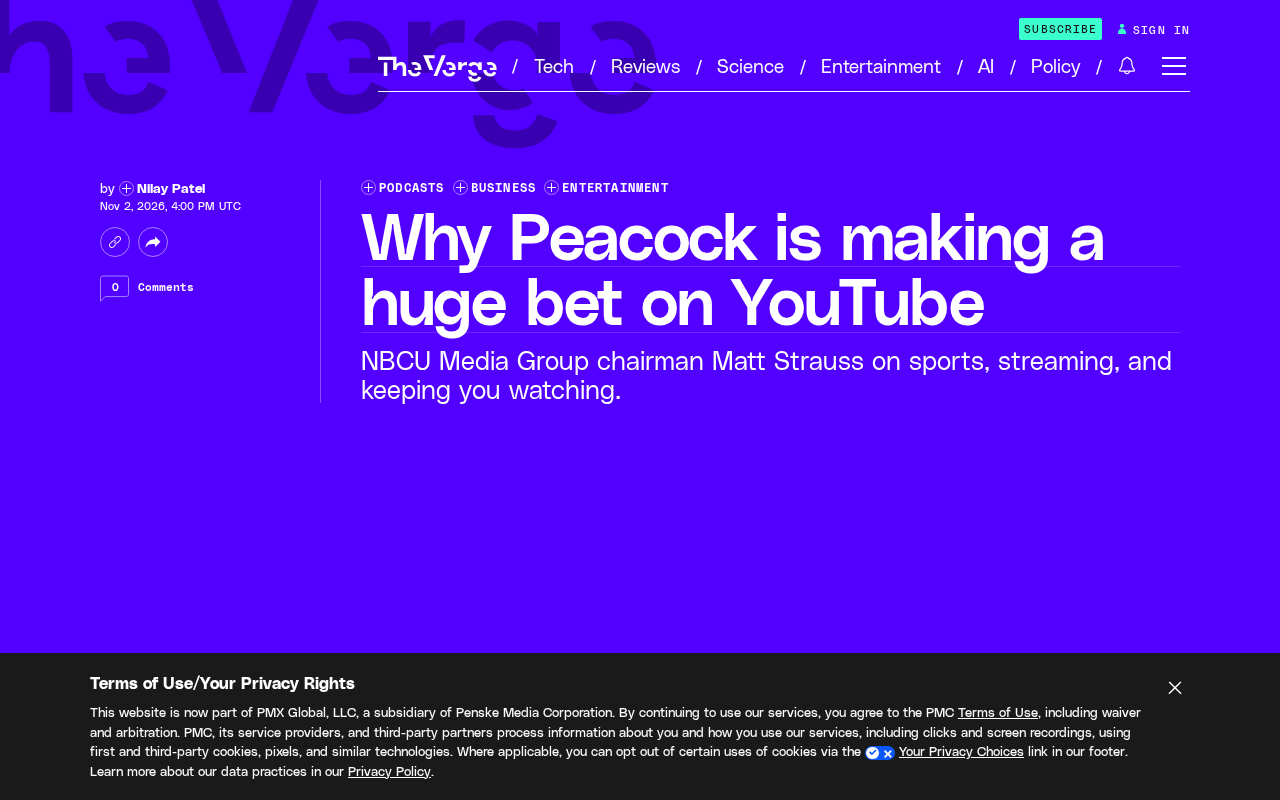
The relationship between streaming platforms and traditional video giants is being redefined. Matt Strauss, Chairman of NBCUniversal Media Group, recently spoke with the host on the Decoder podcast about why Peacock views YouTube as a key strategic partner. This conversation comes two years after his last appearance, during which NBCU has undergone substantial organizational and structural changes—and Peacock's bet on YouTube is a key decision made against this backdrop.
Why YouTube?
The core reason Peacock is betting heavily on YouTube lies in the migration of user attention. As the world's largest video platform, YouTube has a massive active user base and a mature creator ecosystem. For a streaming service like Peacock, rather than treating YouTube as a mere distribution channel, it's better understood as an ecosystem capable of reaching broad audiences and improving content discovery efficiency. In the conversation, Strauss revealed that this strategic consideration is closely tied to NBCU's overall organizational restructuring—the company is shifting from traditional television thinking toward more flexible platform-based operations.
From an industry perspective, partnerships between streaming platforms and YouTube are not isolated cases. More and more content providers are realizing that a closed subscription walled garden cannot independently sustain growth, while leveraging open platforms' distribution capabilities can lower customer acquisition costs and expand brand exposure. Peacock's bet reflects this trend: streaming competition has shifted from a pure content arms race to a contest over distribution channels and user reach efficiency.
Attention Economy and Content Discovery
In the streaming context, "attention migration" refers to the trend of users' viewing time shifting from traditional cable TV and closed subscription platforms to open video platforms. YouTube's core advantage lies in the "content discovery" loop formed by its recommendation algorithm and creator ecosystem: users not only search actively but also encounter content passively through homepage recommendations, short-form clips, and social sharing. For a subscription service like Peacock, this means it can reach potential subscribers through external platforms' algorithmic distribution without relying entirely on in-app recommendations or expensive advertising, reducing acquisition costs and improving content exposure efficiency.
NBCU's Structural Changes and Strategic Pivot
Over the past two years, NBCU has undergone significant organizational and structural adjustments. As Chairman of the Media Group, Strauss has seen changes to both his scope of responsibilities and management structure. These adjustments are not isolated events but a microcosm of traditional media groups repositioning themselves in the streaming era. As NBCU's streaming flagship, Peacock's strategic choices directly reflect priorities at the group level.
Putting YouTube at the strategic core means Peacock is no longer confining itself to being a standalone subscription app but instead seeking synergy with large platform ecosystems. This shift in thinking could affect every link in the chain of content production, distribution, and monetization going forward. In the conversation, Strauss did not shy away from the challenges of this decision but emphasized its necessity—in an era of scarce attention, content must appear where users are.
Platform-Based Operations and Organizational Restructuring
"Platform-based operations" refers to media companies shifting from the traditional TV management model organized by channel and department to an agile, cross-functional architecture centered on streaming products. NBCU's adjustments over the past two years include integrating content production and distribution functions, reorganizing ad sales teams to adapt to programmatic buying, and prioritizing Peacock at the group strategy level. These structural changes aim to shorten decision-making chains so that content investment and distribution strategies can respond more quickly to the competitive pace of the streaming market, rather than following the linear scheduling logic of the cable TV era.
Implications for the Streaming Industry
Peacock's case offers a noteworthy sample for the streaming industry. While platforms like Netflix and Disney+ continue to strengthen their own ecosystems, Peacock has chosen to leverage YouTube—a pragmatic judgment about user behavior and cost structure. On one hand, YouTube's recommendation algorithm and social features can help content spread more efficiently; on the other hand, partnering with a platform may also involve trade-offs in revenue sharing and brand control.
Whether this strategy will succeed depends on whether Peacock can maintain its own brand identity while leveraging external distribution, and whether the terms of its YouTube partnership are sustainable. Strauss's remarks indicate that NBCU leadership has a clear understanding of this and views it as a long-term play rather than a short-term tactic. For other streaming players, Peacock's experiment offers a framework for thinking: in an era of content abundance, the choice of distribution channel may determine success or failure more than the content itself.
The Trade-Off Between Distribution Channels and Brand Control
When streaming platforms leverage third-party open platforms, they typically face a trade-off between "distribution efficiency" and "brand control." Partnering with YouTube can expand reach, but the platform's recommendation rules, ad revenue-sharing ratios, and ownership of user data are not fully controlled by the content provider. Peacock needs to maintain its brand identity within the partnership and avoid becoming just another ordinary content supplier in YouTube's ecosystem. This trade-off also explains why some platforms still insist on strengthening their own app ecosystems—closed ecosystems have higher acquisition costs but offer stronger control over user experience and monetization paths.
Conclusion
Peacock's big bet on YouTube reflects the deeper logic of the streaming industry evolving from closed subscriptions to open distribution. Matt Strauss's conversation on Decoder reveals NBCU's organizational adjustments and strategic trade-offs in this transition. As competition intensifies, how to balance owned platforms with external ecosystems will become a question every streaming service must answer.
Related articles

GPT-Image 2.6 Dual Release: A Double Upgrade in Speed and Precision
OpenAI releases GPT-Image 2.6 with Flare for faster generation and Sunburst for complex prompts and dense infographics. API adds markup editing, SVG, and GIF support.

Robert Caro: How to Get Insiders to Talk and Uncover the Hidden Logic of Johnson's Money Politics
Pulitzer winner Robert Caro shares how he interviewed John Connally, revealing how pressing on Johnson's funding annotations got insiders to explain political money logic.
Showing This Video to Someone in 2014: The Stunning Evolution of AI Video
From the viral Reddit post "Show this AI video to someone from 2014," we look back at a decade of AI video generation's leap from academic research to indistinguishable reality, analyzing the cognitive impact and trust challenges amid the flood of synthetic content.