PenGPT: Generative Transformer Unlocks Handwriting and Sketch Generation
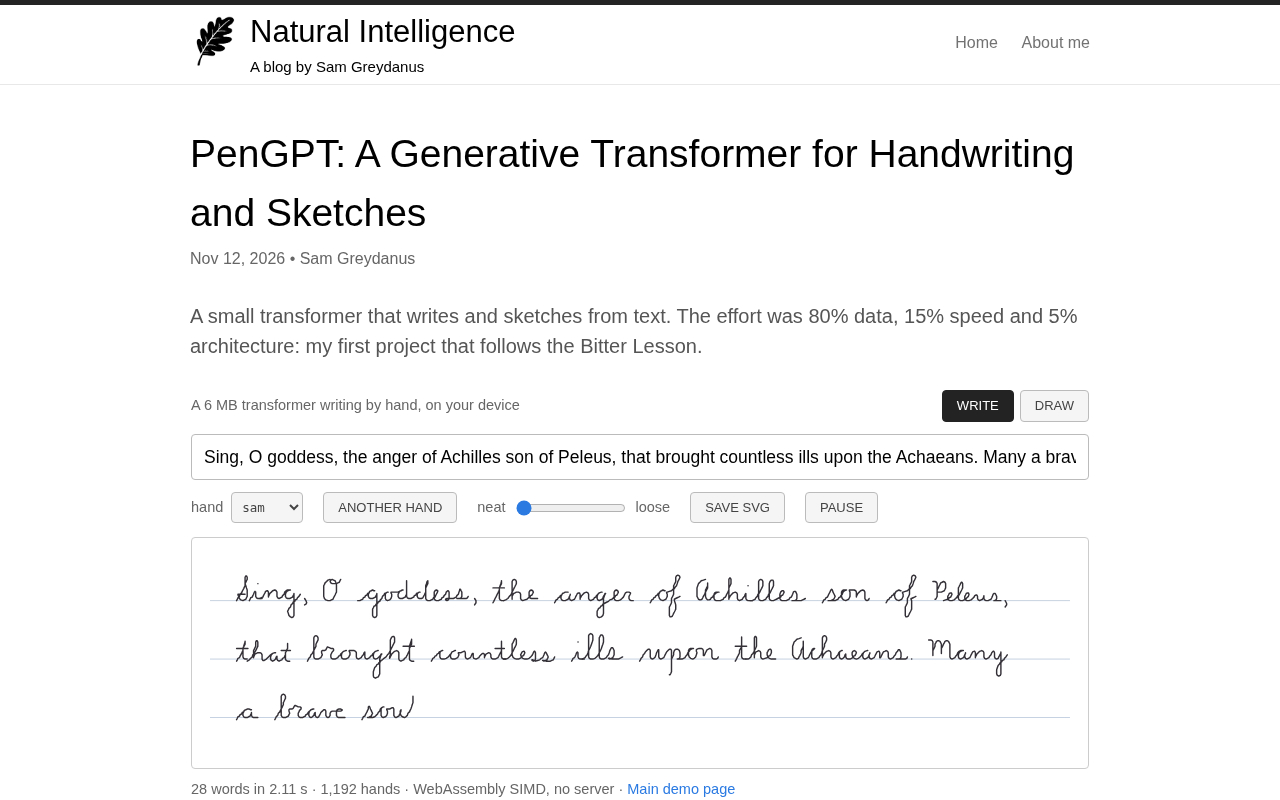
PenGPT uses a generative Transformer to model strokes as sequences, exploring automated handwriting and sketch generation.
PenGPT is a handwriting and sketch generation model recently discussed on Hacker News. Its core idea is to encode strokes as time-series tokens and use a generative Transformer to generate content stroke by stroke, rather than directly generating pixels like mainstream image models. The article notes that serialized modeling preserves writing dynamics such as stroke order and line continuity, making it closer to practical scenarios like stroke animation, handwriting instruction, and signature synthesis. PenGPT echoes existing stroke generation research such as SketchRNN, and they share challenges of long-sequence stability and style variation. However, the work currently discloses limited details and has not attracted much discussion; whether it has made substantive breakthroughs in generation quality or style control still needs reproducible results to verify. The article also cautions that issues such as data copyright, style attribution, and evaluation standards remain unresolved, and it is better to view it as an interesting technical direction rather than a mature product.
Automated generation of handwriting and sketches has long been a relatively niche yet highly challenging direction in generative AI. PenGPT, which recently sparked discussion on Hacker News, is an exploration that attempts to tackle this problem using a generative Transformer architecture.
What Is PenGPT: Teaching Models to "Move the Pen"
PenGPT is positioned as a generative Transformer model for handwriting and sketch generation. Unlike mainstream image generation models, it does not operate on pixel matrices but on serialized representations of strokes—each pen-down, movement, and pen-up can be encoded as a token in a time series. This modeling approach gives the generated output an inherent sense of "process": the model does not smear a pattern onto the canvas all at once, but writes or draws content stroke by stroke, much like a human.
According to the discussion on Hacker News, PenGPT follows the recent line of thought in generative Transformers for sequence modeling, treating stroke data as a special kind of language. The value of this perspective lies in unifying "writing" and "drawing" under the same sequence generation framework, leaving room for future multi-task extensions.
The serialized representation of strokes typically takes the form of vector strokes: each time step records a point or a coordinate offset of a stroke segment, the pen-tip state (pen-down/move/pen-up), and optionally pressure, velocity, and other information. This representation is fundamentally different from pixel matrices—it is naturally variable-length, ordered, and relatively robust to spatial translation and scaling. Common public datasets such as Quick, Draw! and the SketchRNN data use this format, where each sketch is encoded as a series of triplets (Δx, Δy, pen state). Once strokes are treated as sequences, one can directly apply the autoregressive training objective of language models: given a prefix of strokes, predict the next stroke token, thereby generating the complete content stroke by stroke at inference time. The advantage of this paradigm is that the generation process is interpretable and intervenable, and it lends itself easily to conditional control (e.g., character class, style vectors).
Why Handwriting and Sketches Deserve Separate Modeling
Treating strokes as sequences rather than images brings differences far greater than one might imagine. Pixel-level generative models can produce visually appealing final results, but they often lose the genuine dynamics of writing—whether the stroke order is reasonable, whether lines are continuous, whether pressure and velocity changes are natural—these kinds of information are almost invisible in pixel space.
The serialization approach represented by PenGPT directly preserves these dynamic features. For scenarios requiring stroke animation, handwriting instruction, signature synthesis, or sketch-assisted design, this modeling approach is clearly closer to actual needs. The single comment on Hacker News points to a similar concern: the community cares more about whether the model can produce handwriting that "looks like a human wrote it," not merely visually similar shapes.
Pixel-level generative models (such as diffusion models and GANs) and sequence-level stroke models differ fundamentally in their supervision signals. The former optimizes perceptual similarity of the final image, while the latter optimizes the likelihood of the stroke sequence, and can therefore explicitly constrain dynamic attributes such as stroke order, stroke continuity, and pen-up positions. This difference also leads to divergent evaluation practices: image models commonly use metrics like FID and IS, whereas stroke generation focuses more on stroke plausibility, reconstruction error, and human preference. In addition, strokes generated by sequence models can be directly exported to vector formats such as SVG, facilitating lossless scaling and subsequent editing—a practical value in scenarios like typeface design and handwriting instruction animation that pixel models can hardly replace.
Technical Approach and Comparison with Related Ideas
Based on public information, PenGPT is an attempt to apply generative Transformers to the handwriting and sketch domain, echoing existing stroke generation research. The common challenges of such work lie in data representation and sequence length: stroke sequences can be very long, and the model needs to remain stable over long-range dependencies while also handling individual differences in writing style.
Objectively speaking, the technical details currently disclosed for PenGPT are limited, and the level of discussion on Hacker News (24 points, 1 comment) also indicates that it is still in an early stage of exposure. Whether it has made substantive breakthroughs in generation quality, style control, or long-sequence stability still requires more reproducible results to verify.
Before PenGPT, SketchRNN (Ha & Eck, 2018) had already demonstrated that modeling stroke sequences with RNNs can generate recognizable doodles, and introduced a mixture density network (MDN) output layer to handle the continuous distribution of stroke positions. Since then, Transformers have gradually replaced RNNs thanks to their stronger long-range modeling capabilities, giving rise to Sketchformer and multimodal work that aligns strokes with text. The long-sequence challenge mainly comes from two aspects: first, stroke sequences can be thousands of steps long, and the computational cost of self-attention grows quadratically with length; second, individual differences in writing style require the model to have some degree of disentanglement capability. Common countermeasures include stroke-level tokenization, downsampling, relative position encoding, and style-condition injection. If PenGPT is to advance in these directions, it will need comparable evaluations against the above methods on public benchmarks.
Application Possibilities and Open Questions
If such models mature, the most direct applications include handwriting font generation, personalized signatures, sketch-assisted creation, and writing demonstrations in educational settings. More broadly, it could become an entry point for multimodal models to understand "how humans create"—after all, stroke sequences record the creative process itself.
But it is important to view this calmly: data copyright, style attribution, and evaluation standards for handwriting and sketch generation all remain unresolved. Whether PenGPT can grow from a discussion item on Hacker News into an influential open-source or commercial tool depends on whether models, code, and evaluation results are released subsequently.
For developers and researchers interested in niche directions of generative AI, PenGPT is worth keeping an eye on, but before more details are disclosed, it is safer to regard it as an interesting technical direction rather than a mature product.
One-line Summary
PenGPT uses a generative Transformer to model strokes as sequences, exploring automated handwriting and sketch generation.
Paragraph Summary
PenGPT is a handwriting and sketch generation model recently discussed on Hacker News. Its core idea is to encode strokes as time-series tokens and use a generative Transformer to generate content stroke by stroke, rather than directly generating pixels like mainstream image models. The article notes that serialized modeling preserves writing dynamics such as stroke order and line continuity, making it closer to practical scenarios like stroke animation, handwriting instruction, and signature synthesis. PenGPT echoes existing stroke generation research such as SketchRNN, and they share challenges of long-sequence stability and style variation. However, the work currently discloses limited details and has not attracted much discussion; whether it has made substantive breakthroughs in generation quality or style control still needs reproducible results to verify. The article also cautions that issues such as data copyright, style attribution, and evaluation standards remain unresolved, and it is better to view it as an interesting technical direction rather than a mature product.
Related articles
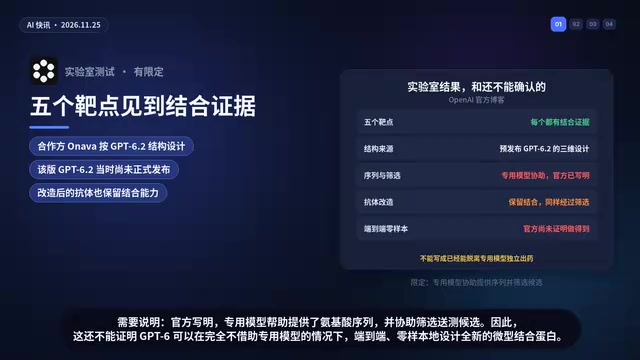
GPT-6 Designs Proteins, Claude Creations Become Apps with One Click, DeepMind Releases New Benchmark
OpenAI says GPT-6 can design protein 3D structures, Anthropic lets Claude creations install as desktop apps, DeepMind's HIP benchmark tests stability on simple questions, Google Workspace opens agent MCP interfaces.
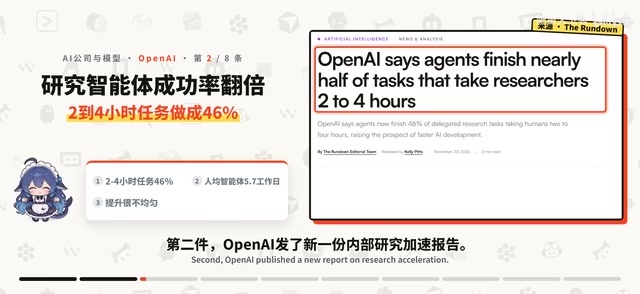
OpenAI Weekly Roundup: GPT-6.2 Rolls Out to ChatGPT, GPT-6 Designs Proteins
OpenAI's week: GPT-6.2 rolls out to ChatGPT, GPT-6 claims independent protein design, agent research share surges, perplexity proposed as a shared metric, and internal safety concerns surface.
Is the Crypto Industry About to "Turn Blue"? The Truth Behind Tech and Politics' Shifting Allegiances
Vergecast discusses whether the crypto industry will shift from the right to the Democrats, revealing the pragmatic nature of tech's politics and the costs of a crypto pivot.