Penguin Huddling Evolutionary Algorithm: Neural Network Learns a Counterintuitive Huddling Strategy

An evolutionary algorithm trains a neural network to make penguins huddle and discovers a counterintuitive "move-the-hot" strategy that beats handcrafted rules.
The article introduces an experiment using an evolutionary algorithm to train a tiny neural network to simulate 60 emperor penguins huddling at -40°C. The handcrafted rule "move the coldest edge penguin" achieved only 49% comfort with severe central overheating; after 41 generations, the neural network scored 65% and learned a strategy opposite to the biological rule: 71% of moved penguins were overheating ones, mostly sent from the center to the windward side, reducing overheating penguins from about 15 to 3. The author notes this shows system-level optimization outperforming individual-level remediation and that algorithms can find solutions beyond human intuition, and discusses implications for AI and bionics.
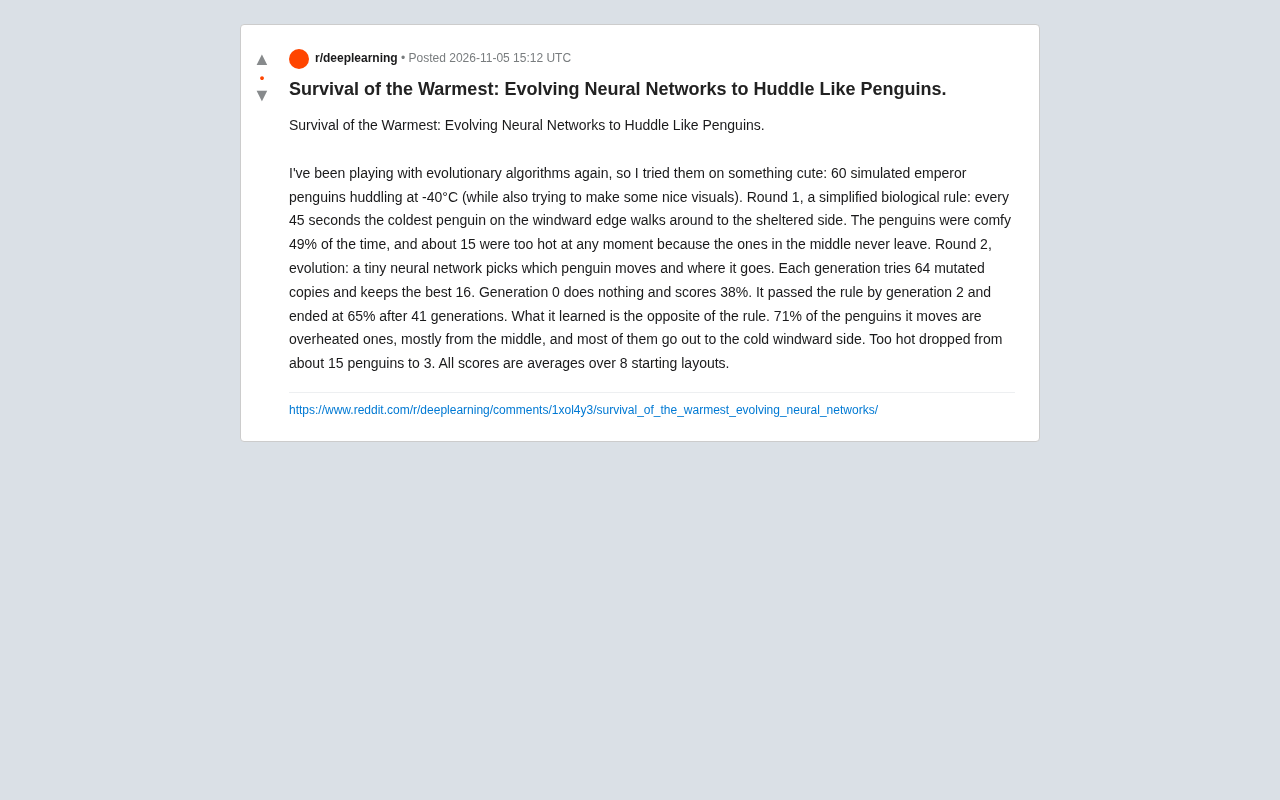
A developer shared an interesting experiment on Reddit: using an evolutionary algorithm to train a tiny neural network so that 60 simulated emperor penguins learn to huddle for warmth at -40°C. The result was unexpected—the optimal strategy the neural network found was the exact opposite of the biological rule humans had预设 (preset).
Experiment Background: From Simple Rules to Evolutionary Learning
The experiment simulated 60 emperor penguins huddling for warmth in the bitter cold of -40°C. The first round used a simplified biological rule: every 45 seconds, the coldest penguin on the windward edge walks to the leeward side. This rule sounds reasonable, but its effectiveness was limited—the penguins were comfortable only 49% of the time, and at any given moment about 15 penguins were unable to leave because they were in the center, causing overheating.
The second round switched to an evolutionary algorithm: a tiny neural network was responsible for deciding "which penguin to move" and "where it should go." Each generation tried 64 mutated copies and kept the best-performing 16. Generation 0 did nothing and scored 38%. By generation 2, it had already surpassed the handcrafted rule; after 41 generations of evolution, the final score reached 65%. All scores are averages based on 8 initial layouts.
Evolutionary Algorithm is a class of optimization methods inspired by biological evolution. Its core loop includes: maintaining a population of candidate solutions, generating new individuals each generation through mutation and crossover, and then selecting and retaining better individuals according to a fitness function (here, the penguin comfort score). The article's "each generation tries 64 mutated copies and keeps the best 16" is a typical (1+λ) or truncation selection strategy, belonging to gradient-free optimization, which is particularly suitable for scenarios where decision rules are hard to express mathematically and the search space is discrete or non-convex.
The tiny neural network plays the role of a "policy network" here: the input may be information such as each penguin's position, temperature state, and environmental wind direction, and the output is the decision "which penguin to move and where to move it." Because the network is very small and has few parameters, the evolutionary algorithm can search directly in parameter space without easily overfitting, and it is also easy to visualize and understand.
Fitness scoring (the "score" in the article) is defined as the proportion of time the penguins are in a comfortable state, averaged over 8 initial layouts to reduce randomness. This closed loop of "simulate—score—select" is a typical paradigm for using evolutionary algorithms to optimize collective behavior.
The "Counterintuitive" Strategy the Neural Network Learned
What the neural network learned happened to be the opposite of the original rule. Of the penguins it moved, 71% were overheating, and most came from the center; most of these overheating penguins were sent to the cold windward side. As a result, the number of overheating penguins dropped from about 15 to 3.
The cleverness of this strategy lies in this: it did not "rescue the coldest" as the handcrafted rule did, but instead "released the hottest." Central penguins, surrounded by companions, cannot dissipate heat and easily overheat; sending them to the windward side both cools them down and allows the gaps on the periphery to readjust, thereby improving overall comfort.
Overheating is an often overlooked constraint in penguin huddling: emperor penguin clusters are very dense, and central individuals are surrounded by companions, making heat dissipation difficult and body temperature potentially rising to dangerous levels. Real penguins dissipate heat by loosening the cluster and changing position, but individuals are often unable to leave freely due to physical compression or cognitive limitations. In the simulated environment, "overheating penguins" refers to individuals whose temperature exceeds the comfort threshold, and their number is one of the key indicators for measuring collective health. The neural network prioritizes moving these overheating individuals, essentially treating "heat dissipation" as the system bottleneck to manage, rather than focusing only on the explicit need of "keeping warm."
The windward side is the side of the cluster directly exposed to the cold wind, where the temperature is lowest and heat loss is fastest. Sending overheating penguins to the windward side is equivalent to using the environment as a "radiator," while also creating gaps on the periphery so that cold penguins have a chance to move toward the center. This spatial scheduling of "trading heat for cold" is a non-intuitive strategy that the neural network discovered on its own from score feedback.
Why Is "Anti-Rule" More Effective?
The core of the handcrafted rule is "help the weak"—the coldest penguins need to move to a warm place. But penguin huddling is a dynamic system, and the problem of central overheating also drags down the whole. Through trial and error, the neural network found that moving overheating penguins yields higher returns: this not only solves the overheating problem but also indirectly creates opportunities for cold penguins on the edge to enter the center.
This strategy is essentially "system-level optimization" rather than "individual-level remediation." The neural network did not follow any preset biological logic, but instead摸索 (explored) a better solution on its own from score feedback.
Implications for AI and Bionics
Although this experiment is small, it reveals the potential of evolutionary algorithms in optimizing complex systems. When rules designed by human intuition have blind spots, letting an algorithm search from scratch can often find unexpected solutions. It also shows that biological behavior is not necessarily always "optimal"—real penguin huddling may be limited by individual cognition and physical constraints, while the neural network in the simulated environment can break out of these limitations.
For AI researchers, this case also provides a lightweight experimental template: using a simple simulated environment to validate evolutionary strategies is low-cost and highly visual, making it suitable for exploring the intersection of collective behavior and neural network decision-making.
One-line Summary
An evolutionary algorithm trains a neural network to make penguins huddle, discovering a counterintuitive "move-the-hot" strategy that outperforms handcrafted rules.
Paragraph Summary
The article introduces an experiment that uses an evolutionary algorithm to train a tiny neural network to simulate 60 emperor penguins huddling for warmth at -40°C. The handcrafted rule "move the coldest penguin on the edge" achieved only 49% comfort and suffered from severe central overheating; after 41 generations of evolution, the neural network scored 65% and learned a strategy opposite to the biological rule: 71% of the moved targets were overheating penguins, mostly sent from the center to the windward side, reducing overheating penguins from about 15 to 3. The author points out that this reflects system-level optimization outperforming individual-level remediation, and that algorithms can find solutions beyond human intuition, and discusses its implications for AI and bionics.
Related articles

Sugra MCP: One-Click Access to 200+ Data Sources, Connecting Mainstream AI Applications
Sugra MCP connects mainstream AI apps like Claude, ChatGPT, and Cursor through a unified MCP protocol, offering 200+ data sources and 1,600+ endpoints. Listed in Anthropic, OpenAI, and GitHub directories—integrate with one command.
 Tech Frontiers
T3 Code: Free, Open-Source, and a Unified Way to Manage All AI Coding Agents
T3 Code is a free open-source app that aggregates AI coding tools like Cloud Code and Codex into one interface, with conversation handoff, branch isolation review, automatic PR creation, and remote access.
 Tech Frontiers
Conductor Cloud Service Shutting Down? A Comparative Review of Three Parallel AI Coding Agent Solutions
Conductor's cloud service is shutting down—how can developers keep running AI coding agents in parallel? This article compares three alternatives: Orca, Codex, and Cursor: Orca is open-source and free and compatible with old workspaces, Codex is built into the ChatGPT desktop app and supports cloud handoff, and Cursor offers multi-agent windows within the editor. Choose the tool that best fits your workflow.