Penguin Moves Up Publication of 'Smarter Than Us': An AI Risk Guide for General Readers

Penguin moves up 'Smarter Than Us,' an AI guide for non-technical readers covering how AI works, its many risks, and responses.
Co-written with Patchen Barss, 'Smarter Than Us' is an AI 'manual' for non-technical readers. It explains how AI systems work, then discusses risks across privacy, bias, employment, and the information ecosystem, plus ways to respond. Penguin has moved up the release date, likely reflecting market timing amid rising AI interest. No programming or ML background is required.
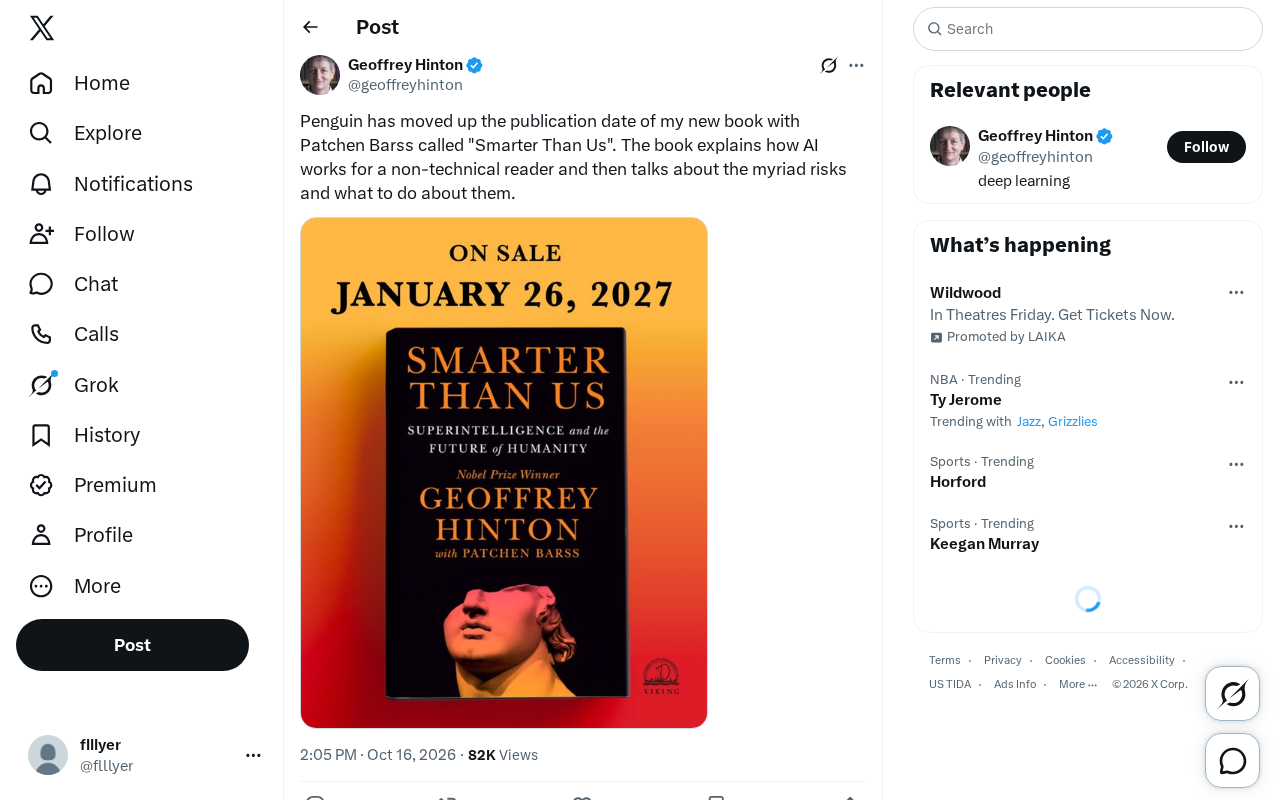
A science book about AI written for non-technical readers, Smarter Than Us, is coming to readers sooner than expected. The author announced on social media that Penguin has moved up the book's publication date. Co-written with Patchen Barss, the book aims to explain how AI works in plain language and to systematically lay out the many risks it poses along with ways to address them.
An AI manual written for ordinary people
AI technology is rapidly permeating every corner of daily life, but most introductions are either overly technical or stuck at the level of hype. Smarter Than Us has a clear positioning: to provide non-technical readers with a "manual" for AI. According to the author, the book first explains the basic working principles of AI systems, then discusses the various risks associated with them. This structure—moving from "how it works" to "what impact it has"—offers readers without a technical background a clear path to understanding.
Risk is not a single dimension
The author uses the phrase "myriad risks" to capture the range of issues discussed in the book. This wording suggests that the book does not reduce AI risk to a single category of threat, but rather covers multiple dimensions—potentially including privacy, bias, employment, the information ecosystem, and broader social impacts. For readers hoping to build a comprehensive understanding, this multi-angle overview is more valuable as a reference than single-point warnings.
The book doesn't just list problems; it also discusses "what to do about them"—the ways to respond. At a time when AI discussions often fall into the two extremes of "either fear or blind optimism," providing an actionable framework for thinking is especially important.
The risk dimensions mentioned in the original text—such as privacy, bias, employment, and the information ecosystem—are typically grouped into two major categories in the field of AI governance: systemic risks and individual risks. Systemic risks refer to the impact of widespread AI adoption on macro-level areas such as economic structure, social fairness, and information authenticity—for example, algorithmic recommendation exacerbating information cocoons, or automation leading to structural unemployment. Individual risks focus on harm in specific contexts, such as facial recognition abuse infringing on privacy, or hiring algorithms amplifying gender or racial bias. In addition, frontier AI research also pays attention to "existential risk"—the possibility that highly autonomous AI systems, if goal alignment fails, could cause irreversible harm to humanity as a whole. The book's use of "myriad risks" to cover these dimensions means it attempts to break the single narrative of "AI risk = unemployment" or "AI risk = privacy," helping readers build a layered, categorized framework for understanding risk so they can more rationally assess the priority of various countermeasures.
What early publication means
Penguin's decision to move up the publication date is itself noteworthy. When a publisher adjusts its schedule, it usually reflects a judgment about market timing or reader demand. Smarter Than Us targets a broad readership that wants to understand AI but doesn't know where to start. With AI topics continuing to heat up, an earlier release helps stake out this niche reading market sooner.
In the book publishing industry, moving up a publication date is usually a market signal. Publishers adjust schedules based on factors such as pre-sale data, topic热度 (topic heat), and competitors' release plans. An earlier launch often means they believe the "window" is narrowing or competition is intensifying. AI science books have emerged in dense numbers in recent years, and Penguin's move may be aimed at capturing readers' minds first and avoiding a head-on collision with subsequent similar works. At the same time, early publication also requires authors and editorial teams to complete final drafts, proofreading, and marketing preparation in a shorter period, which indirectly reflects the publisher's confidence in the book's maturity and market potential. For readers, this means earlier access to a systematic introductory read, but they should also note whether the edition has been fully polished.
Who should read this book
Judging from the author's own account, this book does not require readers to have a background in programming or machine learning. It is written for readers who feel the impact of AI in their work and daily lives but lack a systematic understanding of it. For anyone hoping to build a basic framework for understanding AI in one go, this is an introductory read with clear positioning and a complete structure.
(This article is based on information posted by the author on social media; the specific contents of the book are subject to the officially published edition.)
One-line Summary
Penguin moves up publication of Smarter Than Us, an AI science book for non-technical readers that systematically covers AI principles, multiple risks, and ways to respond.
Paragraph Summary
Co-written with Patchen Barss, Smarter Than Us is positioned as an AI "manual" for non-technical readers. The book first explains the basic working principles of AI systems, then discusses multi-dimensional risks such as privacy, bias, employment, and the information ecosystem, and offers ways to address them. Penguin has announced an earlier publication date, a move that may reflect market timing judgments amid rising AI interest. The book does not require a programming or machine learning background and is suitable for general readers who want to systematically build a framework for understanding AI.
Related articles

Workbuddy for Absolute Beginners: How a Desktop AI Agent Fits Into Real Workflows
A beginner's guide to the Workbuddy desktop AI agent: installation, claiming credits, file management, and building automated workflows—compared with CodeX for fit and cost, helping professionals shift from AI question-askers to AI managers.

OpenAI's New Agent Stack: Computer Use, Decisions API, and Ultra-Fast Workflows
OpenAI Dev Day unveiled a new agent stack: Computer Use outperforms humans, Decisions API delivers ultra-low-latency classification via Luna, Agents API opens the same Computer Use capabilities, and GPT-6.1 Sol costs only one-seventh of Astra. Core updates, benchmark data, and developer insights.

Liang Wenfeng Open-Sources DeepInfo Inference Framework, Takes On U.S. Ban
DeepSeek open-sources its DeepInfo inference framework after its models, featuring GPU/CPU cross-pipelining, small-model prediction with large-model verification, and full Huawei Ascend and NVIDIA chip support—facing the U.S. federal ban head-on. This article analyzes its significance for AI deployment and open-source strategy.