Pentagi: How Fully Autonomous AI Agents Are Reshaping Penetration Testing

Open-source AI agent Pentagi aims to fully automate penetration testing—high popularity but questionable deployment
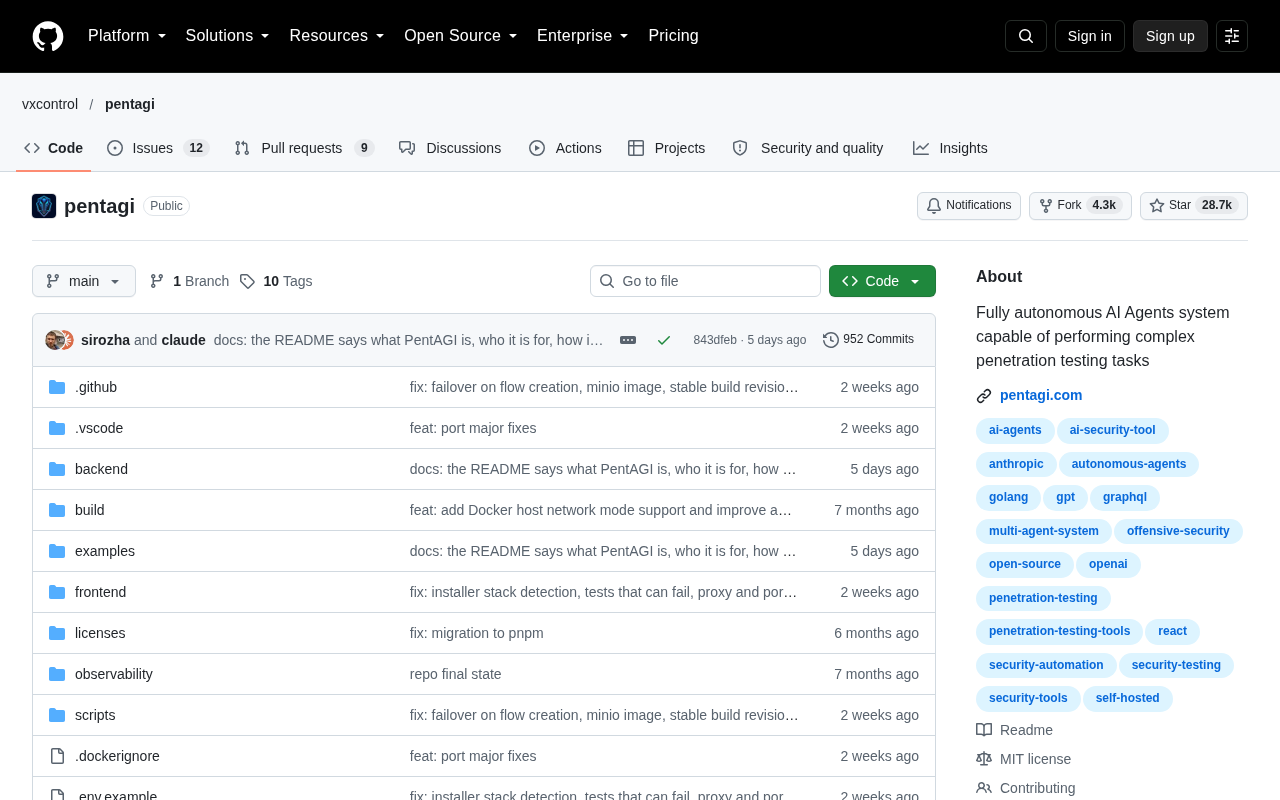
Pentagi is an open-source fully autonomous AI agent system built in Go, focused on complex penetration testing tasks, with 28,671 GitHub stars, drawing widespread attention in the security community. It attempts to replace traditional manual penetration processes with AI, covering the complete chain from reconnaissance to exploitation. Analysis indicates the project faces dual characteristics: improving security testing efficiency while potentially lowering the barrier for cyberattacks. Technically, environmental uncertainty, heterogeneous tool integration, and strategy replanning requirements place extremely high demands on agent autonomy. In the short term, AI is more likely an "enhancement" tool rather than a replacement for security practitioners.
When AI Learns to Penetrate Autonomously: Pentagi's Ambition and Boundaries
An open-source project called Pentagi on GitHub is drawing attention in the security community. As of this writing, the project has garnered 28,671 stars and 4,318 forks, with 1,819 new stars added in a single day. Behind these numbers is a fully autonomous AI agent system built in Go, targeting complex penetration testing tasks.
Traditional penetration testing relies on security engineers manually executing reconnaissance, vulnerability scanning, exploitation verification, and other steps—time-consuming and labor-intensive. Pentagi attempts to replace this process with AI agents: it can autonomously plan attack paths, invoke security tools, analyze feedback results, and advance testing without human intervention.
The Technical Foundation of Autonomous Agents
Pentagi's choice of Go as its development language is no coincidence. Penetration testing toolchains have extremely high requirements for performance and concurrency, and Go's lightweight goroutines and static compilation features make it suitable for building rapidly deployable, highly concurrent security tools.
From the project's positioning, Pentagi represents a deep vertical application of AI Agents. It needs to solve several core problems: How can large models understand the phased objectives of penetration testing? How to orchestrate heterogeneous tools like nmap, metasploit, and sqlmap? How to autonomously adjust strategies when encountering failures? The answers to these questions determine whether it is merely a "collection of automation scripts" or a "truly autonomous agent."
You may not have noticed, but open-source projects in the AI + security space are not uncommon on GitHub—most, however, remain at the level of assisting with command generation or explaining vulnerability reports. Pentagi's emphasis on "fully autonomous" means it attempts to cover the complete chain from information gathering to vulnerability exploitation.
AI Agent refers to a large model application paradigm that can perceive its environment, make autonomous decisions, and invoke tools to execute tasks. Unlike chatbots that merely generate text, it possesses three key capabilities: planning, memory, and tool use. When deployed in vertical domains, agents typically adopt a "plan-execute-reflect" loop architecture: the large model first decomposes task objectives, then selects and invokes external tools, and finally adjusts the next strategy based on returned results. The core difficulty of this paradigm lies in error accumulation within long-chain tasks—a single misstep can be amplified by subsequent steps, necessitating reflection mechanisms or human checkpoints. Pentagi applies this paradigm to the high-risk, highly adversarial scenario of penetration testing, with an autonomy level far exceeding common "command generation assistants."
The nmap, metasploit, and sqlmap mentioned in this article are classic toolchains in the penetration testing field: nmap handles port scanning and service identification, metasploit provides an exploitation framework and module library, and sqlmap focuses on detecting and exploiting SQL injection vulnerabilities. Each of these tools has its own independent command-line parameter system, output format, and applicable phase. Traditionally, security engineers manually select which tool to invoke next and what parameters to pass based on previous results. For AI agents, enabling heterogeneous tools to work together requires building a unified abstraction layer above the tools, encapsulating each tool as a callable function with semantic descriptions, and enabling the large model to understand "under what circumstances which tool should be used." The quality of this engineering layer often determines the agent's real-world performance more than the model itself.
The Double-Edged Sword Nature of Open-Source Security Tools
Pentagi's positioning is inherently controversial. Once an autonomous penetration testing system is misused, it could lower the technical barrier for cyberattacks. The project's high popularity on GitHub reflects both the security community's strong demand for automation tools and sparks discussions about AI safety boundaries.
On the positive side, such tools can help security teams discover system weaknesses at lower cost, especially improving efficiency in red team-blue team exercises. For enterprises, using AI agents to simulate attacker behavior offers advantages in continuity and coverage over manual penetration testing.
Risks are equally real. When an agent can autonomously decide attack paths, how do you ensure its behavior always stays within authorized scope? How do you audit every tool invocation the AI makes? Whether these questions are adequately addressed in the project documentation will directly impact whether Pentagi can evolve from a "geek toy" to an "enterprise-grade tool."
Real-World Challenges of Agent Deployment
The complexity of penetration testing far exceeds general task automation. Real network environments are full of uncertainty: firewall rules may block scanning traffic, target systems may return misleading responses, and exploitation chains may break due to version differences.
For AI agents to handle these challenges, they need environmental awareness, error recovery, and strategy replanning capabilities. Whether Pentagi's architecture design can support this level of autonomy remains unclear from publicly available information. The project's high star count indicates strong community expectations, but a gap often exists between expectations and real-world deployment.
Another practical issue is the depth of tool integration. Penetration testing involves dozens of specialized tools, each with different output formats, parameter systems, and applicable scenarios. Agents need to understand the semantics of these tools rather than simply concatenating command lines. This requires the project to invest substantial engineering effort in prompt engineering, tool abstraction layers, and result parsing.
Replanning is a key capability for autonomous agents to cope with dynamic environments: when a preset path fails due to external feedback, the agent must reassess the current state, abandon invalid sub-goals, and generate new plans rather than mechanically retrying. In penetration testing, firewall blocks, honeypot traps, and version mismatches all trigger replanning needs. Implementing this capability typically relies on reflection prompts, failure cause attribution, and multi-branch search, but places high demands on the large model's contextual understanding and reasoning abilities. If an agent only "goes down one path to the end," it can easily get stuck or generate large numbers of invalid requests in real network environments—this is also one of the core metrics for measuring whether Pentagi achieves "true autonomy."
The Next Step in Security Automation
Pentagi's emergence signals that AI agents are penetrating from general conversation scenarios into highly specialized, high-risk domains. The security industry's pursuit of automation is long-standing, but the leap in autonomy brought by AI represents a qualitative change.
For security practitioners, such tools are more likely to be "enhancements" rather than "replacements" in the short term. AI agents can handle repetitive reconnaissance and preliminary verification, but the discovery of complex logic vulnerabilities and understanding of business scenarios still depend on human expertise.
Pentagi's future evolution is worth tracking: Can it establish a trustworthy authorization mechanism? Can it deeply integrate with mainstream security toolchains? Can it prove reliability in real attack-defense scenarios? The answers to these questions will determine whether autonomous penetration testing is a fleeting concept or a new paradigm for security automation.
One-line Summary
Open-source AI agent Pentagi aims to fully autonomously complete penetration testing—high popularity but questionable deployment
Paragraph Summary
Pentagi is an open-source fully autonomous AI agent system built in Go, focused on complex penetration testing tasks, with 28,671 GitHub stars, drawing widespread attention in the security community. It attempts to replace traditional manual penetration processes with AI, covering the complete chain from reconnaissance and scanning to vulnerability exploitation. Analysis indicates the project faces dual characteristics: on one hand, it can improve red-blue team exercises and enterprise security testing efficiency; on the other, it may lower the barrier for cyberattacks, creating authorization and auditing challenges. Technically, the environmental uncertainty of penetration testing, heterogeneous tool integration, and strategy replanning requirements place extremely high demands on agent autonomy. The article argues that in the short term, AI is more likely an "enhancement" tool for security practitioners rather than a replacement, and whether Pentagi can establish a trustworthy authorization mechanism and deeply integrate toolchains will determine whether it can move from concept to enterprise-grade application.
Related articles

Chain of Thought Isn't Just for AI: How Humans Can Use CoT to Improve Thinking Quality
Chain of Thought isn't just a prompt trick for large models. Starting from a Hacker News discussion, this article analyzes why CoT works for human thinking too, breaks down actionable ways to transfer it, and highlights the key differences between human CoT and machine CoT.
Cloudflare Teams Up with OpenAI: Closi…
Cloudflare Teams Up with OpenAI: Closing the Loop from Vulnerability Discovery to Defense with AI
Cloudflare uses OpenAI Daybreak to investigate security vulnerabilities and generate reviewable remediation plans, while developers use Codex to boost coding efficiency and quality.

Orca Multi-Agent Orchestration in Practice: A Guide to Parallel Collaboration with Claude and Codex
Orca is Stable AI's free open-source agent workbench supporting 34 agents like Claude Code and Codex in parallel. Learn its Git worktree isolation, multi-model orchestration, and mobile management.