Pentagon Taps Musk and Palmer Luckey to Lead Future Warfare Study, Sparking Controversy

Pentagon taps Musk and Luckey to lead future warfare study, raising conflict-of-interest concerns.
Defense Secretary Hegseth has launched a 120-day future warfare study led by Elon Musk, Anduril founder Palmer Luckey, and former House Speaker Newt Gingrich. Critics argue that Musk's SpaceX and Luckey's Anduril sell the very military technologies the study is likely to recommend, creating a clear conflict of interest. The arrangement reflects a broader trend of Silicon Valley power penetrating the core of U.S. defense decision-making, with its directional conclusions set to shape defense budgets and procurement priorities for years to come.
Pentagon Launches 120-Day Future Warfare Study
Secretary of Defense Pete Hegseth recently announced a 120-day study focused on the future of warfare and the U.S. military's next strategic direction. The leadership lineup is drawing significant attention — the effort will be led by Tesla and SpaceX founder Elon Musk, Anduril founder Palmer Luckey, and former House Speaker Newt Gingrich.
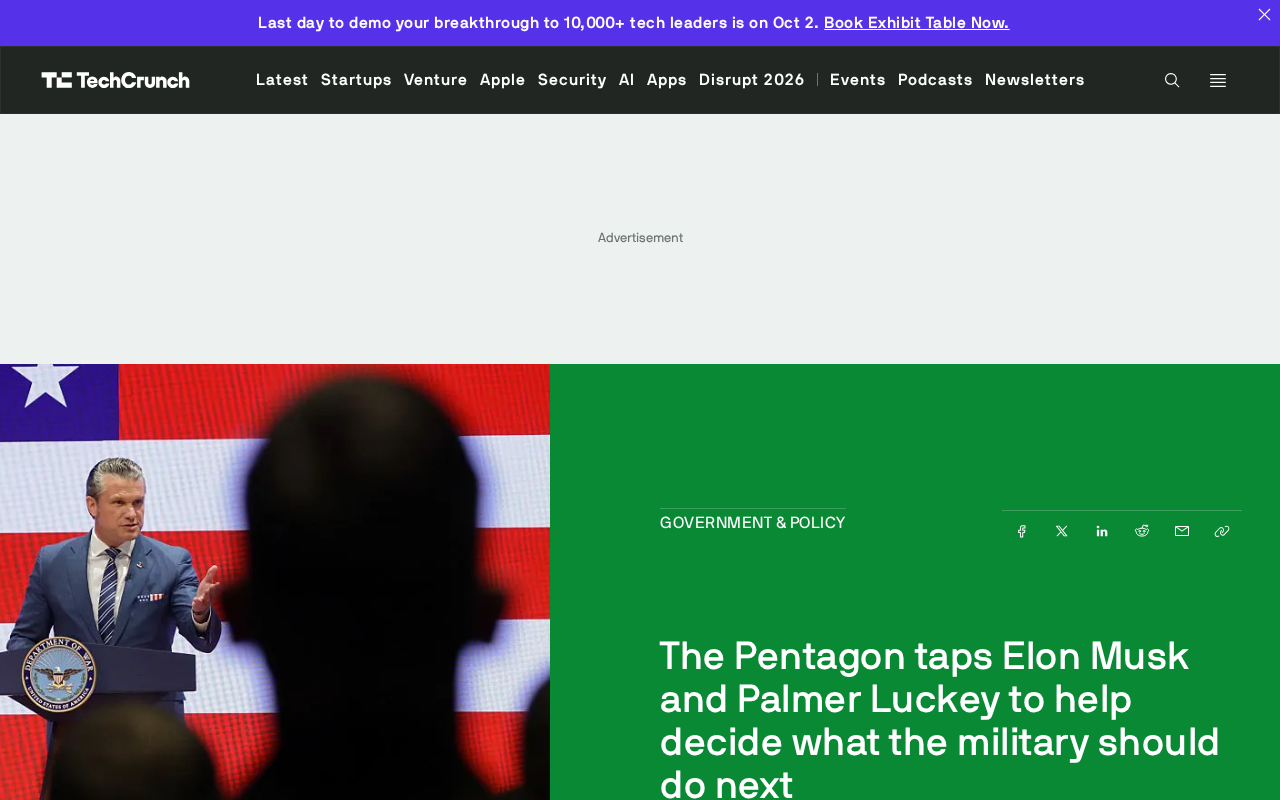
The composition of this group is no coincidence. All three have close ties to the current administration and wield considerable influence at the intersection of technology and defense. Musk's SpaceX is already deeply embedded in military satellite launches and communications, while Luckey's Anduril focuses on autonomous defense systems, drones, and AI-driven military technology — making it one of the fastest-growing defense tech unicorns in recent years.
Questions of Potential Conflicts of Interest
While the arrangement makes political sense, critics were quick to identify the core problem: the companies controlled by Musk and Luckey happen to be selling exactly the kind of technology this study is likely to recommend for procurement.
In other words, having technology vendors define what technology the military should buy in the future inherently carries the risk of a conflict of interest. If the study's conclusions favor autonomous weapons systems, AI combat platforms, or commercial space capabilities, the direct beneficiaries could well be the very companies whose leaders are running the study.
This "referee-and-player" dynamic is the most contentious aspect of these appointments. When it comes to defense procurement budgets that routinely run into the tens or hundreds of billions of dollars, even a slight shift in research direction can translate into enormous commercial gains.
The U.S. federal government has an established regulatory framework for conflicts of interest, centered on the "Organizational Conflicts of Interest" (OCI) provisions in the Federal Acquisition Regulation (FAR) and the Ethics in Government Act applicable to government employees. However, if Musk, Luckey, and others participate as "advisors" or "Special Government Employees" (SGEs) rather than formal employees, the disclosure and recusal obligations that apply to them are significantly weaker. SGEs work no more than 130 days per year and face far fewer financial disclosure and conflict-avoidance requirements than full-time officials. This regulatory gap allows individuals with commercial interests to legally participate in policy recommendations while avoiding full regulatory scrutiny — and it represents the most legally ambiguous gray area in these appointments.
The Deepening Ties Between Tech Giants and Defense
This episode reflects a broader trend: Silicon Valley's technological power is penetrating the U.S. defense establishment at an unprecedented pace. Beyond traditional defense contractors, emerging tech companies like Anduril and SpaceX are reshaping the technological foundation of modern warfare through AI, autonomous systems, and rapid iteration.
Bringing these companies' leaders directly into the strategic decision-making circle does offer real benefits — it can inject cutting-edge perspectives and innovative thinking into the military, compensating for the bureaucratic system's lag in technological sensitivity. But it also blurs the line that should clearly separate commercial interests from public policy decisions.
The 120-day study timeline is relatively compressed, meaning its outputs will likely be directional strategic recommendations rather than detailed implementation plans. Yet it is precisely these high-level recommendations that tend to set the tone for years of subsequent budget allocation and procurement priorities — making their influence difficult to overstate.
Anduril was founded in 2017 by Palmer Luckey (the founder of Oculus VR) and is a defining company in the "DefenseTech" space. Unlike traditional defense contractors such as Lockheed Martin and Raytheon, Anduril uses a software-first development model in the Silicon Valley mold. Its core products include the Lattice AI battlefield management platform, the Sentry Tower autonomous surveillance system, and various drone and counter-drone systems. As of 2024, the company's valuation exceeds $14 billion. On the SpaceX side, its Starlink satellite network has been battle-tested at scale in Ukraine, proving the military value of commercial satellite communications infrastructure; SpaceX also holds multiple launch contracts with the U.S. Air Force and Space Force. The technological trajectories of both companies — autonomous systems, AI-assisted decision-making, low-cost rapid iteration — align closely with the directions a "future warfare" study is likely to point toward, and that alignment is the technical basis for the conflict-of-interest controversy.
What to Watch Going Forward
How the study's final report balances the need for innovation with the need to avoid conflicts of interest will be the key test of its credibility. At a time when the militarization of AI is accelerating, who gets to define "future warfare" — and by what criteria — is itself a question that demands rigorous governance.
For observers tracking the intersection of AI and defense, this appointment is not merely a personnel story. It is a telling case study in how technological power is entering the core of national security decision-making.
Related articles

@ai-sdk/vue 3.0.306 Patch Release Syncs with [email protected] Update
@ai-sdk/vue 3.0.306 released, synced with [email protected]. A routine patch release for the Vercel AI SDK ecosystem with no public API changes; the Vue adapter layer stays version-aligned with the core package.

Gemini 4 Argon API Launches: The Era of Million-Token Output Begins
Google launches Gemini 4 Argon with sparse MoE architecture, up to 1M output tokens, and a 68.90% Vals Index score, available across API, AI Studio, and the Gemini app.

DukaanAI: Turning Product Photos into Inventory Lists with Open-Source AI
DukaanAI is an AI inventory tool for small retailers that turns product photos into inventory entries using the open-source Gemma 3 model, with local inference, editable fields, and CSV export.