People-Pleasing AI Design: Why Cross-Cultural Adaptation Falls Short

Using people-pleasing tendency as a lens, the study finds supportive chatbots perform better overall, but cultural differences appear only in perceived threat.
A collaborative travel-planning experiment with users from Taiwan, China (N=49) and South Korea (N=52) examined supportive vs. challenging chatbot styles and the moderating role of people-pleasing tendency (PPT). Supportive style outperformed challenging style in continuance intention, satisfaction, and trust; PPT did not moderate style-outcome relationships; cultural differences appeared only in perceived threat—higher PPT correlated with stronger baseline threat in Taiwan but not Korea. Generic LLM styles differentially activate cultural scripts, challenging culturally inclusive AI design, though limited samples require further validation.
Research Background: When AI Conversation Styles Collide with Cultural Scripts
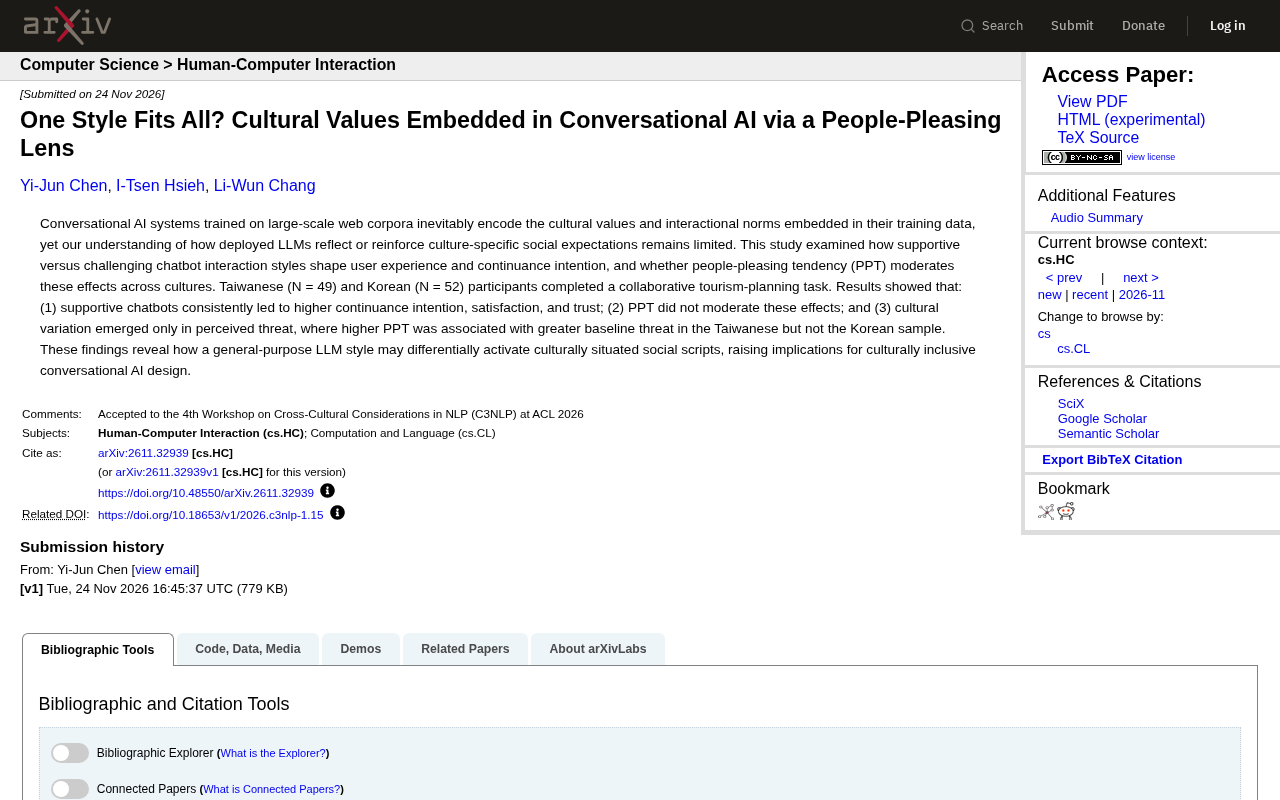
As large language models learn conversational ability from massive web corpora, they inevitably absorb the cultural values and interaction norms embedded in their training data. Yet industry understanding of how these models actually reflect or reinforce culturally specific social expectations in real deployments remains limited. A recent study used "People-Pleasing Tendency" (PPT) as a lens to examine how two chatbot interaction styles—supportive and challenging—affect user experience and continuance intention, and tested PPT's moderating role across cultures.
The study recruited participants from Taiwan, China (N=49) and South Korea (N=52) to complete a collaborative travel-planning task. This task design simulated long-term user-AI interaction in real-world scenarios rather than single-turn Q&A, thus better capturing how continuance intention forms. The results reveal a conclusion worth heeding for AI product designers: generic LLM styles may activate culturally situated social scripts in differentiated ways.
Cultural Scripts is a core concept in social psychology and cross-cultural communication research, first proposed by scholars analyzing speech acts. It refers to the shared, default interaction patterns and expectations of a cultural group in specific social situations—for example, how to express requests, refusals, apologies, or agreement. Cultural scripts are often internalized in individual cognition; users follow them without deliberate awareness, making them prone to misreading in cross-cultural contact. In the context of conversational AI, the response patterns models acquire from training corpora may likewise carry traces of culturally specific scripts. When products are deployed in different markets, these implicit scripts collide with local users' existing expectations. Understanding this concept helps grasp the theoretical origin of the study's core claim that "generic LLM styles activate cultural scripts differentially."
Key Findings: Supportive Style Wins, but Cultural Differences Lurk Beneath
The study reached three key conclusions. First, supportive chatbots consistently outperformed the challenging style across continuance intention, satisfaction, and trust. This means that regardless of users' cultural backgrounds, gentle, affirming conversational approaches yield better user experience. Second, PPT did not moderate the relationship between supportive style and outcome variables—in other words, users with a strong people-pleasing tendency did not show stronger preference differences simply because the bot "catered" to them.
The third point reveals the subtlety of cultural differences: cultural variation appeared only in the "perceived threat" variable. In the Taiwan sample, users with higher PPT had stronger baseline perceived threat; in the Korean sample, this association was not significant. The researchers argue this suggests generic LLM styles may trigger different social-script reactions across cultures.
Perceived Threat in this study refers to the subjective concern users experience when interacting with a chatbot—that their autonomy, social identity, or face might be undermined. It differs from general technological trust and is closer to the "self-threat" category in social psychology: when AI response styles deviate from users' familiar social norms, users may feel offended, manipulated, or socially challenged, even if the task itself is completed well. Perceived threat is a baseline psychological variable at the experiential level that fluctuates with culturally situated expectations about authority, sincerity, and ingratiation. Researchers therefore selected it as a sensitive indicator for testing cultural differences and as a sentinel variable that surfaces cultural effects earlier than outcome variables such as continuance intention.
Design Implications: The Cultural Blind Spot Behind Generic Styles
These findings reveal how generic LLM styles differentially activate culturally situated social scripts, offering implications for culturally inclusive conversational AI design.
For AI product teams, the value of this research lies in puncturing a common assumption: that a "good" conversational style can be directly reused across all markets. Although the supportive style performs better overall, the cultural differences in perceived threat indicate that users' trust foundation toward AI is not a blank slate—it is constrained by existing expectations about "ingratiation," "sincerity," and "authority" in local social scripts.
The study also suggests that the personality variable of people-pleasing tendency is not the key switch for moderating interaction effects as intuition might suggest. If product design attempts to drive stickiness among high-PPT users through "more people-pleasing," it may yield little; what truly needs fine-grained handling is the baseline difference in threat perception across cultural contexts.
Moderation Effect is a relational model in statistical analysis where a variable (the moderator) changes the direction or strength of the relationship between two other variables. In this study, people-pleasing tendency (PPT) was hypothesized as a moderator to test whether it amplifies or attenuates the impact of chatbot style on satisfaction, trust, and continuance intention. Results showed no moderation effect, meaning PPT level does not change users' relative preference for supportive versus challenging styles. This null result is also methodologically valuable: it rules out personality factors as a primary explanatory pathway, directing attention toward cultural explanations, and reminds product teams not to simplistically attribute user stickiness to ingratiating personality traits.
Limitations and Further Reflections
The study's sample size is limited (49 in Taiwan, 52 in Korea) and focuses on the specific collaborative task of travel planning. Whether results generalize to high-stakes scenarios such as customer service, education, or mental health requires further validation. Additionally, the study compared only two extreme styles—supportive and challenging. Whether the "neutral" styles abundant in real products also trigger cultural differences remains an open question.
From a broader perspective, this research offers an operational measurement entry point for "culturally inclusive AI": rather than broadly discussing cultural adaptation, it pinpoints specific psychological variables like perceived threat to guide prompt strategies, dialogue strategies, and even model fine-tuning directions. For conversational AI products deployed across multiple markets, such empirical research offers more actionable guidance than mere interface localization.
One-line Summary
Using people-pleasing tendency as a lens, the study finds supportive chatbots perform better overall, but cultural differences appear only in perceived threat.
Paragraph Summary
A collaborative travel-planning experiment with users from Taiwan, China (N=49) and South Korea (N=52) examined how supportive versus challenging chatbot styles affect user experience and tested the moderating role of people-pleasing tendency (PPT). Results show supportive style outperforms challenging style in continuance intention, satisfaction, and trust; PPT did not moderate the relationship between style and outcome variables; cultural differences appeared only in perceived threat—higher PPT correlated with stronger baseline perceived threat in the Taiwan sample but not in Korea. The study concludes that generic LLM styles differentially activate culturally situated social scripts, posing challenges for culturally inclusive conversational AI design, though limited sample size warrants further validation.
Related articles

Michael Nielsen Takes Down His Classic Neural Network Textbook, Sparking Community Discussion
Michael Nielsen's classic free textbook Neural Networks and Deep Learning has been taken offline, sparking discussion on Hacker News about the reasons and impact.

Inside the AI Training Data Market: The Trade-off Between Exclusivity and Discounts
G2i founder Gabe Greenberg reveals the dual-track pricing of the AI training data market: labs pay a premium for exclusive data or accept discounts that allow others to buy it.

SessionGraph: Unifying All Coding Agent Sessions in One Interactive Graph
SessionGraph aggregates coding agent sessions into an interactive graph, helping developers review, debug, and manage AI coding workflows across sessions. This article examines its positioning, value, and open questions.