Per-Task Pricing: The Key Metric for AI Competitiveness

A tweet argues AI services should adopt per-task pricing, tying cost directly to real output value.
A tweet sparked debate on AI pricing, arguing that per-task pricing — not token usage or monthly subscriptions — is the true metric of competitiveness. Users care about what it costs to get something done, not how many tokens were consumed. The post also champions a product philosophy of lowering barriers to encourage heavy AI use, framing it as critical to a new "renaissance." Advocating for task-based pricing is itself a competitive move — one that shifts the industry conversation from technical metrics to user value.
A Tweet That Sparked a Pricing Debate
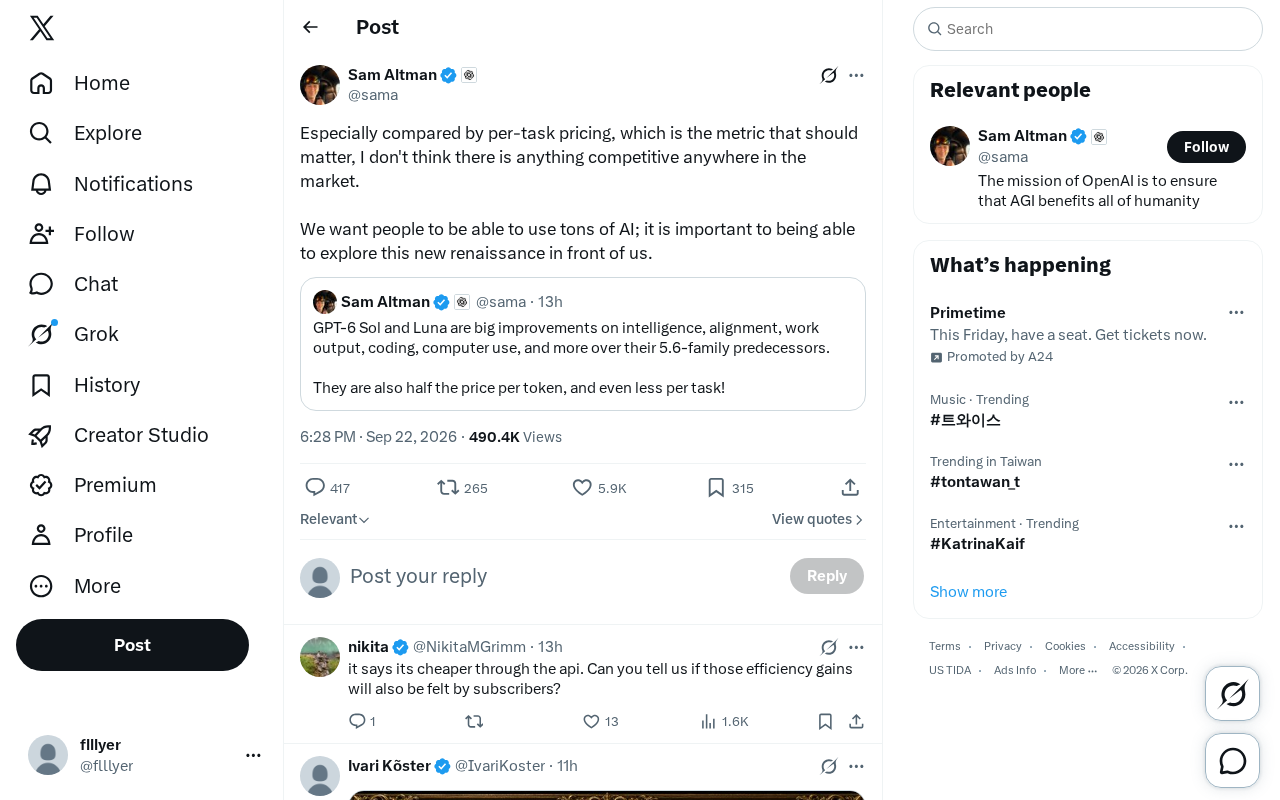
A tweet from the tech world recently ignited a discussion about how AI services should be priced. The author put forward a thought-provoking argument: the key metric for evaluating AI product competitiveness should be "per-task pricing," not the other common billing methods in use today.
The original post was direct and confident: "Especially comparing on per-task pricing — which is the metric you should actually care about — I don't think anything in the market can compete with it right now." Behind these words lies a fundamental rethinking of how AI services are monetized.
Why Per-Task Pricing Deserves Attention
AI services today are billed in all sorts of ways: flat monthly subscriptions, per-token usage fees, and per-API-call charges, to name a few. Each has its limitations — subscriptions fail to reflect actual usage intensity, while token-based billing makes it hard for users to estimate the real cost of any given task.
Per-task pricing offers a different lens: users rarely care about how many tokens they consumed — what they care about is "how much does it cost to get a specific thing done?" Whether it's generating a report, fixing a bug, or running a data analysis, per-task pricing ties cost directly to the value of a concrete output, making cost-effectiveness comparisons far more intuitive.
From a business logic standpoint, this is also a pricing dimension that maps more naturally to how users think. When organizations evaluate whether to adopt an AI tool, "how much does it cost to complete one task" is a far easier decision-making criterion than abstract technical usage metrics.
In practice, per-task pricing isn't an entirely new concept — but applying it to AI comes with unique challenges. In traditional software, task boundaries are relatively well-defined (a single translation, a single image processing job), making standardized pricing straightforward. AI tasks, however, vary enormously in complexity. Fixing one line of code and refactoring an entire module might both count as "one task." Determining the right task granularity and preventing users from gaming the system by splitting tasks are central design challenges. On the platform side, per-task pricing also requires accurate backend tracking of the compute consumed per task and a sound cost model — technically more complex than simply counting tokens. Some AI coding tools (such as certain agent-based products) have already begun experimenting with billing per "successfully merged PR" or "resolved issue," offering early reference points for the industry — but broad adoption is still a work in progress.
The Product Philosophy of "Getting People to Use AI Heavily"
Another line in the tweet is equally worth unpacking: "We want people to use a lot of AI; it's critical for exploring the new renaissance in front of us."
This reflects a clear product philosophy — lower the barrier to entry and encourage high-frequency use. Framing the current AI wave as a "renaissance" signals a belief that AI is ushering in an era of explosive creativity and productivity, and that affordable, transparent pricing is the key lever for driving mass adoption.
This thinking aligns with the flywheel strategy some AI companies pursue: use scale to drive down per-unit costs, then use low prices to stimulate even greater scale. When the cost per task is low enough, users are more willing to experiment and explore, which in turn unlocks AI's full application potential.
The Competitive Strategy Behind the Pricing Model
It's worth noting that shifting the pricing metric from "usage volume" to "task completion" is itself a competitive stance. It attempts to move the conversation away from technical parameters and back toward the value users actually receive.
If a company genuinely believes it holds a significant advantage in cost-per-task, actively championing that as the industry benchmark is both a show of confidence and an attempt to redefine the rules of competition. For the industry as a whole, this may be a reminder: the real battle in AI services ultimately comes down to a simple question — how much actual output can a user get for every dollar spent?
Token-based billing remains the dominant model at the large model API layer, and for good reason — both technical and commercial. Tokens are the smallest unit by which large language models process text (roughly half to one English word, or half a Chinese character), and inference costs correlate closely with total input and output token counts. Billing by token therefore most directly reflects the marginal cost on the supply side. For model providers like OpenAI, Anthropic, and Google, token pricing makes it easier to maintain predictable gross margins across different usage scales. However, for developers and enterprise users building applications on top of these models, the mapping between token consumption and business outcomes is far from intuitive — and that is precisely why the per-task pricing narrative resonates with users. It translates the supply-side cost structure into a demand-side value language that's far easier to understand.
Conclusion
Given that the original source was a brief tweet, this article has largely been an interpretation and extension of the ideas it raised. But the core question it surfaces — that AI pricing should use task value, not technical consumption, as its yardstick — genuinely touches on a pivotal issue in AI commercialization. As AI applications continue to mature, innovation in pricing models may well become one of the key variables determining how quickly these products reach widespread adoption.
Related articles

Chain of Thought Isn't Just for AI: How Humans Can Use CoT to Improve Thinking Quality
Chain of Thought isn't just a prompt trick for large models. Starting from a Hacker News discussion, this article analyzes why CoT works for human thinking too, breaks down actionable ways to transfer it, and highlights the key differences between human CoT and machine CoT.
Cloudflare Teams Up with OpenAI: Closi…
Cloudflare Teams Up with OpenAI: Closing the Loop from Vulnerability Discovery to Defense with AI
Cloudflare uses OpenAI Daybreak to investigate security vulnerabilities and generate reviewable remediation plans, while developers use Codex to boost coding efficiency and quality.

Orca Multi-Agent Orchestration in Practice: A Guide to Parallel Collaboration with Claude and Codex
Orca is Stable AI's free open-source agent workbench supporting 34 agents like Claude Code and Codex in parallel. Learn its Git worktree isolation, multi-model orchestration, and mobile management.