Percepta Unveils Spotlight Architecture: Decoupling Memory from Intelligence So Models Can Grow Without Retraining

Percepta's Spotlight claims unbounded memory growth at constant cost by decoupling intelligence from addressable memory — but lacks independent validation.
AI startup Percepta has introduced the Spotlight architecture, which claims to decouple a fixed-size "intelligence module" from an infinitely expandable, writable external memory — bypassing the O(n²) bottleneck of Transformer attention. Spotlight asserts "arbitrarily sparse" memory addressing where the number of cells accessed stays constant regardless of memory pool size, going further than MoE's proportional activation. Since skills and knowledge can both be written into memory, models could theoretically acquire new capabilities without retraining. The approach touches on long-standing challenges like continual learning and catastrophic forgetting, but all claims come solely from Percepta's own blog with no independent benchmarks or peer review — making this a direction worth monitoring rather than a proven breakthrough.
AI startup Percepta has publicly unveiled a new architecture called Spotlight, with the core claim of completely separating a model's "intelligence" from its "memory" — allowing knowledge and skills to grow continuously without ever changing the model's weights. This design targets a fundamental bottleneck in current Transformer architectures: the quadratic scaling of attention mechanism costs with context length.
What Problem Does Spotlight Aim to Solve
Existing large models rely on attention mechanisms to process context, but attention comes with an unavoidable tradeoff: the larger the memory capacity, the higher the access cost per token. Neither standard attention nor its various sparse variants have truly escaped this constraint.
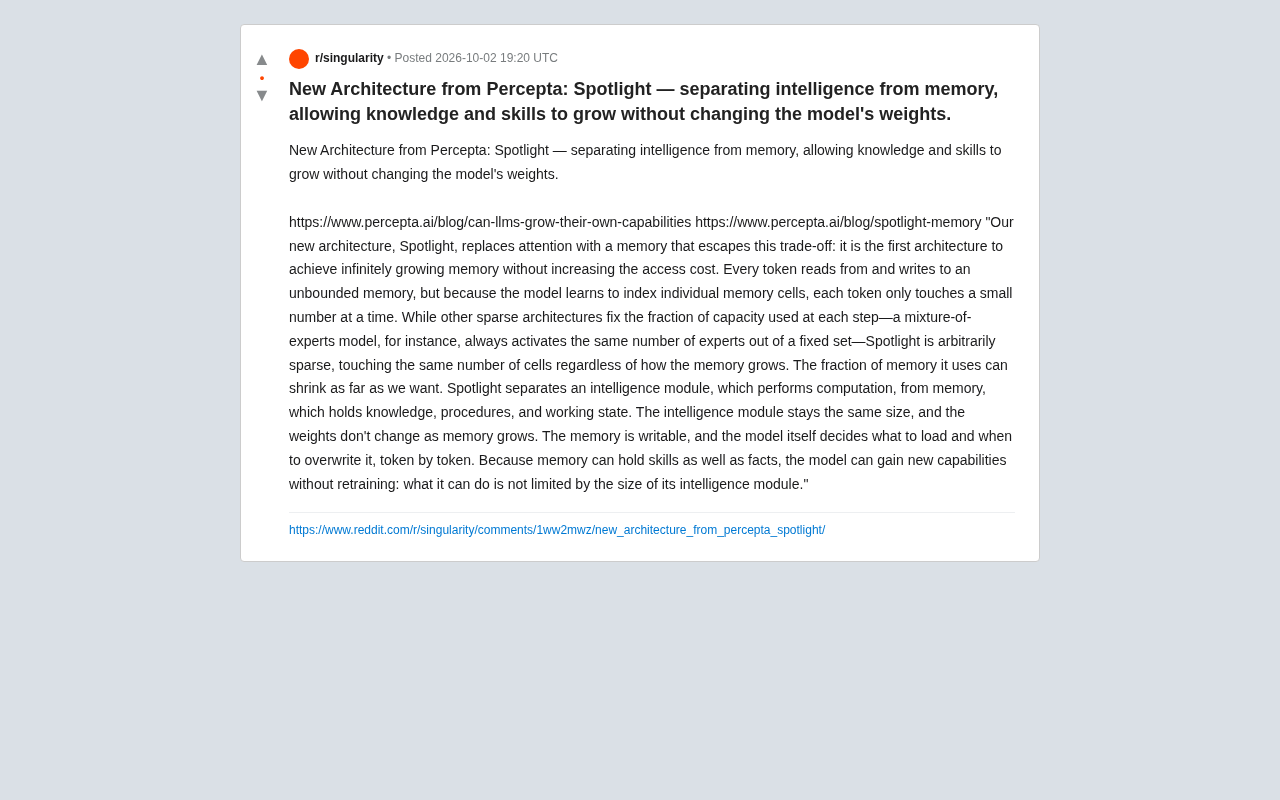
According to Percepta's blog, Spotlight "replaces attention with a memory mechanism that escapes this tradeoff," claiming to be the first architecture to achieve unbounded memory growth without increasing access costs. If this holds true, it means a model could process and store information at arbitrary scale with near-constant computational overhead.
The quadratic complexity of attention (O(n²)) means that when processing a sequence of length n, every token must compute similarity scores against all other tokens — causing both compute and memory usage to grow quadratically with sequence length. Double the sequence length and the cost quadruples. To address this, researchers have proposed various sparse and linear attention schemes such as Longformer, FlashAttention, and RetNet, but these fundamentally still optimize how attention is computed, rather than changing the underlying logic that longer context means higher overall cost. Spotlight's claim is to sidestep this tradeoff at the mechanism level, rather than patching it within the Transformer framework.
Core Mechanism: Arbitrarily Sparse Addressable Memory
The key to Spotlight lies in how memory is organized. Each token can read from and write to an unbounded memory, but the model learns to index individual memory cells — so each token only ever touches a tiny fraction of that memory at a time.
This stands in sharp contrast to Mixture-of-Experts (MoE) models. The blog specifically highlights this distinction: MoE always activates a fixed number of experts from a fixed set, with the proportion of capacity used hardcoded; Spotlight is arbitrarily sparse — no matter how large the memory grows, the number of cells touched remains constant, meaning the fraction of memory accessed can shrink indefinitely.
In other words, MoE still incurs proportional costs as it scales, whereas Spotlight claims to maintain constant access costs even as memory expands. This is the technical differentiator it puts forward relative to existing sparse architectures.
Mixture of Experts (MoE) is an architecture that splits a neural network into multiple "expert" sub-networks, with a gating network activating only a few of them during inference — enabling enormous total parameter counts while controlling per-inference compute. Models like GPT-4 and Mixtral use this design. MoE's sparsity is proportional: as the number of experts grows, the number activated typically scales linearly as well, so overall access cost is not strictly constant. Spotlight's claimed "arbitrary sparsity" means that no matter how many times the memory pool expands, the absolute number of memory cells accessed per step stays fixed — a more radical form of decoupling. If true, this would represent a significant architectural differentiator in the sparse architecture space.
Decoupling the Intelligence Module from Memory
Spotlight splits the system into two components:
- Intelligence module: Handles computation; fixed in size, with weights that do not change as memory grows.
- Memory: Stores knowledge, procedures, and working state.
The most intriguing aspect here is that memory is writable, and the model itself decides token-by-token what to load and when to overwrite. Memory can store not just facts, but also "skills."
This leads to Percepta's boldest claim: the model can acquire new capabilities without retraining. What it can do is no longer bounded by the size of the intelligence module. In conventional thinking, a model's capability ceiling is largely determined by its parameter count; in Spotlight's framework, capability expansion is offloaded to an ever-growing memory store.
Why This Direction Is Worth Watching
Whether LLMs can "grow their own capabilities" is actually the title of another Percepta blog post — and it touches on topics the industry has long debated: continual learning, long-term memory, and avoiding catastrophic forgetting. Current mainstream approaches — RAG-based retrieval, fine-tuning, expanding context windows — are all patches applied within the Transformer framework. Spotlight attempts to redefine memory at the architectural level.
If memory can grow without bound at constant access cost, and skills can also be written into memory, then a fixed-size "intelligence core" paired with an ever-expanding memory store could theoretically evolve continuously. This could have significant implications for inference costs, model update workflows, and deployment paradigms.
Continual Learning and Catastrophic Forgetting are classic challenges in deep learning: when neural networks learn new tasks, they tend to overwrite weights for old tasks, causing sharp degradation of prior capabilities. Current industry approaches include Retrieval-Augmented Generation (RAG), which separates external knowledge from the model; parameter-efficient fine-tuning methods like LoRA, which minimize weight changes via low-rank matrices; and context window expansion, which stuffs historical information directly into the input. These approaches share a common limitation: they still rest on the Transformer's attention mechanism, and cannot fundamentally resolve the tension between long-term memory and compute costs. Spotlight's approach of writing both "skills" and "knowledge" into an external addressable memory is architecturally closer in spirit to early work on Neural Turing Machines (NTM) and Memory-Augmented Neural Networks (MANN) — a continuation and radicalization of that research lineage.
The Caution We Should Maintain
It must be noted that all current information comes from Percepta's own blog — a single-source vendor claim. Several of the core assertions — "the first to achieve unbounded memory growth," "no increase in access cost," "new skills without retraining" — are quite aggressive, and there is as yet no independent benchmarking, peer review, or reproducible experimental data to support them.
The specific implementation of "indexing individual memory cells," training stability, write conflict and forgetting control, and real-task performance are all critical to evaluating this architecture's real-world merit — and none of these are clearly addressed in the available public materials. For any new architecture claiming to "replace attention," history reminds us: the gap between elegant theory and stable, scalable practice tends to be enormous.
Pending further evidence, Spotlight is best regarded as a research direction worth tracking — not a confirmed breakthrough.
Related articles

Chain of Thought Isn't Just for AI: How Humans Can Use CoT to Improve Thinking Quality
Chain of Thought isn't just a prompt trick for large models. Starting from a Hacker News discussion, this article analyzes why CoT works for human thinking too, breaks down actionable ways to transfer it, and highlights the key differences between human CoT and machine CoT.
Cloudflare Teams Up with OpenAI: Closi…
Cloudflare Teams Up with OpenAI: Closing the Loop from Vulnerability Discovery to Defense with AI
Cloudflare uses OpenAI Daybreak to investigate security vulnerabilities and generate reviewable remediation plans, while developers use Codex to boost coding efficiency and quality.

Orca Multi-Agent Orchestration in Practice: A Guide to Parallel Collaboration with Claude and Codex
Orca is Stable AI's free open-source agent workbench supporting 34 agents like Claude Code and Codex in parallel. Learn its Git worktree isolation, multi-model orchestration, and mobile management.