Perceptual Display Engine: Deep Dive into a Frame-Accurate Video Control Engine

A frame-accurate experimental video engine designed for fine-grained control of multi-source AIGC content.
The Perceptual Display Engine is an experimental tool offering frame-accurate video switching, playback manipulation, and perceptual render interventions. Positioned as the final stage in an AIGC pipeline alongside Midjourney and Uisato Studio, it addresses the growing need for precise control over AI-generated video assets, reflecting the broader shift from single-tool workflows to specialized toolchain collaboration.
An Experimental Video Playback Engine for Creators
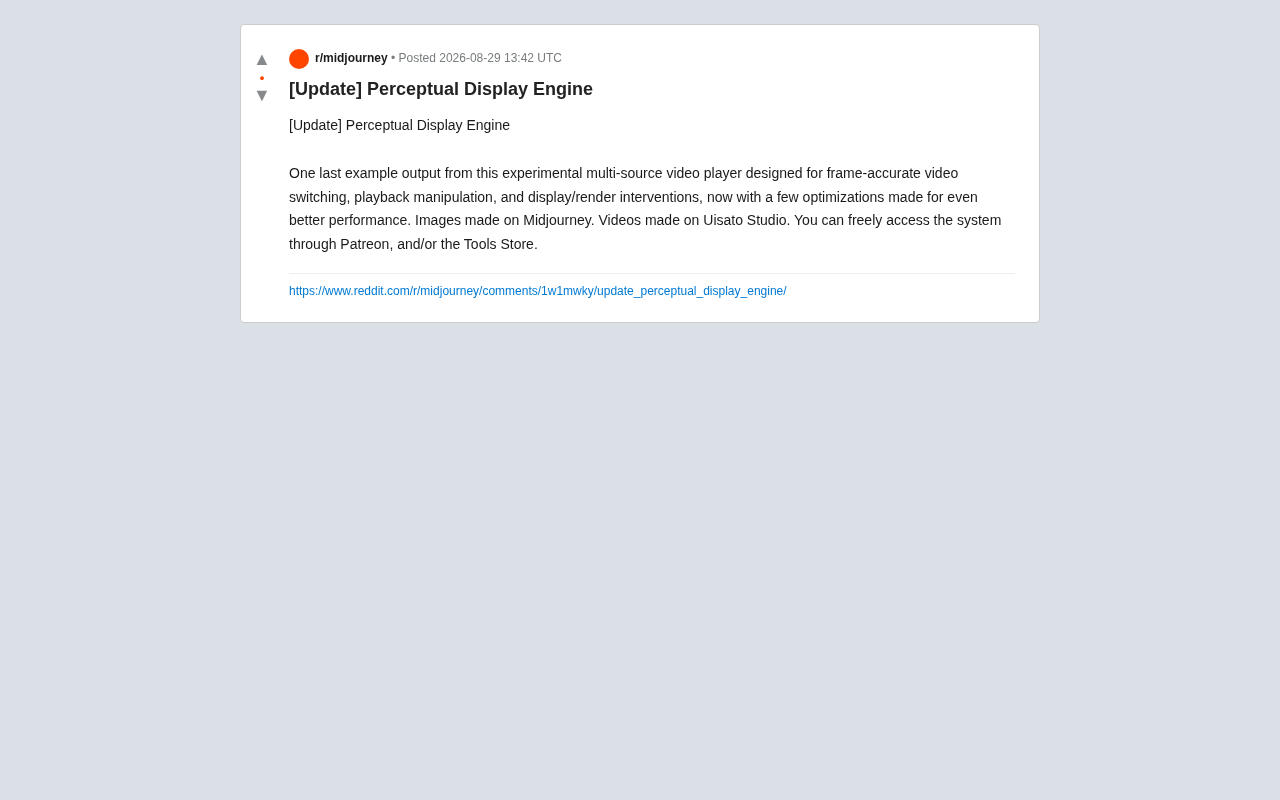
As AI-generated content becomes increasingly prevalent, how to integrate, control, and present multi-source materials with greater precision has become a core technical challenge for creators. Recently, an experimental tool called Perceptual Display Engine posted its latest update on the Reddit community, showcasing its outstanding capabilities in frame-accurate video switching, playback manipulation, and display/render intervention.
According to the developer, this is an experimental system designed specifically for "multi-source video playback." Its core objective isn't simply playing video—it's providing fine-grained control over the video presentation process, from frame-to-frame precision switching to real-time render pipeline intervention.
What Problems Does Frame-Accurate Video Control Solve?
Traditional video players are positioned around "reproduction"—faithfully recreating original video content. The Perceptual Display Engine, on the other hand, leans toward "manipulation" and "intervention," as clearly demonstrated by its three core features.
Frame-Accurate Switching
Multi-source video switching is nothing new in professional editing and live streaming scenarios, but achieving "frame-level accuracy" is far from trivial. The keyframe (I-frame) and predictive frame (P/B-frame) structure in video encoding makes random seeking inherently complex.
To understand the technical roots of this challenge, one must grasp the frame structure of modern video encoding. Taking the widely used H.264 and H.265 standards as examples, video streams are organized into GOP (Group of Pictures) structures: I-frames serve as keyframes that independently encode complete image data, P-frames reference previous frames through forward prediction, and B-frames reference both preceding and following frames for bidirectional prediction. This layered dependency design dramatically improves compression efficiency—in a typical GOP, an I-frame might occupy tens of kilobytes, while P/B-frames need only a few KB to describe differences from reference frames. However, the tradeoff is that random access becomes difficult: to decode a given P-frame or B-frame, the system must first decode the entire reference frame chain it depends on. When performing seek operations, traditional players can typically only jump to the nearest I-frame and then decode frame by frame to reach the target position, resulting in noticeable latency.
Seamlessly switching between multiple video sources at any arbitrary frame position means the system must perform deep optimization at the decoding level—maintaining multiple parallel decoding contexts, managing pre-decode buffers, and even keeping partially decoded states of multiple video streams in memory. This places extremely high demands on memory management and CPU/GPU scheduling, and is the core focus of the "performance optimization" in this update.
Playback Manipulation
Playback manipulation encompasses a range of timeline intervention capabilities including variable speed, reverse playback, looping, and frame skipping. For AI-generated video assets, this type of control is particularly important—generated content often requires secondary arrangement to form coherent narratives or visual rhythms.
Display/Render Interventions
This is the most "experimental" aspect of the engine. The term "perceptual display" implies that the system incorporates considerations of human visual perception characteristics into the rendering pipeline, applying real-time interventions at the display layer to influence the final visual output.
The human visual system is far from a linear passive receiver. The Weber-Fechner law reveals that our perception of brightness changes follows a logarithmic relationship—in dark scenes, extremely subtle brightness changes can be detected, while in highlights, even relatively large brightness differences may go unnoticed. Additionally, the human eye is significantly more sensitive to green light than blue, and in the temporal dimension, it perceives frame rate changes in motion areas far more acutely than in static regions. The concept of perceptual coding has long been validated in the audio domain—MP3 encoding achieves efficient compression by leveraging psychoacoustic models to remove frequency components imperceptible to the human ear. Bringing a similar philosophy to the video display layer means the system can dynamically adjust rendering precision, color mapping strategies, and frame rate allocation based on scene content, concentrating limited computational resources on visual regions and time segments where the human eye is most sensitive—thereby significantly improving subjective visual quality without increasing absolute data volume.
This philosophy sets it apart from traditional players, positioning it closer to a programmable visual presentation platform.
The Complete AIGC Production Pipeline
Here's a notable detail: the developer explicitly stated the sources of the demo materials—static images were generated by Midjourney, and videos were produced by Uisato Studio. This effectively outlines a complete AIGC content production pipeline:
- Image Generation Stage: Midjourney generates concept art and keyframe assets
- Video Generation Stage: Uisato Studio transforms static assets into dynamic video
- Playback & Control Stage: Perceptual Display Engine handles final integration, switching, and precise presentation
Midjourney, as one of the most influential AI image generation tools today, is based on Diffusion Model technology and generates high-quality artistic-style images from text prompts. Unlike Stable Diffusion's open-source approach, Midjourney operates as a closed-source cloud service. Its core strength lies in precise aesthetic control—generated images excel in color harmony, compositional quality, and artistic expressiveness, making it the go-to tool for concept design, visual reference, and keyframe creation. In the AIGC production pipeline described above, Midjourney serves the role of "visual concept anchoring," providing high-quality starting materials for downstream video generation.
This pipeline reflects a clear trend: AI creation is evolving from "individual tools" to "toolchain collaboration." The AIGC space is undergoing a paradigm shift from the "Swiss Army knife" to the "professional toolbox." In the early days, users expected a single model to handle everything from text to final output. But as quality demands rise and workflows grow more complex, a division-of-labor toolchain model is emerging. This trend parallels the evolution of DevOps toolchains in traditional software development—progressing from monolithic IDEs to organic combinations of specialized tools like Git version control, CI/CD continuous integration, and container orchestration. In the AIGC space, the popularity of workflow orchestration tools like ComfyUI has already begun validating this direction.
A single generative model solves the "creating something from nothing" problem, while downstream tools like the Perceptual Display Engine focus on the critical question of "how to better use and present generated content." Going forward, the middleware connecting these stages—including format conversion, metadata passing, and version management capabilities—may become an underestimated but crucial value layer in the AIGC tool ecosystem.
Access and Business Model
In terms of access, the developer has adopted a business model common among indie developers: users can subscribe via Patreon for ongoing support, or obtain system access on demand through the Tools Store.
Patreon was founded in 2013, originally serving musicians and artists, and has since evolved into a core platform for independent developers to secure sustained funding. Unlike traditional one-time payment models, Patreon's monthly subscription mechanism provides developers with a predictable revenue stream, enabling continuous iteration and optimization even before a product is fully mature. This model is particularly well-suited for experimental tools—users are essentially investing in a direction they believe in, rather than purchasing a finished product.
This "subscription + tool store" dual-track model is becoming increasingly common among independent AI tool developers. The Patreon side builds stable community support and recurring revenue, cultivating a core user base and gathering early feedback; the tool store side targets a broader market with more flexible pay-as-you-go options. For frequently iterated experimental tools, this model can progressively validate market demand while preserving development freedom. The risk is that subscriber churn rates may be relatively high, but the advantage is that it preserves the developer's creative autonomy, avoiding the directional constraints that external investment might impose.
Trend Observations and Future Outlook
Judging from this update, the Perceptual Display Engine is still in an experimental exploration phase—the developer is more focused on demonstrating concepts and capability boundaries than launching a mature commercial product. However, several directions it touches on deserve close attention:
The demand for AIGC content manipulation is on the rise. When AI-generated content becomes cheap and abundant, how to arrange, switch, and present these assets actually becomes the key differentiator for creative work. Generation itself is being de-skilled, while fine-grained control and creative arrangement of generated results will become the core capability distinguishing professional creators from casual users.
Professional-grade capabilities are trickling down to indie tools. Capabilities like frame-accurate switching used to exist only in professional non-linear editing software (such as Avid Media Composer, DaVinci Resolve) or broadcast-grade switcher systems, often requiring tens of thousands of dollars in hardware and software investment. Now independent developers are attempting to productize these capabilities and lower the barrier to entry, aligning with the broader software industry trend of "democratizing professional capabilities."
Perceptual optimization may become the new frontier in video presentation. The introduction of the "perceptual" concept suggests that future video presentation may increasingly incorporate human visual characteristics for targeted optimization, rather than merely pursuing absolute fidelity in technical metrics. This philosophy shares common ground with the "perceptual quality optimization" already practiced by streaming platforms like Netflix (Per-Title Encoding, dynamic bitrate allocation), but bringing it down to the client-side rendering layer opens up new creative possibilities for creators.
For AI creators and tech enthusiasts, while experimental tools like this aren't yet fully mature, the directions they explore often foreshadow the evolutionary path of next-generation creative tools.
Key Takeaways
Related articles

Chain of Thought Isn't Just for AI: How Humans Can Use CoT to Improve Thinking Quality
Chain of Thought isn't just a prompt trick for large models. Starting from a Hacker News discussion, this article analyzes why CoT works for human thinking too, breaks down actionable ways to transfer it, and highlights the key differences between human CoT and machine CoT.
Cloudflare Teams Up with OpenAI: Closi…
Cloudflare Teams Up with OpenAI: Closing the Loop from Vulnerability Discovery to Defense with AI
Cloudflare uses OpenAI Daybreak to investigate security vulnerabilities and generate reviewable remediation plans, while developers use Codex to boost coding efficiency and quality.

Orca Multi-Agent Orchestration in Practice: A Guide to Parallel Collaboration with Claude and Codex
Orca is Stable AI's free open-source agent workbench supporting 34 agents like Claude Code and Codex in parallel. Learn its Git worktree isolation, multi-model orchestration, and mobile management.