Perplexity AI Goes Local with RTX GPU Support: Privacy and Performance Combined
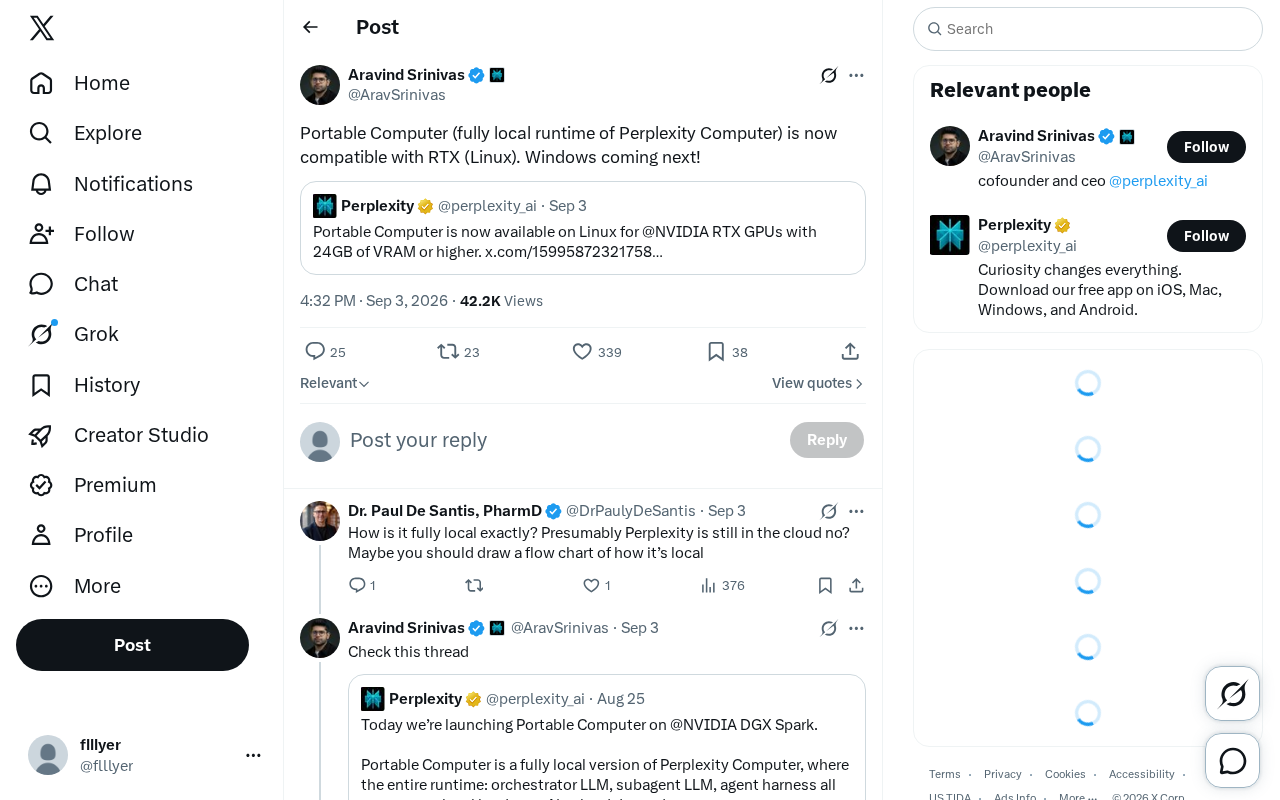
Perplexity AI's Portable Computer now runs locally with NVIDIA RTX GPU support for private, fast AI.
Perplexity AI has launched Portable Computer, a fully local runtime environment with NVIDIA RTX GPU support on Linux, with Windows coming soon. It enables private, low-latency AI search and reasoning on personal hardware, leveraging Tensor Cores for multi-fold performance gains. Combined with Perplexity's unique RAG capabilities, it offers an end-to-end local AI search experience that rivals cloud services.
Perplexity AI Goes Local with RTX GPU Support: Privacy and Performance Combined
Recently, the Perplexity AI team announced that its local runtime environment, Portable Computer, now fully supports NVIDIA RTX GPUs on Linux, with a Windows version coming soon. This marks a significant milestone as AI search and reasoning tools officially enter a new era of fully local, high-performance computing.
Perplexity AI was founded in 2022 by former OpenAI researcher Aravind Srinivas, positioning itself as an "answer engine" rather than a traditional search engine. It combines the generative capabilities of large language models with real-time web retrieval, delivering structured answers with source citations. As of 2024, Perplexity has completed multiple funding rounds with a valuation exceeding $9 billion, making it one of the most influential unicorns in the AI search space. The launch of Portable Computer represents a pivotal step in its transition from a purely cloud-based service to a hybrid deployment model.
Portable Computer: Running AI Entirely On-Device
Portable Computer is the fully local version of Perplexity Computer, allowing users to run Perplexity's AI capabilities on their own hardware without relying on cloud servers. This design aligns perfectly with the current "edge computing" and "local-first" trends in the AI industry.
Edge Computing is a computing paradigm that moves data processing from the cloud to local devices closer to the data source. In the AI domain, this trend is known as "local-first" or "on-device AI," driven by increasingly strict data sovereignty regulations (such as GDPR and China's Data Security Law), rising cloud API costs, and growing user privacy awareness. Apple Intelligence, Qualcomm's AI PC strategy, and Meta's open-sourcing of the Llama model for local deployment are all prime examples of this trend.
Compared to cloud-based solutions, local execution offers clear advantages:
- Data Privacy: All data is processed locally without being uploaded to the cloud, fully complying with data sovereignty regulations
- Response Speed: Zero network latency with instant results
- Offline Availability: Works regardless of network connectivity — even in airplane mode or unstable network environments
- Cost Transparency: No API call fees to worry about, especially beneficial for high-frequency use cases
For enterprise users and privacy-conscious developers, this fully local solution delivers significant value.
RTX GPU Acceleration: Multi-Fold Performance Gains
NVIDIA's RTX series GPUs are equipped with dedicated Tensor Cores specifically optimized for AI inference and deep learning tasks. Tensor Cores are specialized matrix computation units introduced by NVIDIA starting with the Volta architecture (2017), designed specifically for the fused multiply-add (FMA) operations central to deep learning. Compared to traditional CUDA Cores, Tensor Cores can complete 4x4 matrix multiply-add operations in a single clock cycle, boosting AI inference and training throughput by several times. In the RTX 40 series (Ada Lovelace architecture), fourth-generation Tensor Cores added FP8 precision support, doubling inference efficiency yet again. This means even a consumer-grade RTX 4060 is capable of running medium-scale large language models.
RTX support in Portable Computer brings substantial improvements:
Dramatically Faster Inference: Leveraging the parallel computing power of RTX GPUs, LLM inference speed can improve by several times or even an order of magnitude, enabling local AI applications to match or even exceed the response speed of some cloud services.
Support for Larger Models: High-end GPUs like the RTX 4090, with 24GB of VRAM, can run open-source models with 7 billion to 13 billion parameters, providing a more powerful foundation for local AI applications. It's worth noting that VRAM is the most critical hardware bottleneck when running LLMs locally. Using FP16 (half-precision floating point) format as an example, each billion parameters requires approximately 2GB of VRAM. Thus, a 7B parameter model needs about 14GB, and a 13B model about 26GB. However, through quantization techniques (such as GPTQ, AWQ, and 4-bit quantization in GGUF format), VRAM requirements can be reduced to roughly one-quarter — a 7B model needs only about 4GB, and a 13B model about 8GB. This makes even the RTX 3060 (12GB) and lower-tier GPUs capable of running reasonably sized models. While quantization introduces some precision loss, it's typically imperceptible in practical use.
Lower Long-Term Costs: For high-frequency use cases, the marginal cost of local GPU inference is far lower than token-based cloud API pricing, offering significant economic advantages over time. Using GPT-4o's API pricing as a benchmark, the ROI on an RTX 4090 investment could be achieved in just a few months under heavy usage scenarios.
The Evolution of Local AI Tools
This development reflects a major shift in AI tools: from centralized cloud services to local, distributed computing. Companies like OpenAI and Anthropic offer cloud-based API services, while tools like Ollama and LM Studio focus on local deployment.
The local AI deployment ecosystem has already become quite rich: Ollama centers on the command line, offering a minimalist experience for pulling and running models, with support for mainstream open-source models like Llama, Mistral, and Gemma; LM Studio provides a graphical interface that lowers the barrier for non-technical users; vLLM and llama.cpp offer high-performance inference engines aimed at developers. What sets Perplexity's Portable Computer apart from these tools is that it's not just a model runtime — it also integrates Perplexity's unique Retrieval-Augmented Generation (RAG) capabilities and search pipeline, delivering an end-to-end AI search experience rather than a simple chat interface.
By offering both cloud and local options through Portable Computer, Perplexity demonstrates a more flexible product strategy.
For developers, local RTX support lowers the barrier to building AI applications:
- No need to apply for API keys
- No quota limits to manage
- Freedom to experiment and iterate
- No risk of cost overruns
This has a positive impact on fostering a thriving AI innovation ecosystem.
Windows Version Coming Soon
The announcement mentions that Windows support is on the way, which will further expand the user base. Given Windows' dominant position in the desktop OS market (with a global market share exceeding 70%) and the large number of RTX GPU users on Windows, the Windows release is expected to bring Portable Computer to a much broader audience.
On the technical side, CUDA driver and deep learning framework support in the Windows environment is already quite mature. CUDA (Compute Unified Device Architecture) is a parallel computing platform and programming model launched by NVIDIA in 2006. After nearly 20 years of development, the CUDA ecosystem on Windows is highly mature: mainstream deep learning frameworks like PyTorch and TensorFlow provide native Windows CUDA support, and inference optimization libraries such as cuDNN and TensorRT are fully compatible with Windows. Additionally, NVIDIA's Game Ready and Studio drivers come with built-in CUDA runtimes, allowing users to access GPU acceleration without additional installations. This provides a solid technical foundation for porting Portable Computer to Windows, theoretically enabling an "out-of-the-box" experience.
The Windows version is expected to deliver the same performance and feature set as the Linux version.
Conclusion
Portable Computer's RTX GPU support is an important milestone in the evolution of local AI runtimes. It provides users with privacy protection, low latency, and cost-effective AI capabilities while maintaining performance comparable to cloud services.
As the Windows version launches and the ecosystem continues to mature, fully local AI tools are poised to become an essential option for developers and enterprise users. For professionals following AI technology trends, this is a development worth watching: improved local computing capabilities will redefine AI application architectures and may give rise to new product forms and business models. With the continued advancement of open-source model capabilities and the ever-growing computational power of consumer GPUs, "local AI for everyone" is rapidly shifting from vision to reality.
Related articles

Magnitude: One Service to Handle Local LLM Inference and Agent Integration
Magnitude is an open-source local LLM inference server that auto-optimizes for your hardware and integrates seamlessly with Codex, Claude Code, and other AI Agents.
Mac Local AI Buying Guide: A Complete Breakdown of Memory Configurations and Model Speed
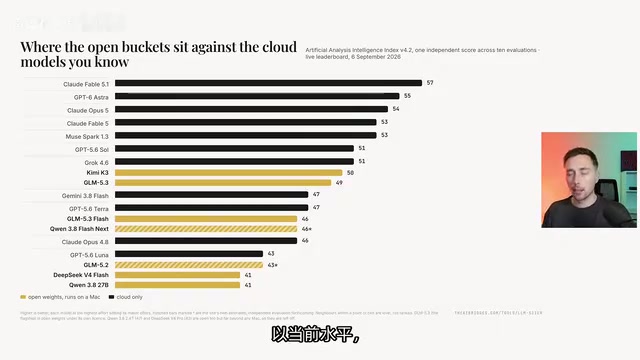
In-depth analysis of Mac memory requirements, inference speed, and costs for running local AI LLMs. From 48GB to 512GB configs — which models fit, how bandwidth affects speed, and local vs. cloud cost comparison.
Perplexity Builds AI Sandbox with Rust: A Deep Dive into the RustConf Technical Talk
Perplexity shares its Rust-built sandbox architecture for its Computer product at RustConf. Explore why Rust is ideal for secure AI execution environments.